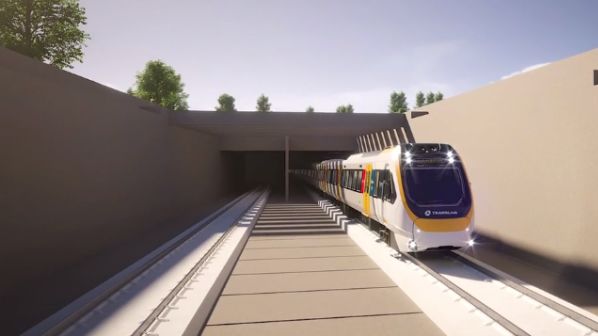
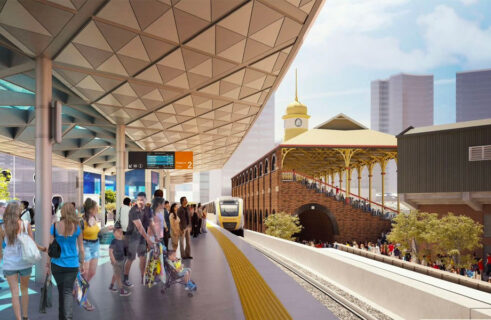
The multi-billion-dollar Cross River Rail project is heavily intertwined with the newly confirmed Brisbane Olympic Stadium at Victoria Park (Barrambin), functioning as the transit backbone for the flagship 2032 venue. Following the Queensland Government’s pivot to the Victoria Park site, the focus has shifted toward seamlessly linking the stadium precinct with the nearby Exhibition Station. Major structural construction at Exhibition Station has officially wrapped up, and the site has been handed over to Queensland Rail for specialized operational testing and event use. This station, which previously only operated during special events like the annual Ekka, is being transformed into a high-capacity, year-round transport hub with direct, dedicated pedestrian links and greenways designed to funnel tens of thousands of spectators straight into the stadium gates.
More broadly, the wider Cross River Rail network is entering crucial systems integration and operational testing phases, positioning it perfectly to handle the massive logistical demands of the 2032 Games. The 10.2-kilometer rail line, featuring 5.9 kilometers of twin tunnels under the Brisbane River and CBD, will unlock massive transport bottlenecks across South East Queensland. While underground station fit-outs, track signaling, and European Train Control System (ETCS) installations progress toward the network’s broader phased launch, the adjacent Victoria Park stadium site has commenced its initial groundbreaking and early earthworks. Together with the trackless Brisbane Metro system, this integrated rail infrastructure ensures that the flagship Olympic arena will be completely accessible from anywhere in the metropolitan region without relying on private vehicles.
May 19, 2026
Brisbane’s Cross River Rail project continues progressing through major construction and systems integration phases in 2026 as Queensland authorities push ahead with one of Australia’s largest rail infrastructure developments. The multibillion-dollar transport project now focuses on station fit-outs, signaling installation, and operational testing across the 10.2-kilometer rail corridor beneath Brisbane’s CBD. Additionally, project teams continue completing above-ground station upgrades and new Gold Coast rail stations linked to the wider network expansion.
The project, originally estimated at $5.4 billion, has experienced substantial scope expansion and cost increases during delivery. Current estimates from multiple Australian reports place total project costs near $12 billion to $19 billion depending on associated infrastructure packages and future rail components. Despite delays, the development remains central to Queensland’s long-term transport modernization strategy ahead of the Brisbane 2032 Olympic Games.
Cross River Rail project reaches major construction and systems milestones
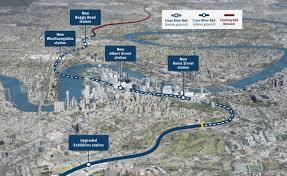
Cross River Rail includes 5.9 kilometers of twin tunnels beneath the Brisbane River and central business district. The scheme also delivers four new underground stations at Boggo Road, Woolloongabba, Albert Street, and Roma Street. Furthermore, the wider program upgrades several surface stations while introducing new signaling technology to improve rail network capacity and reliability.
Current construction updates show crews concentrating on mechanical, electrical, and architectural fit-out works at Roma Street and Albert Street stations. Meanwhile, signaling system testing continues across operational corridors as teams prepare for future commissioning stages. Queensland officials expect rail services to commence by 2029 following extended testing and integration activities.
The project recently reached several milestones, including the reopening of Salisbury Station ahead of schedule and the opening of Hope Island Station on the Gold Coast corridor. Authorities described these achievements as important steps toward expanding regional and commuter connectivity throughout southeast Queensland.
Cross River Rail project supports Australia’s broader rail modernization strategy
Industry observers continue monitoring industrial relations issues affecting the project. Recent inquiry hearings examined disputes involving contractors and trade unions that reportedly contributed to delays and rising costs across several construction packages. Nevertheless, the Queensland Government maintains that the rail development remains critical to Brisbane’s future transport network capacity.
The Cross River Rail project also connects with Australia’s wider rail modernization agenda, including the Melbourne Airport Rail Stage 1 development that recently unveiled early designs for new stations and rail bridge infrastructure. Both projects demonstrate increasing investment in urban rail expansion, accessibility improvements, and long-term congestion reduction strategies across major Australian cities.
Transport analysts expect Cross River Rail to reshape commuter mobility across southeast Queensland once operational. The new tunnel system will allow more frequent train services while reducing congestion through Brisbane’s existing rail bottlenecks. Additionally, the project supports long-term population growth and urban development planning across the region.
Authorities also continue community engagement activities surrounding station precincts and urban integration planning. These consultations focus on accessibility improvements, pedestrian connectivity, and future commercial opportunities around the new transport hubs. Consequently, planners expect the rail corridor to generate broader economic benefits beyond transportation upgrades alone.
Also Read: The WestConnex project in Sydney Australia.
In total, the project will deliver four new underground stations at Boggo Road, Woolloongabba, Albert Street, and Roma Street; two upgraded stations at Dutton Park and Exhibition; six upgraded stations on Brisbane’s southside from Salisbury to Fairfield; and the development of three new Gold Coast stations.
This revolutionary project will improve Australia’s quality of life, assist her economy in continuing to thrive, create thousands of employment, and spark urban growth throughout South East Queensland.
Progress on the Cross River Rail Project
After TBM Merle broke through into the Northern Portal on December 17, 2021, Cross River Rail’s twin tunnels are now entirely excavated. The 5.9km twin tunnels currently connect Dutton Park to Bowen Hills and run beneath the Brisbane River and CBD. The northern cavern at Boggo Road is approaching completion, with nine of ten permanent lining pours completed, 29% of in situ concrete put, and 35% of reinforcing installed. Permanent lining work in the northern cavern and cross passageways resumed at Woolloongabba, while seven of the eleven back of house slabs were finished in the station box. The station box excavation on Albert Street is 90% complete. Work on the cavern bench and invert ground support is also proceeding, as is spoil disposal.
Excavation at the northern station entrance is ongoing, with 13,793 cubic meters (72 %) of spoil removed thus far. Cavern concreting at Roma Street resumed, with the invert slab 86% complete and the kickers 72 % complete. Lift overflow excavation has been finished in the station box, and the internal wall has been constructed in the services building. All retaining wall panels have been installed at the Exhibition, and the FRP superstructure steel girder manufacturing is % complete. At the Southern Portal, 607 (of 635) piles have been put, and capping beam pours are still underway, with 688 of 1,015 lineal meters finished thus far. The microtunnelling project is well underway, with the sixth and final drive already starting.
Excavation along the entrance is 92 % complete (55,000 of 60,000 cubic meters), and the precast roof deck on capping beams is 86 % complete (207 of 240). The inside walls of the Rail Traffic Crew Building at Mayne Yard are 50% complete while signaling roads 9-11 are 88 % complete. At Clapham Yard, 401m of drainage has been laid, and the RW620 piling portion has been completed. 70% of the platform 1 canopy and 60% of the platform 2/3 canopy have been erected at Yeronga.
Project Fact Sheet
Project name: Cross River Rail Project
Location: Brisbane, Queensland, Australia
Project type: Underground heavy rail and urban transport infrastructure
Rail corridor length: 10.2 kilometers
Tunnel length: 5.9 kilometers twin tunnels beneath Brisbane River and CBD
Main stations: Boggo Road, Woolloongabba, Albert Street, Roma Street, Exhibition Station
Additional infrastructure: Gold Coast stations at Pimpama, Hope Island, and Merrimac
Current project stage: Systems integration, station fit-outs, signaling installation, and testing
Estimated completion: 2029 operational target
Initial project value: Approximately $5.4 billion
Current estimated value: Between $12 billion and $19 billion depending on associated packages and revisions
Key infrastructure works: Underground stations, surface station upgrades, rail tunnels, ETCS signaling system
Major benefits: Increased rail capacity, reduced congestion, improved commuter reliability, Olympic transport support
Signaling system: European Train Control System (ETCS)
Construction start: Major works commenced in 2020
Strategic importance: Supports Brisbane 2032 Olympic transport planning and southeast Queensland growth
Project Team
Project owner: Queensland Government
Delivery authority: Cross River Rail Delivery Authority
Rail operator: Queensland Rail
Tunnel and station consortium: Pulse Consortium
Rail integration consortium: Unity Alliance
Signaling technology provider: Hitachi Rail
Major contractors: CPB Contractors and Ghella
Design and engineering partners: Multiple rail, tunneling, and urban infrastructure consultants
Station architecture contributors: HASSELL and associated design teams
Government oversight agencies: Queensland Department of Transport and Main Roads
Community and stakeholder coordination: Brisbane City Council and regional transport authorities
Systems integration teams: Rail signaling and operational testing specialists
Future operations support: Queensland Rail network operations and maintenance teams

Leave a Reply