
The United Kingdom’s ambition to host the world’s first prototype nuclear fusion power station has moved significantly closer to reality since the project was first unveiled in late 2020. What began as a nationwide search for a suitable site has evolved into the government-backed STEP (Spherical Tokamak for Energy Production) program at the former West Burton coal-fired power station in Nottinghamshire.
In 2026, the project entered a new delivery phase following the launch of the UK’s Fusion Strategy. There has also been the award of major engineering and construction contracts, including a £30 million digital engineering agreement with Dassault Systèmes. The continued implementation of a £2.5 billion government funding package announced in 2025 also features in the strategy.
Public consultation and planning activities are also advancing as developers work toward starting construction around 2032, with the prototype fusion power plant targeted to begin generating electricity by 2040. The UK initiative is unfolding amid intensifying global competition, with Germany’s Proxima Fusion simultaneously advancing plans for a commercial stellarator power plant backed by a new €411 million funding round, highlighting Europe’s accelerating race to commercialize fusion energy.
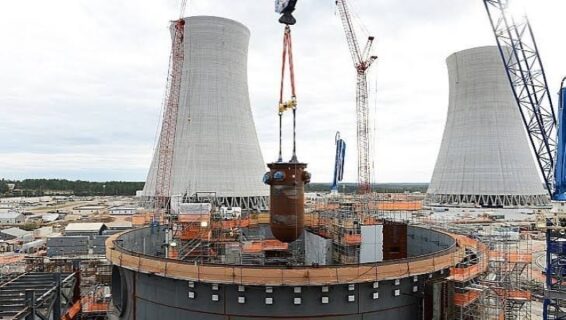
UK inches closer to world’s first nuclear fusion power station
Reported December 3, 2020 – The UK has begun the process towards constructing the world’s first nuclear fusion power station by launching a search for a 100-plus hectare site where it can be plugged into the electricity grid. However, there are still major hurdles to overcome before it could start generating power.
Boris Johnson, the prime minister committed US$267 million to begin research on the possibility of building the project, known as the Spherical Tokamak for Energy Production (STEP). The UK Atomic Energy Authority (UKAEA), the government body overseeing STEP, hopes construction could begin around 2030, with the plant operating as soon as 2040.
Also read: Construction proceeds at Turkey’s first nuclear plant
UK nuclear fusion plant and the target of net zero emissions by 2050
The plant is pitched as an important plank in efforts to hit the UK’s target of net zero emissions by 2050. But fusion faces big challenges to play that role. Reproducing the way the sun makes energy, by fusing hydrogen together to make helium, requires significant energy on Earth to heat and control the hydrogen with huge magnets.
So far, no fusion reactor has yet produced more power than it consumed. That might change in the next 5 years when the world’s biggest fusion project, ITER in France, is due to switch on. The hope is it will turn 50 megawatts of power into 500MW, proving a net gain is possible and this will help the case for the STEP project, however, STEP’s power output goal is more modest, a net gain of 100MW. Unlike ITER, it will be connected to the ordinary electricity grid to understand how a fusion plant operates day in, day out.
Ian Chapman at the UKAEA says the nuclear fusion power station may cost around US$2.67 billion, the equivalent cost in today’s money of building the Joint European Torus (JET), an existing fusion reactor in the UK that was constructed in the 1980s. Francis Livens at the University of Manchester, UK, says the cost and timeline are “ambitious but not implausible”.
Leave a Reply