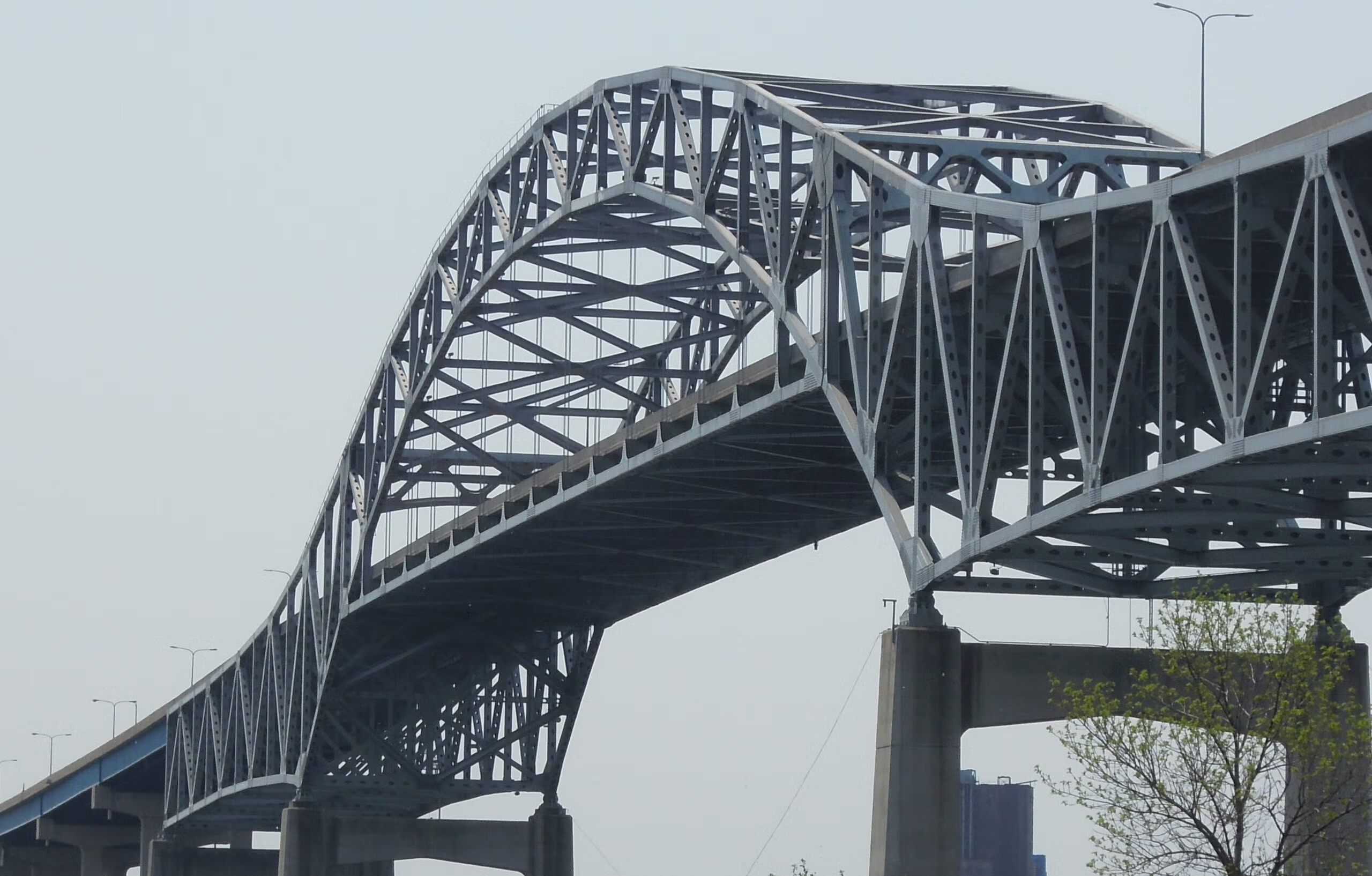
The United States Department of Transportation has officially released $1.05 billion in federal grant funding for the replacement of the John A. Blatnik Bridge. The announcement clears the final financial hurdle for what Superior Mayor Jim Paine has described as the largest transportation infrastructure project in the living memory of any current elected official.
The release, announced on 18 March 2026, unlocks a project that will replace one of the two primary high-capacity fixed crossings between Duluth, Minnesota, and Superior, Wisconsin. Following weeks of pressure from regional senators and representatives, the funding ensures the project can move forward to replace the aging structure, which serves alongside the Richard I. Bong Memorial Bridge as the lifeblood of the Twin Ports’ harbor traffic. Preliminary construction is expected to begin later in 2026, with a full bridge closure anticipated in 2027 to allow for demolition and reconstruction on the same alignment. The new Blatnik Bridge is scheduled to open to traffic in 2031.
The Bridge, the Bay, and the Stakes of Replacement
The John A. Blatnik Bridge has carried Interstate 535 across St. Louis Bay since 1961. While the Bong Bridge (US-2) serves as a vital high-capacity link, the Blatnik remains the only Interstate-grade crossing between the two cities. More than 33,000 vehicles cross the bridge daily, including approximately 265,000 trucks annually transporting nearly $4 billion in goods. This freight volume reflects the bridge’s role as a critical node in the Upper Midwest’s supply chain, connecting Minnesota’s Iron Range, Wisconsin’s industrial corridor, and the Port of Duluth-Superior to the national highway network.
Project Fact Sheet: Blatnik Bridge Replacement
- Project Name: John A. Blatnik Bridge Replacement (I-535 over St. Louis Bay)
- Location: St. Louis Bay, connecting Duluth, MN and Superior, WI
- Total Project Cost / Federal Grant: $1.05 billion (USDOT grant; Bipartisan Infrastructure Law)
- Lead Agency: Minnesota Department of Transportation (MnDOT)
- Partner Agency: Wisconsin Department of Transportation (WisDOT)
- Current Bridge: Opened 1961; carries I-535
- Replacement Strategy: New bridge built on the same alignment
- Existing Bridge Disposition: Demolition required early in the process to make room for the new structure
- Full Bridge Closure Start: 2027 (lasting several years)
- Detour Route: Richard I. Bong Memorial Bridge (US-2)
- Project Completion: 2031
Construction Logistics and Alignment
Unlike projects where a new span is built alongside the old one, the Blatnik replacement will be constructed on the same alignment as the current bridge. This requires a complete demolition of the existing 1961 structure before the new bridge can be finished. Consequently, a full closure beginning in 2027 is unavoidable. During this period, all traffic will be diverted to the Richard I. Bong Memorial Bridge, located approximately one mile to the west. This creates a significant traffic management challenge that local governments and freight operators are currently working to mitigate.
The Politics of the Grant Release
The $1.05 billion grant was originally designated under the Biden administration through the 2021 Bipartisan Infrastructure Law. However, the Trump administration’s Department of Transportation, under Secretary Sean Duffy, held the funds for review through early 2026.
In early March 2026, Senators Tina Smith, Amy Klobuchar, and Tammy Baldwin sent a formal joint letter to Secretary Duffy demanding the immediate release of the funds, warning that delays were increasing project costs. Following the release, Congressman Pete Stauber (MN-08) and Congressman Tom Tiffany (WI-07) also welcomed the funding, noting the bridge’s critical importance to the regional economy.
Regional Impact: Superior and the Twin Ports
While the project affects both sides of the bay, the city of Superior, Wisconsin, faces a particularly heavy impact. Businesses and industrial corridors in Superior rely on the Blatnik for direct Interstate access and heavy freight movement. While Duluth’s Lincoln Park neighborhood will also see disruption, Superior’s local economy is bracing for a multi-year shift in traffic patterns.
Transportation planners are working with the City of Superior, the City of Duluth, and Douglas and St. Louis Counties to develop traffic frameworks that preserve mobility. The Port of Duluth-Superior, which handles over 35 million tonnes of cargo annually, remains a key stakeholder in these discussions to ensure the “Bong-only” period does not result in prohibitive operational costs for regional commerce.
A Generation of Infrastructure Renewal
The Blatnik replacement is a proactive investment in safety. Rather than waiting for a catastrophic failure, MnDOT and WisDOT are replacing a 60-year-old structure that was never designed for modern vehicle sizes or today’s massive traffic volumes. For the 33,000 daily users and the regional freight economy, the March 18 funding release marks the moment this essential project finally moved from the drawing board to reality. The same federal funding framework is simultaneously enabling similarly consequential bridge renewals elsewhere in the country, including the $595 million replacement of New Jersey’s 166-year-old Raritan River Bridge on the North Jersey Coast Line — a critical commuter rail link serving more than 11,000 daily passengers, now under construction by Skanska with completion targeted for 2029.



Leave a Reply