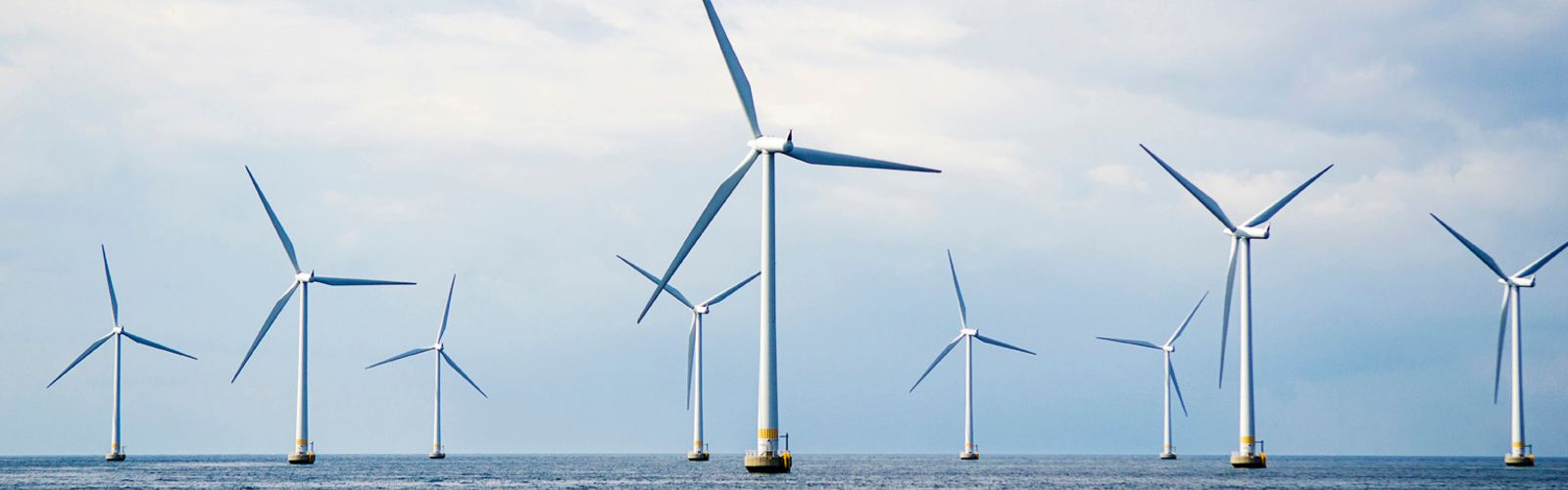
The joint venture between ORLEN Group and Northland Power has successfully completed the installation of all 78 foundations at the Baltic Power offshore wind farm, marking a pivotal moment for Poland’s energy transition. This campaign, executed approximately 23 kilometers off the coast of Choczewo, is notable not just for being Poland’s first commercial-scale offshore wind project, but for its speed. The heavy-lift operations were finalized in just four months—a pace that underscores the efficiency of the specialized marine spread employed. With the steel now in the seabed, the 1.2 GW project remains firmly on track to power over 1.5 million Polish households by 2026.
Heavy Lift Logistics and XXL Steel
The “Jobsite Impact” of this phase was defined by the deployment of Van Oord’s iconic heavy-lift vessel, the Svanen. Known for its immense gantry crane, the Svanen was tasked with driving the massive XXL monopiles into the Baltic seabed. These steel piles, manufactured by Steelwind Nordenham, are engineering marvels in their own right—weighing up to 2,400 tonnes and measuring 120 meters in length (taller than the Statue of Liberty).
This level of specialized maritime engineering mirrors other major energy projects, such as the 3.6 GW Dogger Bank Wind Farm, where Seaway7 recently wrapped up a massive installation campaign to bolster the North Sea’s renewable capacity.
Baltic Power Offshore Wind Farm: Factsheet
Project Name: Baltic Power
Location: Baltic Sea (approx. 23km north of Choczewo, Poland)
Developers:
ORLEN Group (51% – Poland)
Northland Power (49% – Canada)
Total Capacity: 1.2 GW (1,140 MW)
Total Investment: ~€4.73 Billion
Construction Team (EPCI & Key Suppliers):
Foundations (T&I): Van Oord (using HLV Svanen).
Monopile Fabrication: Steelwind Nordenham (Germany).
Transition Piece Fabrication: Smulders (Belgium/Poland).
Turbine Supplier: Vestas (76 x V236-15.0 MW units).
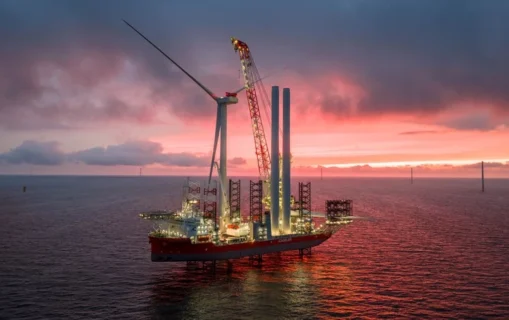
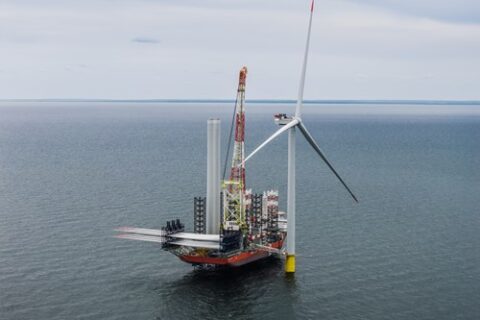
Turbine Installation: Cadeler.
Offshore Substations (OSS): Bladt Industries (now CS WIND Offshore) & Semco Maritime.
Onshore Substation EPC: GE Vernova (consortium with Enprom).
Export Cables: NKT.
Technical Scope:
76 Wind Turbine Foundations (Monopiles).
2 Offshore Substation Foundations.
Total: 78 Foundations.
Timeline:
Foundations Complete: Feb 2026.
Commercial Operations: Expected 2026.
Following the piling, the secondary steel work involved the installation of Transition Pieces (TPs), fabricated by Smulders. These yellow visible sections serve as the interface between the submerged pile and the wind turbine tower. The logistical precision required to coordinate the arrival of these components from marshalling ports to the installation vessel, while battling the unpredictable autumn/winter weather windows of the Baltic Sea, highlights the mature capabilities of the supply chain partners involved.
Next Steps: Cables and Turbines
With the foundations secure, the construction focus now shifts to the “nervous system” of the wind farm. The next major scope is the installation of the inter-array and export cables, which will connect the 76 turbines to the two offshore substations and subsequently to the onshore grid. Once the subsea cabling is laid, the stage will be set for Cadeler to mobilize its jack-up vessels for the installation of the 76 massive Vestas V236-15.0 MW turbines, some of the most powerful units currently available on the market.
Leave a Reply