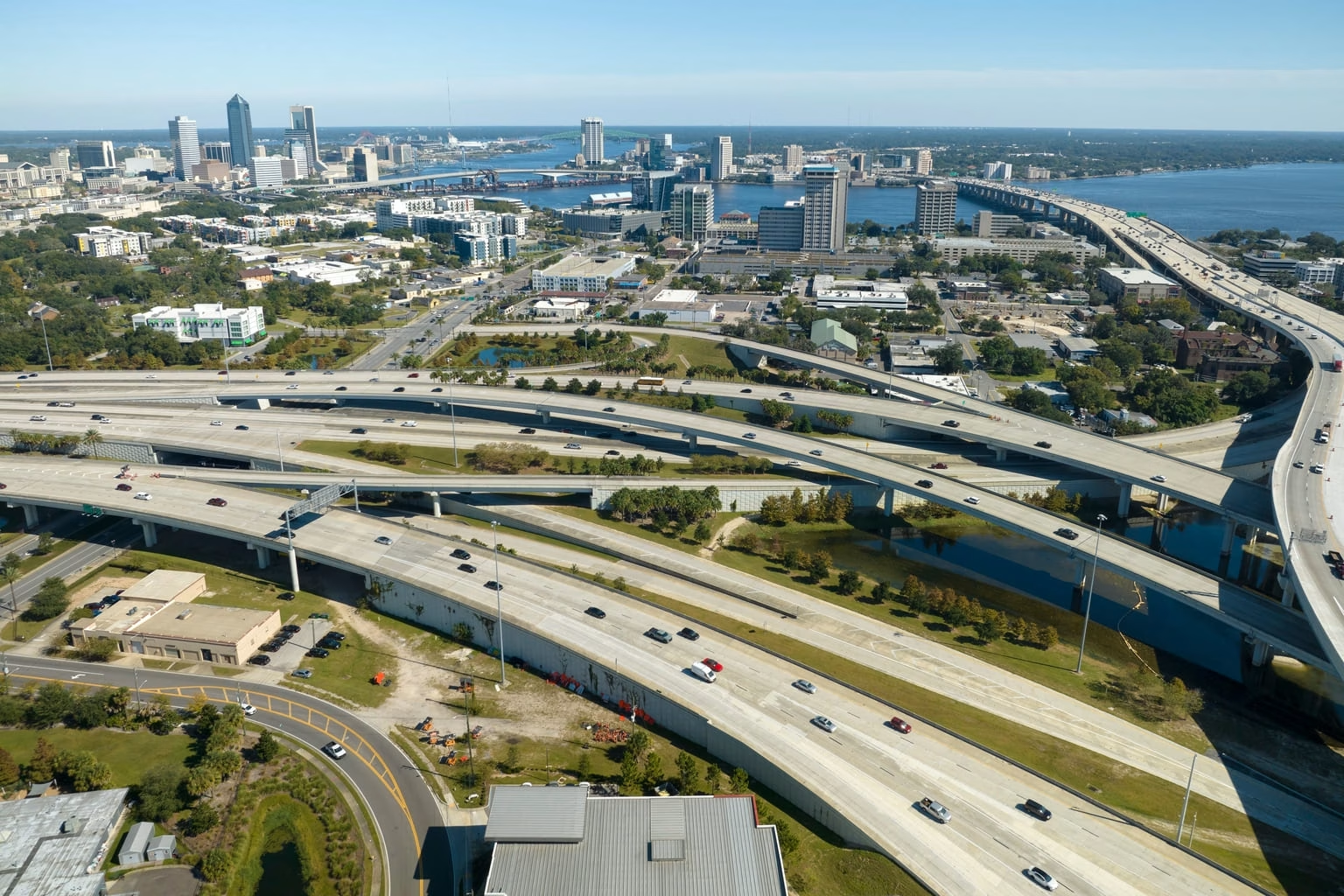
Major construction has officially commenced on the long-awaited overhaul of Tampa’s Westshore Interchange, a massive infrastructure overhaul designed to untangle one of Florida’s most notorious traffic bottlenecks. The Florida Department of Transportation (FDOT) marked the milestone this week, greenlighting the Superior-Lane Joint Venture (SLJV) to begin the heavy civil work on the project. While the total program value is estimated at nearly $1 billion, the joint venture—comprising American firm Superior Construction and Webuild Group subsidiary Lane Construction—recently secured the pivotal $643 million construction contract to execute the transformation. The project aims to modernize the convergence of Interstate 275, State Road 60, and the Veterans Expressway, a critical node that currently serves over 400,000 vehicles daily.
The Westshore Interchange project is more than just a capacity expansion; it represents a strategic redesign of the region’s transportation backbone—an overhaul paralleling legislative acceleration efforts elsewhere, such as the California Governor signing AB 697 to accelerate Highway 37 upgrades. For decades, the interchange has been a source of frustration for commuters and freight operators alike, suffering from weaving traffic patterns and outdated geometry that caused severe congestion during peak hours. The new design focuses on smoothing these traffic flows by widening lanes, adding general-use and tolled express lanes, and replacing the outdated loop ramp from westbound SR 60 to northbound I-275 with modern flyover structures. These upgrades are projected to significantly improve travel time reliability for residents and the millions of tourists visiting the Gulf Coast.
Westshore Interchange Project: Factsheet
Project Name: Westshore Interchange Reconstruction (I-275/SR 60)
Location: Tampa, Florida (Hillsborough County)
Owner/Client: Florida Department of Transportation (FDOT) District 7
Contractor: Superior-Lane Joint Venture (SLJV)
Partners: Superior Construction (USA) and Lane Construction (Webuild Group subsidiary)
Construction Contract Value: $643 Million
Total Program Value: ~$1 Billion
Start Date: January 2026
Estimated Completion: December 2029
Daily Traffic Volume: ~400,000 vehicles
Key Infrastructure Elements:
Direct express lane ramps to Tampa International Airport.
Replacement of SR 60 loop ramp with flyovers.
Three new local street underpasses (Reo, Occident, Trask Streets).
Integration with Howard Frankland Bridge express lanes.
New pedestrian and bicycle shared-use paths.
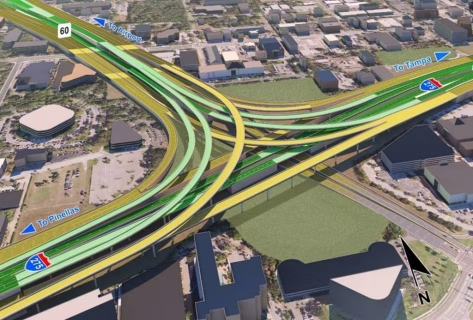
Beyond the highway improvements, the project includes a significant community restoration component designed to heal the urban fabric severed by the original interstate construction. Planners have prioritized “reconnecting communities” by incorporating three new underpasses at Reo Street, Occident Street, and Trask Street. These new local connections will allow residents to cross underneath the massive highway infrastructure safely, linking neighborhoods north and south of the corridor that have been isolated from one another for years. This approach aligns with broader federal and state trends to ensure major infrastructure projects provide benefits to the local neighborhoods they traverse, rather than just the vehicles passing through.
Enhancing Connectivity to Tampa International Airport
A centerpiece of the reconstruction is the creation of a seamless, direct connection to Tampa International Airport (TPA), a major economic engine for the region. The updated interchange will feature dedicated express lane ramps that allow drivers to bypass local traffic and head straight into the airport terminals from the highway. This is expected to be a game-changer for travelers, decoupling airport traffic from the local commuter grid and reducing the backups that frequently spill onto the interstate. The design also integrates with the northern end of the Howard Frankland Bridge project, creating a continuous flow of express lanes from St. Petersburg directly into the Westshore business district and the airport.
The project also places a heavy emphasis on multimodal transportation, moving away from a car-only focus to include robust facilities for pedestrians and cyclists. The construction plan involves building miles of new sidewalks and shared-use paths that will connect with existing regional trail networks. These additions are vital for the Westshore District, which is not only a transit hub but also Florida’s largest employment center, hosting thousands of workers who currently lack safe options for walking or biking to work. By integrating these “Complete Streets” elements, FDOT aims to transform the area into a more accessible, urban-friendly environment.
With the heavy equipment now rolling, the Superior-Lane Joint Venture faces a complex timeline that is scheduled to run through December 2029. The team must execute this massive reconstruction while keeping hundreds of thousands of cars moving through the heart of Tampa every day, a logistical challenge that required extensive planning during the pre-construction phase. Ryan Hamrick, the project director for SLJV, noted that the team evaluated nearly 90 innovative solutions to maximize taxpayer value and minimize disruptions. Once complete, the new Westshore Interchange will stand as the largest infrastructure project ever delivered by FDOT’s District 7, securing the region’s mobility for decades to come.
Leave a Reply