
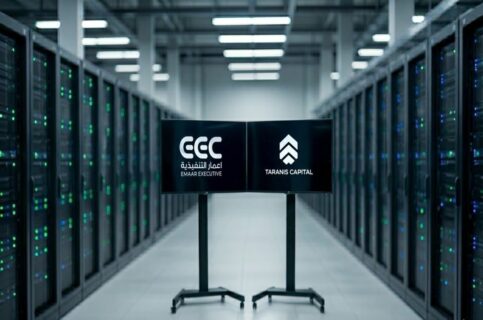
The Carrier-Neutral data centers project in Saudi Arabia has entered a new development phase. Taranis Capital and Emaar Executive Company (EEC) are preparing the first 50MW AI-ready hyper scale campus. The development forms part of a wider program targeting $2 billion in committed capital.
The program will support next-generation carrier-neutral data center facilities across Saudi Arabia. EEC recently confirmed that its Taranis agreement covers the initial 50MW AI-ready hyper scale data center campus. The company said preparations are underway to begin design and development.
This represents the latest progress since the companies signed their memorandum of understanding in April 2026. Their partnership covers the development, construction, and operation of multiple data center facilities.
Carrier-Neutral Data Centers Project Moves Toward 50MW Campus Development
The Carrier-Neutral Data Centers Project will initially focus on a 50MW hyper scale campus. However, the broader program targets facilities with 40MW to 50MW capacities per site.
The facilities will support hyper scalers, cloud providers, enterprises, and increasingly demanding artificial intelligence workloads. Their designs will incorporate advanced cooling technologies and flexible infrastructure.
The facilities will also support high-density computing environments, including workloads using next-generation NVIDIA GPU architectures. This approach reflects the rapidly increasing power requirements of AI computing.
EEC will provide engineering, procurement, construction, design, and operational capabilities for the program. Meanwhile, Taranis Capital will lead investment structuring and its investor network.
The investment firm is developing the program through the Taranis Data Centre Fund KSA. The fund targets $2 billion in committed capital for Saudi Arabia’s data center infrastructure market.
Carrier-Neutral Data Centers Project Targets AI Infrastructure Growth
The Carrier-Neutral Data Centers Project comes as Saudi Arabia accelerates its AI and digital infrastructure expansion.
EEC has also disclosed discussions with other market participants for another 50MW development. That additional capacity remains separate from the confirmed Taranis-linked 50MW campus.
Together, the two opportunities give EEC a potential 100MW development pipeline. However, only the initial 50MW campus currently falls under the Taranis agreement.
The Kingdom’s wider data center market is also attracting several large AI infrastructure developments.
For instance, HUMAIN and DataVolt recently announced a 100MW AI-ready facility at Oxagon in NEOM. Construction has already started on that development. The market is also seeing new infrastructure platforms beyond conventional hyper scale developments.
Desert Technologies and CTS Group launched the CTS-DT data center project in Saudi Arabia. The venture targets 300MW of annual data center infrastructure capacity initially. It can eventually scale to 1.2GW annually.
Importantly, the 300MW figure represents annual production capacity. It does not represent a single 300MW data center. These developments demonstrate Saudi Arabia’s expanding ecosystem for AI-focused digital infrastructure.

Project Status and Next Steps
The initial 50MW campus remains in the design and development preparation stage. EEC has not publicly confirmed physical construction commencement for the Taranis-linked facility.
The partners have also not disclosed the first campus location, construction contractor, completion date, or commercial operation date.
The project will therefore require further development approvals, detailed design, procurement, financing, and construction before operations begin.
However, the latest EEC update marks a clear progression beyond the April memorandum stage. It also strengthens the Kingdom’s pipeline of AI-ready, carrier-neutral digital infrastructure.
Saudi Arabia’s National Data Center Strategy continues to support this market expansion. The strategy seeks to strengthen the Kingdom’s position in cloud computing and artificial intelligence infrastructure.
Carrier-Neutral Data centers project expands capacity in Saudi Arabia
The Carrier-Neutral data centers project will deliver multiple campuses sized between 40MW and 50MW per site across Riyadh, Jeddah, and Dammam. These facilities will support hyper scale and multi-tenant operations. Furthermore, the Saudi Investment Promotion Authority is expected to facilitate licensing and regulatory approvals for the program. This support streamlines project execution and accelerates construction timelines.
Saudi Arabia is expanding from a relatively modest installed base. S&P Global reports 222MW of live IT load as of Q1 2025, with projections reaching 760MW by 2030. Additionally, the National Data Centre Strategy launched in June 2025 targets up to 1.5GW of capacity by 2030. Therefore, the new campuses directly support national digital infrastructure goals. Consequently, developers are aligning site selection with connectivity corridors and subsea cable landing points. These locations ensure low latency and strong network performance.
Carrier-neutral data centers project targets dense compute
The Carrier-Neutral data centers project in Saudi Arabia emphasizes carrier-neutral campuses designed for dense compute environments and flexible tenant requirements. These facilities will accommodate advanced AI workloads. Moreover, engineering teams will integrate high-efficiency cooling systems and adaptable data halls to support next-generation racks. Nvidia-driven AI deployments are among the expected use cases.
Carrier-neutral infrastructure allows tenants to access multiple telecom networks, cloud platforms, and redundancy options within a single site. This flexibility strengthens operational resilience. Meanwhile, Emaar Executive Company contributes engineering, procurement, construction, and operational expertise to the program. Taranis Capital provides investment structuring and access to global capital.
As a result, the partnership combines financial capability with local execution strength. This integration supports efficient delivery of complex mission-critical infrastructure. Public deal summaries highlight a supply gap in Saudi Arabia’s data center market. Demand from hyper scalers, enterprises, and digital platforms continues to outpace available multi-tenant capacity.
In August 2025, Humain’s initial data centers in Riyadh and Dammam were expected to launch at 100MW each. Therefore, the 40MW to 50MW campuses rank among upper-tier commercial developments.
Policy support accelerates data centers project delivery
Saudi policy frameworks continue to encourage foreign investment and public-private collaboration in digital infrastructure. This approach supports long-term project viability. Trade.gov notes strong government backing for localization partnerships and infrastructure investment. Consequently, developers benefit from a favorable regulatory environment.
Another major signal includes DataVolt’s $20 billion partnership with Supermicro, reinforcing the national push toward large-scale compute infrastructure. Meanwhile, Dubai-based investors are increasingly moving into mission-critical assets, including data centers. This shift reflects confidence in Saudi Arabia’s growing digital economy.
At the same time, local contractors are expanding their role in delivering complex infrastructure projects. This trend supports domestic industry growth and knowledge transfer. However, the Taranis and Emaar Executive Company agreement remains at the memorandum stage. Developers must still secure financing, finalize sites, and attract anchor tenants.
Nevertheless, market fundamentals remain strong. Saudi Arabia’s data center demand is rising rapidly, supported by AI adoption, cloud expansion, and digital transformation. In conclusion, the data centers project in Saudi Arabia represents a critical step in scaling regional digital infrastructure and strengthening construction sector pipelines.
Meanwhile, the Gulf continues to expand its infrastructure pipeline across sectors. For instance, the education-led development highlights similar cross-border investment momentum, as seen in the UAE–India collaboration on the IIT Abu Dhabi campus project which highlights how strategic partnerships are shaping construction activity across the region.
Project Fact Sheet
Name: Saudi Arabia Carrier-Neutral Data Centers Project
Type: AI-ready carrier-neutral data center infrastructure
Location: Saudi Arabia
Investment Target: $2 billion
Initial Confirmed Capacity: 50MW
Planned Capacity per Campus: 40MW–50MW
Initial Campus Type: AI-ready hyper scale data center
Additional EEC Pipeline: Another 50MW under advanced discussions
Potential EEC Pipeline: 100MW
Target Users: Hyper scalers, cloud providers, enterprises, and AI operators
Infrastructure Model: Carrier-neutral
Target Workloads: Artificial intelligence, cloud computing, and high-performance computing
Cooling: Advanced cooling technologies
GPU Support: Next-generation NVIDIA GPU architectures
Development Model: Develop, construct, and operate
Investment Vehicle: Taranis Data Centre Fund KSA
Investment Target: $2 billion in committed capital
Current Status: Design and development preparation
Construction Status: Physical construction not publicly confirmed
Strategic Objective: Expand Saudi Arabia’s AI and digital infrastructure capacity
Project Team
Investor: Taranis Capital
Data Center Development Partner: Emaar Executive Company (EEC)
Investment Vehicle: Taranis Data Centre Fund KSA
EPC Partner: Emaar Executive Company
Engineering Partner: Emaar Executive Company
Design Partner: Emaar Executive Company
Operations Partner: Emaar Executive Company
Investment Structuring: Taranis Capital
Investor Network: Taranis Capital
Regulatory Support: Saudi Investment Promotion Authority (SIPA)
Additional Development Pipeline: Emaar Executive Company
Additional AI Infrastructure Partner: Magna AI
AI Infrastructure Scope: Sovereign AI data centers and AI Factory infrastructure


Leave a Reply