
Jin’an-Jinsha River Bridge remains a major engineering landmark within China’s expanding expressway network in Yunnan Province. The 1,386-metre main-span suspension bridge carries the Chengdu-Lijiang Expressway across the Jinsha River near Lijiang.
Construction began in 2016, while the bridge reached structural completion in January 2020. It subsequently opened to traffic on December 31, 2020, forming part of the wider Chengdu-Lijiang Expressway corridor.
Jin’an-Jinsha River Bridge strengthens Yunnan highway connectivity
Jin’an-Jinsha River Bridge forms part of the Huaping-Lijiang Expressway, also known as the Huali Expressway. The route improves road connectivity between Lijiang and Panzhihua while supporting broader regional transport links.
The bridge crosses the Jinsha River in an area characterized by steep mountains and deep river valleys. Its deck stands approximately 335 meters above the river under full conditions.
The bridge also features a substantial cable system designed for construction across difficult mountainous terrain. Its cable crane spans more than 1,000 meters, making it a significant construction feature for the project.
The wider expressway required extensive tunneling because of the surrounding mountainous landscape. The road rises westward from the Jinsha River gorge towards Lijiang.
Consequently, the expressway combines major bridges with long tunnels to overcome steep elevation changes. This engineering approach reduces travel barriers across Yunnan’s complex terrain.
The Jin’an-Jinsha River Bridge therefore represents more than an isolated bridge project. It forms part of a wider transport corridor designed to improve regional mobility and economic connections.
China expands strategic road infrastructure
The bridge’s role also fits within China’s continuing investment in strategic road infrastructure. The country is now advancing the $55bn Golden Outer Ring Highway program under its 15th Five-Year Plan.
The program will build and upgrade approximately 27,000 kilometers of roads between 2026 and 2030. It will strengthen three major national highways, G219, G331 and G228, across border and coastal regions.
The Golden Outer Ring Highway project will involve highway construction, reconstruction, bridges, tunnels and supporting transport facilities.
Although the Jin’an-Jinsha River Bridge does not form part of the Golden Outer Ring routes, both developments demonstrate China’s continued focus on major road connectivity.
Meanwhile, the Huali Expressway provides important transport infrastructure within southwestern China. It helps address longstanding connectivity challenges created by the Jinsha River and surrounding mountains.
The bridge also supports access to Lijiang, an important tourism destination in Yunnan. Improved road connectivity can facilitate tourism movement and regional freight transportation.
Engineering challenges continue to shape China’s mountainous highway construction. Projects in these areas require specialized bridge structures, tunnel systems and construction methods.
Jin’an-Jinsha River Bridge demonstrates how large-span structures can overcome geographical barriers within major highway corridors. Its completion consequently contributed to the broader development of Yunnan’s expressway network.
Also Read: California to construct World’s largest highway overpass for wildlife
Huaping-Lijiang Expressway
Completion of the Jin’an-Jinsha River Bridge project is a milestone for the expected completion of the entire Huali Expressway project.
The Huali expressway begins a long rise west out of the Jinsha River gorge from a bridge deck elevation of 1,760m towards Lijiang city’s elevation of 2,400m, gaining elevation largely by punching in and out of several long tunnels.
It is reported that after the project is fully completed, it will fill the gaps in the east-west layout of the expressway networks in Lijiang city and Panzhihua city, making travel between Yunnan and Sichuan more convenient, and at the same time promoting the export of industrial crops and tourism in Lijiang.
A previous plan for the Huali expressway would have taken travelers across an even higher bridge about 20km to the south near the village of Taku.
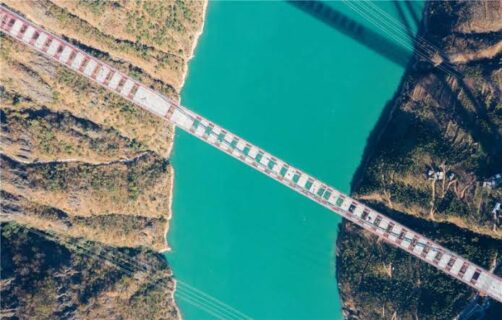
Project Fact Sheet
Project: Jin’an-Jinsha River Bridge
Location: Lijiang, Yunnan Province, China
River crossed: Jinsha River
Bridge type: Steel suspension bridge
Main span: 1,386 meters
Total bridge length: Approximately 1,678 meters
Maximum deck-to-river drop: Approximately 335 meters
Bridge construction start: 2016
Structural completion: January 2020
Traffic opening: December 31, 2020
Expressway: G4216 Chengdu-Lijiang Expressway
Wider corridor: Huaping-Lijiang, or Huali, Expressway
Engineering feature: More than 1,000-metre-span cable crane
Strategic purpose: Improve highway connectivity across southwestern China
Regional benefit: Strengthen transport links around Lijiang and Panzhihua
Current status: Operational
Previous distinction: Formerly described as the world’s largest-span suspension bridge
Current distinction: One of China’s major long-span mountain suspension bridges
Project Team
Owner: Yunnan Huali Expressway Investment and Development Co., Ltd.
Highway Program: Huali Expressway project authorities
Bridge Construction: China Communications Construction Company Limited (CCCC)
Engineering Design: Broadvision Engineering Consultants
Construction Supervision: Huali Expressway project supervision team
Transport Oversight: Yunnan Provincial Department of Transport
Regional Coordination: Lijiang municipal authorities
Infrastructure Integration: Chengdu-Lijiang Expressway project authorities

Leave a Reply