
The Port Authority of New York and New Jersey (PANYNJ) has announced service cuts as the construction phase of the $3.5 billion AirTrain Newark replacement project begins, a cornerstone of the agency’s EWR Vision Plan. Groundbreaking for the 2.5-mile automated people mover took place in late 2025, marking the start of a multi-year effort to replace the airport’s aging monorail system, which has been in operation since 1996.
The project is designed to address the terminal’s rapid growth, welcoming nearly 50 million passengers in 2024, and will eventually increase daily ridership capacity from 33,000 to 50,000 passengers. Slated for completion in 2030, the new system will provide a more reliable, high-tech connection between terminals and parking facilities. Additionally, linking the Northeast Corridor rail link, effectively eliminating the current 15-minute walk to the new Terminal A.
AirTrain Newark Replacement: Factsheet
Project Name: AirTrain Newark Replacement Program
Location: Newark Liberty International Airport (EWR), NJ
Total Cost: $3.5 Billion
Owner: Port Authority of New York and New Jersey (PANYNJ)
Lead Contractors: * Tutor Perini/O&G Joint Venture: Guideway and Stations ($1.184B).
Doppelmayr: APM System, Vehicles, and Operations.
Stantec: Maintenance Facility and Decommissioning Design.
Key Specs: * 2.5-mile elevated automated people mover.
3 new climate-controlled stations.
50,000 daily passenger capacity.
Timeline: * Groundbreaking: October 2025.
Construction: Ongoing (2026).
Completion/Passenger Service: 2030.
Strategic Goal: Replace outdated 1996 monorail and support EWR Vision Plan.
Building the elevated Guideway and New Stations
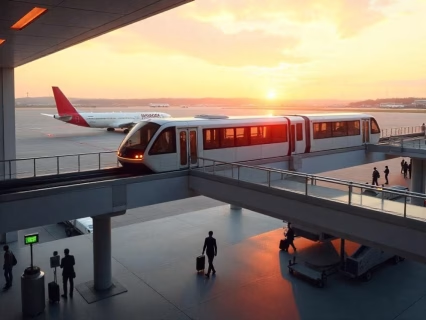
The centerpiece of the construction effort is a new 2.5-mile elevated rail structure, or guideway. It will support cable-propelled, automated trains. A joint venture between Tutor Perini and O&G Industries was awarded the $1.184 billion design-build contract for the guideway and three state-of-the-art stations. These new stations are engineered to be climate-controlled and fully integrated with modern wayfinding and digital amenities.
Unlike the current system, the new alignment is designed to be expandable to accommodate future terminal redevelopments. Furthermore, ensuring the infrastructure remains resilient as the airport transitions through its next decade of growth. As of early 2026, site preparation and initial foundation work for the elevated columns are underway across the central terminal area.
Advanced Technology and Maintenance Infrastructure
To power the new transit system, the Port Authority selected Doppelmayr, a global leader in cable-propelled transport, to design and manufacture the automated vehicles. Doppelmayr will also be responsible for the long-term operation and maintenance of the system. Supporting this fleet is a new 70,000-square-foot Maintenance and Control Facility (MCF), designed by Stantec. This facility will house the system’s nerve center and provide the necessary infrastructure for the fleet’s upkeep.
The project also includes four new pedestrian connectors that will link the stations to the terminals via climate-controlled passageways with moving walkways. Further enhancing the seamless “curb-to-gate” experience envisioned by airport leadership.
Maintaining Continuity Amid Construction
Ensuring that Newark Liberty remains fully operational during construction is a primary logistical challenge. The existing AirTrain will continue to serve passengers throughout most of the build, though strategic partial outages are planned to facilitate construction activity. Starting this month, commuters will experience daily service adjustments between the Airport Train Station and the terminals. What’s more, shuttle buses will fill the gaps during off-peak windows.
This phased transition allows crews to work on new alignments and station foundations without severing the airport’s vital link to NJ Transit and Amtrak services—a critical project prioritized as the New York Port Authority unveils a decade-long $45bn spend on the Capital Plan. Additionally, the Port Authority is using this development period to pilot autonomous shuttle technology, with testing slated to begin later this year. This innovation runs parallel to other regional modernization efforts, such as Governor Hochul awarding $101M for New York rail and port modernization, which aims to enhance safety, improve climate resiliency, and bolster economic development across the state’s freight and maritime networks.
Leave a Reply