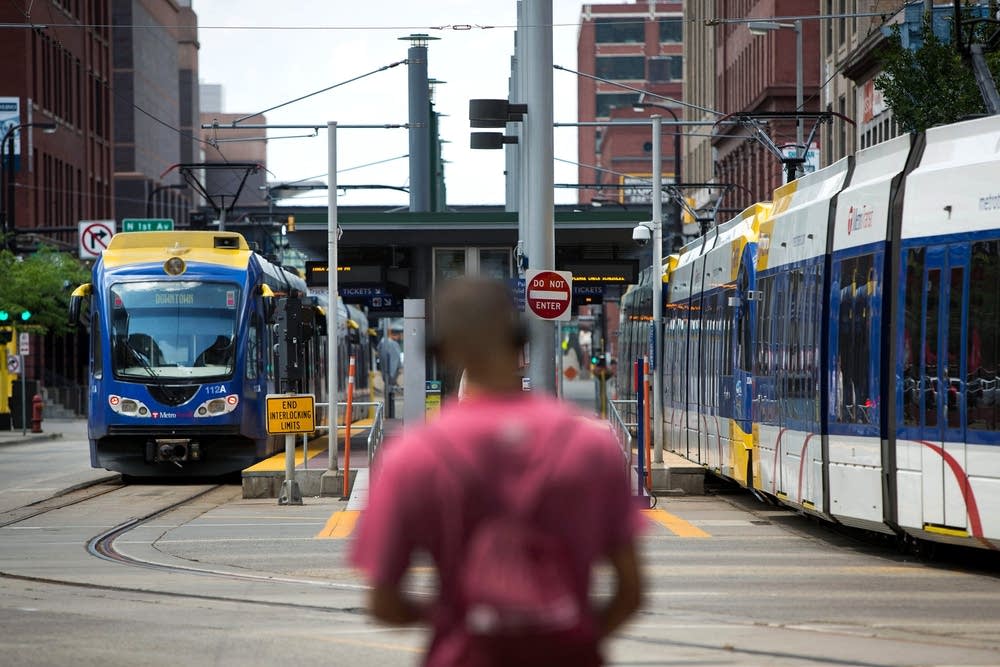
The Blue Line light rail extension project, Minnesota’s most expensive public works undertaking, faces a deepening financial crisis as the Metropolitan Council confirms a fresh $336 million cost surge, pushing the total budget to nearly $3.6 billion. The extension, which would carry light rail from downtown Minneapolis north to Brooklyn Park, originally carried a price tag of just $1 billion.
Furthermore, the project has now moved past the Federal Risk Assessment process, and engineering plans are nearing 90 percent completion. Nevertheless, the revised budget has ignited fierce political debate and renewed calls to abandon the rail plan entirely in favor of cheaper bus alternatives. The Blue Line light rail extension cost increase exposes the extraordinary challenge of delivering major urban transit infrastructure amid relentless inflation, scope changes, and uncertain federal support.
Blue Line Light Rail Extension Cost Increase Driven by Design Changes and Contingency
The additional expense stems from project changes requested by cities through which the 13.4-mile line would pass, as well as the need for contingency funds to cover inflation. Specifically, changes include adding a station at Washington Avenue and West Broadway, redesigning the Lowry Avenue Station, and improving road connections in the North Loop area to offset traffic losses on 10th Avenue North.
Additionally, the new budget carries a large contingency fund of 32 percent to account for economic volatility and uncertainty. Consequently, officials stress the estimate reflects a fully matured design. Budget estimates were last issued in 2024, when only 30 percent of engineering was finished; at that point, the Met Council estimated the base cost at approximately $2.2 billion. Moreover, final design will continue through 2026, with major construction anticipated to begin in 2027, and the project expects to apply for a Full Funding Grant Agreement with the Federal Transit Administration in 2026.
Blue Line Light Rail Extension Cost Increase Sparks Political Backlash
Meanwhile, the revised figure has drawn sharp criticism from Republican legislators. House Transportation Chair Jon Koznick declared the situation should give policymakers serious pause, arguing that 30 bus rapid transit lines could be built for $3 billion. Furthermore, Koznick pointed out that an arterial bus line serving the same corridor costs approximately $120 million, compared to the $3.6 billion light rail option.
However, Metro Transit warned that switching to bus rapid transit would mean starting almost from scratch and would delay construction until 2030 at the earliest, wasting hundreds of millions already spent on light rail design. Conversely, Hennepin County officials maintain the extension will connect tens of thousands of transit-dependent residents to work, school, and healthcare, while driving economic investment and new housing construction.
Equally important, light rail ridership has declined in recent years, with Metro Transit still grappling with changing commuting patterns and safety perceptions. Therefore, supporters argue the long-term transit equity case remains strong. Hennepin County Commissioner Irene Fernando described the project as a generational equity investment in communities of colour that have historically been underinvested in.
Federal Funding Remains the Critical Uncertainty
The Republican-controlled White House and Congress have significantly clouded prospects for the federal investment necessary to mount such a costly project. Nevertheless, the Blue Line Extension team is working to develop construction contract procurement documents for solicitation in 2026.
Additionally, Metropolitan Council and Hennepin County have decided to deliver the project through multiple contract packages, with major construction included in a single civil, track, systems, and stations package using a Design-Bid-Build Best Value procurement method. Thus, even as political pressure mounts, project partners are pressing forward with construction readiness.
The pattern of ballooning costs is not new to Minnesota’s light rail program. Workers on the Southwest Light Rail project, the Green Line Extension connecting downtown Minneapolis to Eden Prairie were already installing track in Hopkins as far back as 2021, yet that project also ran significantly over its original budget before completion. The Blue Line extension has already eclipsed the $3 billion Green Line Extension, which is on target to open next year. Thus, the Blue Line repeats a costly trajectory that Minnesota transit planners had vowed to avoid
Project Fact Sheet
Project name: METRO Blue Line Extension Light Rail Transit Project
Location: Minneapolis, Robbinsdale, Crystal, and Brooklyn Park, Minnesota, USA
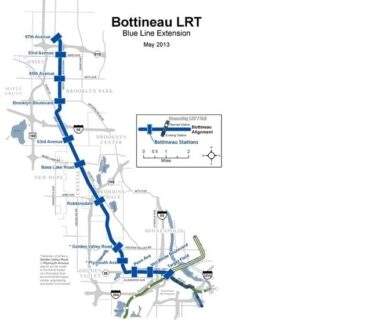
Route: 13.4 miles northwest from Target Field Station in downtown Minneapolis to Oak Grove Parkway near the Target North Campus in Brooklyn Park
Total estimated cost: $3.6 billion, updated June 2026
Previous cost estimate (2024, 30% design): approximately $2.2 billion base cost; $2.9–$3.2 billion including contingency
Cost increase: $336 million above the 2024 estimate
Original projected cost: approximately $999 million–$1 billion
Contingency fund: 32% of total budget, incorporated to account for inflation and economic volatility
Key scope additions driving the increase: new Washington Avenue and West Broadway station; redesigned Lowry Avenue Station; North Loop road connection improvements; community-requested design changes from Municipal Consent process
Design status: 90% design completed May 2026; 100% design expected by fall 2026
Construction start: anticipated 2027
Projected completion: 2032
Rider service commencement: anticipated 2033 (previously forecast 2030)
Projected daily ridership: 30,000+ on the full Blue Line, adding 11,500–13,000 new daily rides
Federal funding pathway: Full Funding Grant Agreement application to the Federal Transit Administration planned for 2026; federal approval not yet secured
Procurement method: Design-Bid-Build Best Value; construction procurement solicitation to begin 2026
Stations: Multiple stations across Minneapolis, Robbinsdale, Crystal, and Brooklyn Park corridors
Connection: Links to existing Blue Line (Mall of America to Target Field) and Green Line at Target Field Station
Accessibility benefit: Up to 50% of new riders expected to come from car-free households
Alternative studied: Arterial Bus Rapid Transit along the same corridor, estimated at approximately $120 million; bus option would delay service to 2030 at the earliest
Project office location: Park Place West Building, Suite 600, 6465 Wayzata Boulevard, St. Louis Park, MN 55426
Project Team
Lead agency: Metropolitan Council (Met Council), St. Paul, Minnesota
Co-lead agency: Hennepin County
Project office: METRO Blue Line Extension Project Office, led jointly by Metro Transit and Hennepin County staff
Engineering and design oversight: Metropolitan Council and Hennepin County project staff, with constructability reviews conducted in partnership with the Minnesota Department of Transportation (MnDOT) and Metro Transit construction staff
Federal oversight: Federal Transit Administration (FTA)
Environmental review: FTA signed off on an Amended Record of Decision (AROD) in 2025, completing the federal environmental review process
Major construction contractor: To be appointed

Leave a Reply