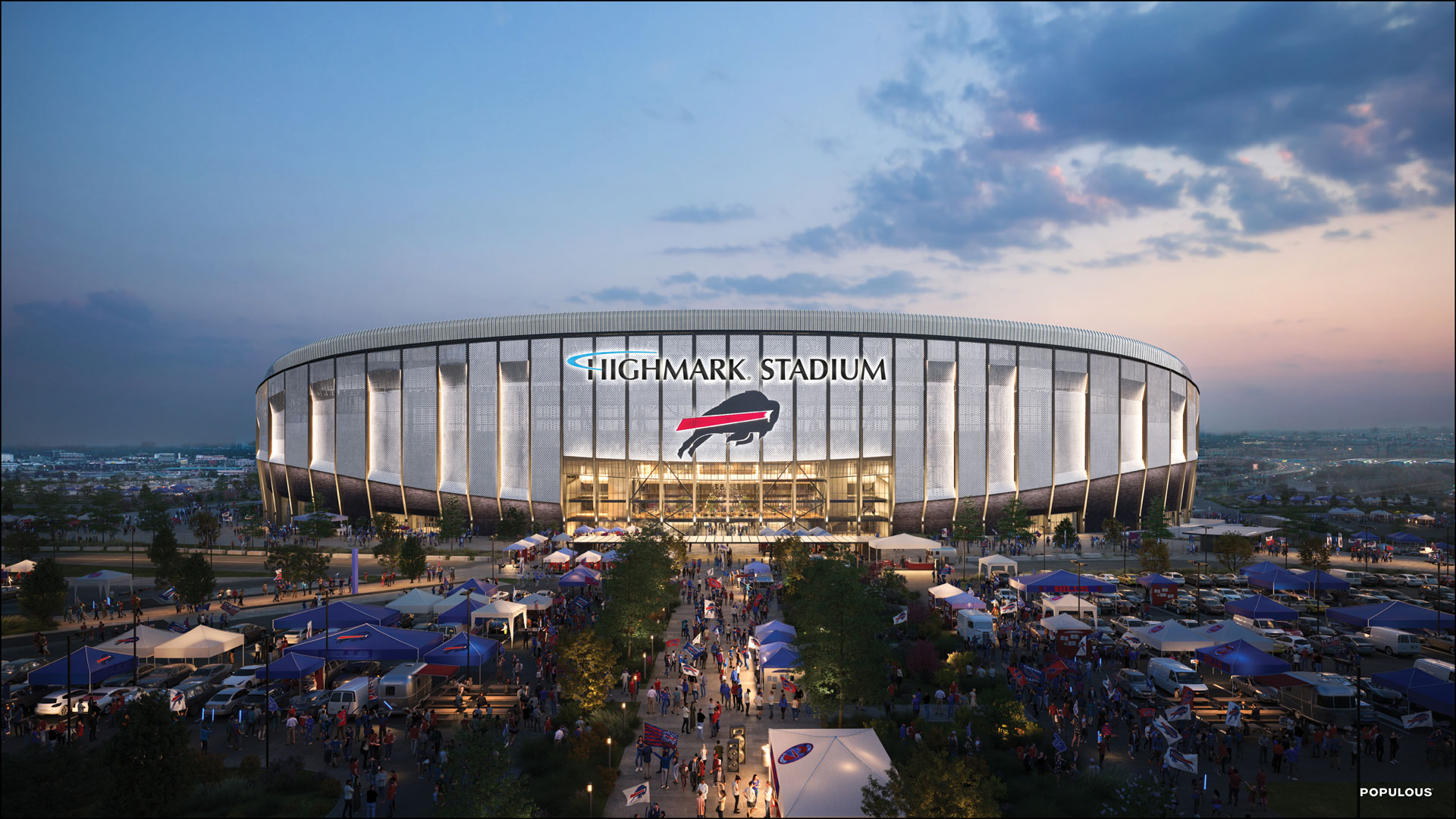
The Buffalo Bills’ $2.2 billion New Highmark Stadium in Orchard Park, New York has hit two significant milestones simultaneously in March 2026: the installation of all exterior perforated metal panels is now complete, giving the facility its finished façade for the first time, and the stadium has crossed the 90 per cent completion threshold with approximately 140 days remaining before its scheduled opening. With more than 1,500 construction workers operating on a 24-hours-a-day, seven-days-a-week schedule, the project is on track for the Bills to receive the keys to the building in June 2026, formal transfer of title from Erie County to New York State by 1 August, and the first football event — the annual Blue and Red scrimmage — in early August. The stadium, which replaced an expansive series of parking lots directly across Abbott Road from the team’s previous home, is the most expensive NFL stadium ever built and the centrepiece of one of the largest sports infrastructure investments in New York State history.
The Exterior Panel Story: Engineering, Aesthetics, and the Lake Erie Wind
The completion of the exterior panels is far more than a cosmetic milestone. The 4,400-plus perforated metal panels that now wrap the stadium structure were selected and engineered specifically to address one of the most persistent challenges of watching football in western New York: the cold, unrelenting wind that blows in off Lake Erie and across the open terrain of Orchard Park. The panels are designed to diffuse and reflect wind before it reaches spectators in the bowl, softening the aerodynamic impact on the seating areas without fully enclosing the stadium — a balance that preserves the traditional outdoor football atmosphere that Bills Mafia has celebrated through decades of legendary weather-defiant attendances at the old Highmark Stadium. Beyond their functional wind management role, the perforated panels give the stadium its sleek, contemporary visual identity — a dark, textured skin that will be lit dynamically for game-day events and that positions the building as a landmark visible across the flat Erie County landscape.
Project Fact Sheet: New Highmark Stadium
Project Name: New Highmark Stadium (Buffalo Bills NFL Stadium)
Location: Abbott Road, Orchard Park, Erie County, New York, USA
Total Project Cost: $2.2 billion
Seating Capacity: ~62,000
Construction Start: June 2022 (site preparation); vertical construction from 2023
Exterior Panels Milestone: All 4,400+ perforated metal panels installed, March 2026
Completion %: >90% as of March 2026
Keys Transferred to Bills: June 2026 (expected)
Title Transfer (ECSC → New York State): By 1 August 2026
First Event: “Return of the Blue and Red” scrimmage, early August 2026
First Preseason / Regular Season Game: Summer/Fall 2026 (schedule TBC)
Construction Workforce: 1,500+ workers on site; 24/7 schedule
Funding Sources: Bills/NFL ~$550M; New York State ~$600M; Erie County ~$250M; revenue bonds and other financing
Playing Surface: Natural grass
Predecessor: Old Highmark Stadium (1973–2026, 71,608 seats) — slated for demolition
Significance: Most expensive NFL stadium ever built at time of construction
Project Team: New Highmark Stadium
NFL Franchise / Owner: Buffalo Bills (Terry Pegula, owner)
Bills COO / President of Business Operations: Pete Guelli
Public Entity: Erie County Stadium Corporation (ECSC)
ECSC President: Steve Ranalli
State Development Partner: Empire State Development (New York State)
Architect: Populous (lead design architect)
General Contractor: Turner Construction Company
Structural Engineer: Thornton Tomasetti
MEP Engineer: Arup
Project Management: Legends Global Planning (owner’s representative)
The choice of perforated metal panelling connects New Highmark to a lineage of recent NFL stadium designs that have prioritised active, designed relationships with local climate rather than simply sealing against it. Populous, the stadium’s lead architect, and Turner Construction, the general contractor, together navigated a design and construction sequence in which the panel installation — requiring precise sequencing to ensure the structural framing was ready to accept the panel systems — ran concurrently with interior fit-out works across multiple levels of the building. The fact that all panels are now in place means the building’s weathertight envelope is effectively closed, allowing interior finishing trades to accelerate through the winter months without exposure risk.
The Team Behind the Build and the Governance Structure
New Highmark Stadium is being delivered under one of the more complex public-private development structures in recent US stadium history. The Erie County Stadium Corporation (ECSC) — a public benefit corporation affiliated with Empire State Development — was established as the legal entity to receive, hold, and ultimately transfer the stadium to New York State. Steve Ranalli, ECSC’s president, has been the public face of the construction programme throughout its three-year execution, providing regular status updates and coordinating between the County, the State, and the Bills. Pete Guelli, the Bills’ chief operating officer and president of business operations, leads the franchise’s side of the project and has been equally visible in communicating construction progress and opening timelines to fans and media.

Turner Construction Company is the general contractor, executing what is one of the largest vertical construction programmes currently underway in the northeastern United States. Populous, the Kansas City-based architecture firm with the largest portfolio of NFL stadium designs of any firm in the world, served as design architect. The project’s $2.2 billion cost is funded through a mixture of sources: the Bills and the NFL contributed approximately $550 million in private capital, New York State committed $600 million, Erie County committed $250 million, and the remaining balance was drawn from a combination of stadium revenue bonds and other financing instruments — a public-private split that became one of the most debated sports infrastructure deals in recent American political history. The original cost at the time of the 2022 agreement was $1.4 billion; the figure has risen to $2.2 billion over the course of design development, scope refinement, and construction inflation.
What the New Stadium Delivers: Capacity, Technology, and Fan Experience
New Highmark Stadium has been designed from first principles as a football-first facility — a deliberate strategic choice by the Bills in a market where the multipurpose events business, while commercially attractive, can conflict with the turf quality and configuration that optimal game-day football requires. The stadium seats approximately 62,000 spectators in the bowl, marginally fewer than the previous Highmark Stadium’s 71,608-seat capacity, but with a significantly improved sightline geometry that concentrates seating closer to the field and wraps the bowl more steeply. The grass playing surface — another deliberate choice against the artificial turf trend — is one Pete Guelli has emphasised publicly, with the Bills committed to ensuring that the surface condition for the first game is not compromised by premature multi-purpose use.
The stadium incorporates a partial roof canopy over the seating bowl that, in combination with the exterior panel wind management system, addresses the atmospheric conditions that historically made late-season and playoff football at the old stadium both legendary and occasionally uncomfortable. The technology infrastructure includes the largest LED videoboard system in NFL history at the time of its design specification, immersive audio systems calibrated for the bowl’s acoustics, and a digital fan engagement platform integrated with the stadium’s WiFi and cellular network. Concourse design reflects years of fan feedback on the previous stadium: wider circulation paths, improved food and beverage positioning, and expanded premium and club spaces that bring Highmark into alignment with the broader NFL stadium experience that fans increasingly benchmark against newer venues in Las Vegas, Los Angeles, and Atlanta.
The New NFL Stadium Landscape and What Highmark Means for Orchard Park
The opening of New Highmark Stadium in August 2026 will complete one of the most significant renewal cycles in NFL infrastructure history. Within a decade, the league will have seen new or substantially rebuilt stadiums open in Las Vegas (Allegiant Stadium, 2020), Los Angeles (SoFi Stadium, 2020), Buffalo, and — under active construction or planning — Kansas City, Tennessee, and potentially Cleveland, where the Browns have unveiled a $2.4 billion proposal for a new stadium in Brook Park adjacent to Cleveland Hopkins International Airport, featuring a design that descends approximately 80 feet into the ground and would anchor a broader entertainment district exceeding $1 billion in additional development. The NFL’s stadium investment wave reflects a strategic reality: the gap in revenue-generating capability between a modern purpose-built venue and a 1970s-era facility has become so wide that it directly affects team competitiveness, as the league’s revenue sharing model allows local stadium revenues to sit outside the shared pool.
For Orchard Park and wider Erie County, the arrival of the new stadium is a generational economic event. The construction programme alone has generated thousands of Western New York jobs across building trades, materials supply, professional services, and support functions. The stadium’s operational phase will sustain employment in hospitality, security, facilities management, and the broader entertainment economy of the Buffalo metropolitan area. The old Highmark Stadium — operational from 1973 to the Bills’ final game there in January 2026 — is slated for demolition in the coming months, its footprint returning to the Orchard Park landscape and creating the opportunity for potential ancillary development adjacent to the new facility. For Bills Mafia, the most passionate fanbase in the NFL by many measures, the moment the blue and red scrimmage kicks off in early August will be the culmination of a wait that began with the financing agreement signed in Albany in March 2022.
Leave a Reply