
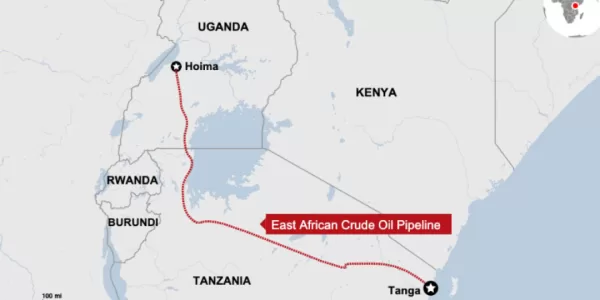
The East African Crude Oil Pipeline (EACOP) is a cross-border pipeline project under development to transport crude oil from Uganda to Tanzania’s coastline. The project forms part of a broader set of pipeline developments being undertaken across Africa.
Standard Bank indicated that it expected to participate in the financing of the planned $5 billion project, which had attracted interest from multiple investors. The project also faced opposition from environmental groups, who called on financial institutions to reconsider their involvement.
EACOP is one of several inter-country pipeline projects under development in Africa. Other pipelines include the Nigeria-Morocco Gas Pipeline and the Egypt-Israel Pipeline Project.
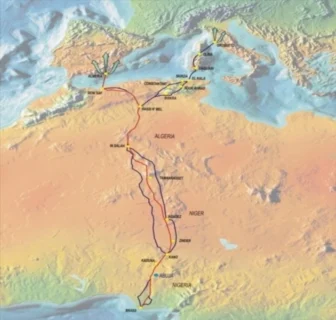
Other than the EACOP pipeline project, the Trans-Sahara gas pipeline project has also made significant advancements over the past few days. The nation’s state-owned Sonatrach has sent a delegation to Niger to advance talks on the monumental project. According to the official Algerian news agency, the visit focuses on technical and operational details ahead of the pipeline’s operational launch immediately after Ramadan.
The project, which was first proposed in the 1970s, will connect Nigeria’s gas fields in Warri to Algeria’s Hassi R’Mel. Moreover, it will link into existing pipelines that supply European markets. The project has delayed for decades despite advancements from involved nations to ensure it full-scale development.
With technical oversight now underway, the long-stalled trans-Sahara pipeline appears closer than ever to reality. The collaboration between Nigeria, Niger, and Algeria could finally deliver a decades-old vision of a West-to-North Africa gas corridor.
Other Advancements
Talking of the Egypt-Israel Pipeline Project, Egypt has approved the construction of the pipeline from its side, at a cost of $400 million. Egypt is usually a large gas consumer, and despite having significant gas reserves of its own, it is struggling to meet its energy needs. Therefore, gas from Israel is crucial to its economy. Also it is an alternative to the even more expensive liquefied natural gas (LNG).
In the same way the Egypt-Israel pipeline is crucial for Egypt’s economy, so is EACOP to Uganda’s economy. EACOP will boost economy of Uganda by allowing the landlocked country to monetize its discovered oil reserves in the Lake Albert region. Without a pipeline to an international port, the crude oil would be difficult and costly to transport, limiting its value.
Cost of EACOP Pipeline
The EACOP project, which is expected to cost a price of $5 billion, has a total length of 1,443 kilometer-long (897 miles) and will be constructed from landlocked Uganda to the Tanga port in Tanzania. The oil pipeline is expected to bring crude from the Lake Albert project in Uganda to the international oil market. It is designed to transport a total of 216,000 barrels of crude oil daily, with a ramp-up of up to 246,000 bpd, Uganda revealed.
Size of the EACOP Pipeline
The EACOP pipeline, which is set to be the largest in Africa, is a part of Uganda’s comprehensive plan to develop its overall- oil resources.
The EACOP project is currently being developed and will also be operated by EACOP Ltd, a company comprising of the local branch of French supermajor TotalEnergies, as well as UNOC, the Tanzania Petroleum Development Corporation (TPDC), and the China National Offshore Oil Company (CNOOC).
Amid the prevailing controversies and continued calls on banks to halt the financing of oil and gas exploration and infrastructure development, Standard Bank hired in the year 2021 an independent adviser to help it come up with a decision on whether to accept or reject involvement in this ambitious project. The project has been strongly criticised by rights activists and environmental groups and has also faced criticism in the European Parliament.
EACOP Pipeline Funding to be Supported by Standard Bank
The bank has completed its years-long environmental and due diligence review, the chair of Standard Nonkululeko Nyembezi revealed to Bloomberg during an interview that was published on Thursday.
“We have all the lenders on deck,” the executive added.
Field developments are currently ongoing and TotalEnergies could make an announcement regarding the pipeline in the months to come, Nyembezi told Bloomberg, adding that there is “complete commitment on the part of the sponsors of the oil projects to get it executed.”
EACOP Faces Opposition
The groups – Darwin Climax Coalitions, Sea Shepherd France, Wild Legal and Stop EACOP-Stop Total – say that TotalEnergies is liable for charges including destruction, damage or deterioration of property belonging to others likely to create a danger to persons, and failing to deal with a disaster.
Human Rights Watch in July urged a halt to the project, saying the project has “devastated thousands of people’s livelihoods in Uganda and will exacerbate the global climate crisis”.
TotalEnergies says that those displaced by the project have been fairly compensated, and measures have been taken to protect the environment.
Furthermore, the project involves drilling around 400 oil wells in Murchison Falls Nature Park, a biodiversity reserve and Uganda’s largest national park.
Lastly, Ugandan President Yoweri Museveni has vowed to proceed, saying the East African country’s economy will benefit from the project.
Project Overview
- Project Type: Crude oil export pipeline
- Estimated Cost: ~$5 billion
- Total Length: ~1,443 km
- Capacity:
- Initial: 216,000 barrels per day (bpd)
- Peak: ~246,000 bpd
- Objective: Transport crude oil from Uganda to international markets
Key Developers
- Project Company: EACOP Ltd
- Shareholders:
- TotalEnergies
- Uganda National Oil Company
- Tanzania Petroleum Development Corporation
- China National Offshore Oil Corporation
Location & Route
- Origin: Lake Albert region, Uganda
- Terminus: Tanga Port, Tanzania
- Corridor: Cross-border pipeline linking inland oil fields to the Indian Ocean
Financing
- Expected Lenders: Multiple international financiers
- Key Bank: Standard Bank (potential participant)
- Status: Due diligence completed; financing discussions ongoing
Status
- Stage: Under development
- Field Activities: Ongoing
- Implementation: Advancing toward full execution
Scope
- Transportation of crude oil from Uganda’s oil fields
- Integration with export terminal at Tanga
- Development of associated upstream oil fields
Environmental & Social Context
- Project has attracted responses from environmental and human rights organizations
- Concerns raised regarding environmental impact and community displacement
- Project sponsors indicate mitigation measures and compensation frameworks are in place
Strategic Significance
- Enables Uganda to export crude oil to global markets
- Reduces reliance on costly alternative transport methods
- Supports regional energy infrastructure development
- Forms part of broader inter-country pipeline developments in Africa
Related Pipeline Developments
- Nigeria-Morocco Gas Pipeline
- Egypt-Israel Gas Pipeline
- Trans-Saharan Gas Pipeline
Bottom of Form
Also read: $3 Billion to be Sought for EACOP Debt Financing
East African Crude Oil Pipeline (EACOP) Above Ground Installations Commence
