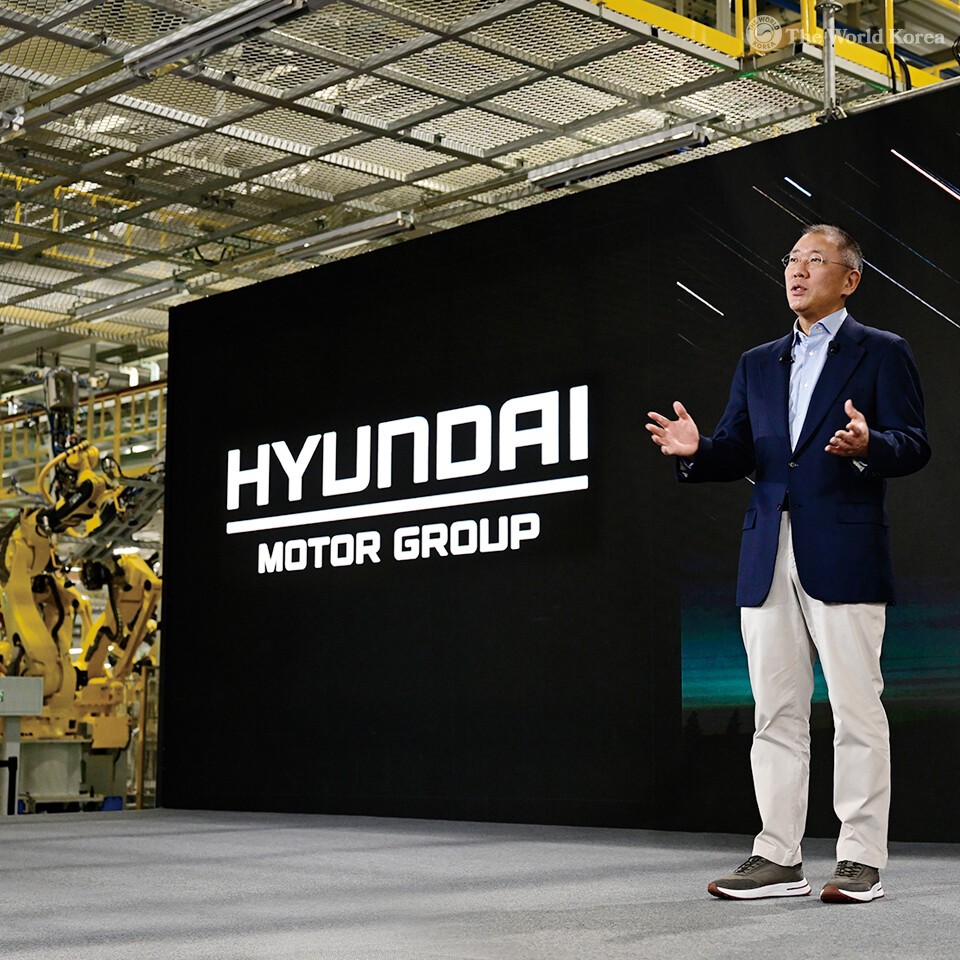
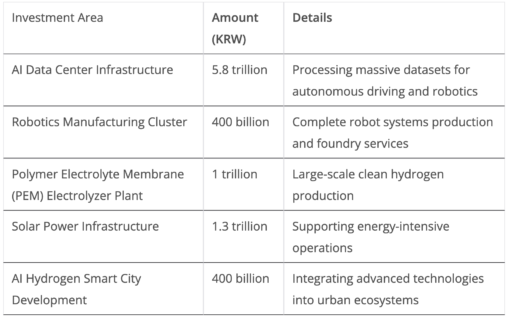
Hyundai Motor Group Innovation Hub will anchor South Korea’s next phase of industrial transformation, as Hyundai Motor Group commits $6.3 billion to robotics, physical AI, and hydrogen energy in Saemangeum. The large-scale investment will consolidate advanced laboratories, AI data centers, hydrogen production facilities, and robot manufacturing plants within an integrated innovation campus in Korea.
Hyundai Motor Group Innovation Hub to Accelerate Physical AI
First, the Hyundai Motor Group Innovation Hub will focus on physical AI robots designed for real-world industrial environments. Moreover, engineers will integrate advanced sensors, mobility systems, and adaptive intelligence into next-generation robotic platforms. Therefore, the group aims to commercialize humanoid and logistics robots at scale.
In addition, the company will expand robotics capabilities through Boston Dynamics to strengthen embodied AI development. Consequently, autonomous robots will operate in factories, logistics hubs, and construction sites. Meanwhile, AI researchers will refine real-time learning models for machine perception and movement optimization.
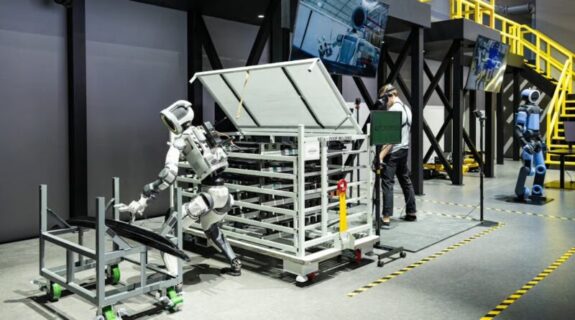
Robotics and AI Convergence at the Hyundai Motor Group Innovation Hub
The innovation hub will connect robotics hardware with high-performance AI computing systems. Furthermore, the campus will include a large AI data center to process simulation and operational datasets. As a result, robots will continuously learn from digital twin environments and field deployments.
Simultaneously, AI teams will develop advanced algorithms for autonomous vehicles and smart mobility systems. Therefore, vehicle platforms will integrate robotics intelligence for manufacturing precision and predictive maintenance. In turn, production efficiency will increase while operational costs decline.
The group will also link physical AI with smart factory automation frameworks. Consequently, manufacturing plants will adapt to fluctuating demand without major reconfiguration. This model will strengthen Korea’s competitiveness in advanced manufacturing.
Hydrogen Integration within the Hyundai Motor Group Innovation Hub
Hydrogen energy will form a central pillar of the Hyundai Motor Group Innovation Hub. Notably, the investment will support hydrogen production, storage, and fuel cell system development. Therefore, engineers will scale hydrogen technologies for commercial vehicles and stationary power systems.
Moreover, the hub will coordinate with national energy stakeholders to expand refueling infrastructure. As a result, hydrogen mobility ecosystems will mature alongside clean industrial power solutions. In addition, the initiative will contribute to South Korea’s carbon neutrality strategy.
The group will leverage its HTWO hydrogen brand to unify research and commercialization. Consequently, fuel cell stacks and hydrogen solutions will move rapidly toward industrial deployment. This integration will position Korea as a leading hydrogen technology exporter.
Regional Development and Economic Impact
Importantly, the innovation Hub will stimulate regional economic growth in Saemangeum. Furthermore, the $6.3 billion investment will create high-skilled employment across robotics engineering and AI software development. Therefore, local universities and startups will benefit from expanded collaboration opportunities.
In parallel, the campus will host research partnerships with domestic and international institutions. Consequently, innovation clusters will emerge around robotics, hydrogen systems, and digital mobility technologies. This synergy will accelerate commercialization timelines and attract global investors.
Government agencies will support regulatory frameworks that enable pilot programs and smart infrastructure deployment. As a result, Korea will strengthen its strategic position in physical AI and hydrogen innovation.
Global Competitiveness and Long-Term Outlook
The Hyundai Motor Group Innovation Hub will reinforce the company’s leadership in next-generation mobility. Moreover, integrated robotics and hydrogen research will reduce time-to-market for advanced solutions. Therefore, the group will respond effectively to global demand for automation and clean energy systems.
In addition, embodied AI development will differentiate Hyundai’s industrial capabilities from global competitors. Consequently, the company will scale robotic platforms across automotive, logistics, and energy sectors. This initiative signals a decisive transition toward intelligent and sustainable industrial ecosystems.
South Korea’s broader clean energy expansion also includes large-scale nuclear generation projects designed to stabilize long-term power supply. Notably, the government recently advanced plans for additional reactors under its national energy roadmap, as detailed in Two New Nuclear Reactors Planned in South Korea as Energy Demand Grows. The initiative complements the Hyundai Motor Group Innovation Hub strategy by strengthening the country’s baseload electricity capacity to support hydrogen production, AI data centers, and robotics manufacturing.
Project Fact Sheet: Hyundai Motor Group Innovation Hub
- Project Name: Hyundai Motor Group Innovation Hub
- Location: Saemangeum, Republic of Korea
- Developer: Hyundai Motor Group
- Total Investment: $6.3 billion
- Primary Focus: Physical AI robots, robotics manufacturing, AI data center, hydrogen energy systems
- Core Technologies: Humanoid robots, logistics robots, machine learning platforms, hydrogen fuel cells, and smart factory systems
- Key Facilities: AI data center, robot production lines, hydrogen production and storage units, R&D laboratories
- Strategic Objective: Establish global leadership in robotics, embodied AI, and hydrogen mobility
- Economic Impact: High-skilled job creation, regional industrial cluster development, export growth.
Project Team: Hyundai Motor Group Innovation Hub
Owner
- Hyundai Motor Group – Project owner and master developer responsible for capital allocation, strategic direction, and overall delivery governance.
Project Sponsor
- Hyundai Motor Company – Lead automotive sponsor overseeing robotics integration, AI commercialization, and hydrogen mobility alignment.
- Kia Corporation – Strategic co-sponsor supporting smart manufacturing deployment and next-generation mobility platforms.
Strategic & Technology Partners
- Boston Dynamics – Robotics technology partner leading development of humanoid and industrial physical AI systems.
- Korea Advanced Institute of Science and Technology (KAIST) – Research collaboration on AI algorithms, robotics autonomy, and machine learning optimization.
- Saemangeum Development and Investment Agency – Regional development authority coordinating land, infrastructure, and regulatory facilitation.
- HTWO Fuel Cell Business Unit (Hyundai Motor Group) – Hydrogen systems integration and commercialization partner.
Government & Institutional Stakeholders
- Ministry of Trade, Industry and Energy – Policy alignment, industrial strategy support, and hydrogen ecosystem coordination.
- Jeollabuk-do Provincial Government – Local government partner supporting infrastructure and workforce development.
Main Contractors & Engineering Delivery
- Hyundai Engineering & Construction – EPC lead for site development, industrial facilities, and core infrastructure.
- Hyundai Engineering Co., Ltd. – Engineering contractor for hydrogen production systems and energy facilities.
- Hyundai Robotics – Robotics manufacturing contractor for production line installation and automation systems integration.
- Hyundai Rotem – Industrial systems contractor supporting advanced manufacturing and hydrogen mobility infrastructure.
Leave a Reply