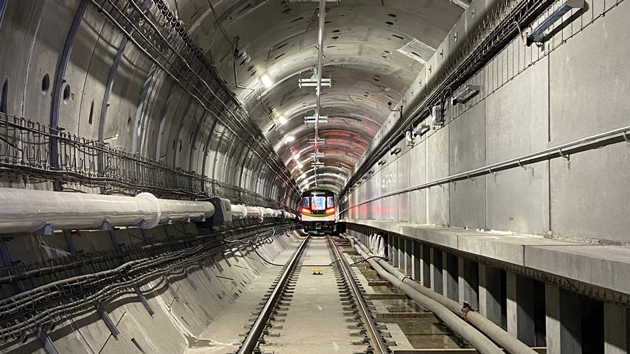
Officials at Montreal Trudeau International Airport have confirmed that construction of the airport’s highly anticipated light rail station is approximately 80 per cent complete and remains on budget and on schedule, with an expected opening in late 2027. The $600 million station, which will form the final segment of the greater Montreal area’s Réseau express métropolitain network, is being built 40 metres underground directly beneath the airport terminal. When fully operational, the station is projected to serve around seven million passengers annually, representing roughly 20 per cent of the 35 million yearly travellers the airport anticipates handling by 2035.
Walls, Wiring and an Iceberg: What Is Happening Underground Right Now
Project Director Steeve Bouffard led media representatives into the unfinished station in April 2026, providing a rare ground level look at progress inside the tunnel environment. Workers on mechanical lifts were actively engaged with the wall systems and electrical infrastructure, while tracks ran north and south through the tunnel with open sky still visible through sections of the unfinished ceiling above. Among the remaining tasks is the completion of a signature architectural feature that will give the station its visual identity: a striking design element intended to evoke the form of an iceberg, an artistic gesture that connects the subterranean station to Canada’s northern landscape and climate heritage.
Bouffard was candid about the complexities still ahead, noting that coordination between the airport authority and the REM organisation, each of which carries responsibility for distinct portions of the project, presents an ongoing logistical challenge. Tight physical spaces and compressed timelines add further pressure. Despite these factors, he confirmed that the project remains within its financial parameters. The first train run on the airport branch tracks was completed in January 2026, at which point all track laying had been finished and teams had shifted focus to installing rail systems and auxiliary equipment in preparation for dynamic testing.
Project Fact Sheet
Project Name: REM Airport Station, Montreal Trudeau International Airport
Location: Montreal Pierre Elliott Trudeau International Airport, Montreal, Quebec, Canada
Station Depth: Approximately 40 metres underground
Project Cost: CAD $600 million
Current Construction Progress: Approximately 80 per cent complete as of April 2026
Expected Opening: Late 2027
Projected Annual Passenger Volume: 7 million passengers per year at full capacity
Airport Passenger Context: Montreal Trudeau is targeting 35 million annual passengers by 2035, with the REM station expected to serve approximately 20 per cent of that volume
Network Context: Final and last segment of the greater Montreal REM network
Total REM Network upon Completion: 26 stations across 67 kilometres of track
First Train Run on Airport Branch: January 2026
Rolling Stock Supplier: Alstom
Operating Company: Pulsar
Project Team
Airport Authority: Aéroports de Montréal (ADM), responsible for the airport side of the station construction and integration with terminal infrastructure
REM Project Organisation: CDPQ Infra, the infrastructure subsidiary of the Caisse de dépôt et placement du Québec, the institutional developer and owner of the REM network
Project Director: Steeve Bouffard, overseeing construction delivery and coordination between the airport and REM organisations
Train Supplier: Alstom, the French multinational rail technology company responsible for the supply of the automated light rail vehicles operating across the REM network
Operating Company: Pulsar, the entity responsible for day to day operations of the REM network and currently working with Alstom to resolve reliability concerns identified over the 2025 to 2026 winter period
Government Stakeholders: Government of Quebec and the Government of Canada, both of which have contributed funding to the broader REM programme
The Reliability Question: Cold Weather, Alstom and What It Means for the Airport Branch
The construction milestone comes against a backdrop of scrutiny over the REM network’s operational performance. A series of service interruptions during the winter of 2025 to 2026 drew public attention to questions about whether the automated light rail system was adequately equipped to handle Montreal’s harsh cold weather conditions. Alstom, which supplies the trains running on the network, acknowledged that the REM had not yet delivered the standard of reliability that passengers had a right to expect, and stated in January 2026 that it was actively working with Pulsar to diagnose and resolve the underlying issues.
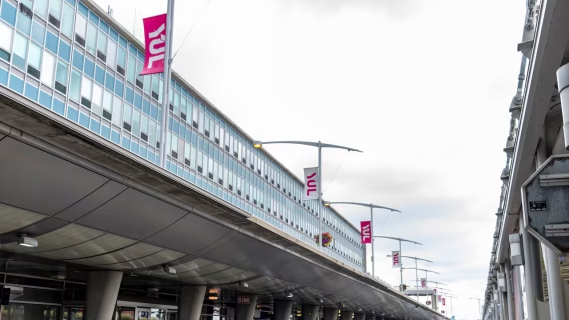
For the airport branch specifically, officials have offered a measured degree of reassurance. Airport Vice President Anne Marie Hamel noted that the station’s fully underground design offers a degree of insulation from the weather related variables that affected surface and elevated sections of the network during the winter months. She also pointed to a structural advantage that works in the airport branch’s favour: as the last segment of the network to open, it benefits from the lessons and technical corrections being applied across the rest of the system before its own launch date. By late 2027, the REM operators and Alstom will have had additional months to stabilise performance, update software and address mechanical vulnerabilities, meaning the airport branch is likely to enter service in better operating condition than the earlier phases did at their respective openings.
Why the Airport Rail Link Matters Beyond Montreal
Rail connections to major airports remain one of the most contested and chronically underdeveloped categories of transit infrastructure in North American cities. Toronto’s Union Pearson Express, which opened in 2015, took years to reach meaningful ridership levels and continues to operate at a fare premium that limits its appeal to budget conscious travellers. Vancouver’s Canada Line, which opened in 2009 and connects the city centre to Vancouver International Airport, is widely regarded as the most successful airport rail link in Canada, carrying millions of passengers annually and serving as a model for integrated multimodal planning. Montreal’s REM airport station, when it opens, will place the city in a select group of North American urban centres with a direct, frequent and affordable rail connection between downtown and the main international airport.
This selective club is soon to include Los Angeles, where the LAX/Metro Transit Center Station officially opened in June 2025 to serve as the primary gateway for the Metro C and K lines. While the $900 million station is now operational as a major bus and rail hub, the project’s final “missing link”, the 2.25-mile Automated People Mover (APM), is currently in its final phase of high-speed testing. Despite some contractual delays, passenger service is projected to begin by late 2026, providing a seamless, two-minute connection from the light rail platforms to the central terminal area and the new Consolidated Rent-A-Car (ConRAC) facility. Once complete, the system will move up to 30 million passengers annually, finally ending the “transportation donut” gap in the city’s network ahead of the 2028 Olympic Games.
The broader significance of the project extends to urban development patterns along the REM corridor. Light rail investments of this scale tend to catalyse transit oriented development in the areas surrounding new stations, and the Montreal airport corridor is no exception. Commercial and logistics developments near Trudeau are already factoring the REM connection into their planning assumptions. For the airport itself, a reliable rail link reduces the pressure on road based access infrastructure, lowers the carbon footprint of passenger ground transportation, and strengthens Montreal’s competitive position as a hub airport relative to rivals in Toronto and New York. The station’s projected seven million annual users, if realised, would represent a meaningful modal shift in how travellers access the airport and a long overdue modernisation of the ground transport ecosystem that surrounds one of Canada’s busiest international gateways.




Leave a Reply