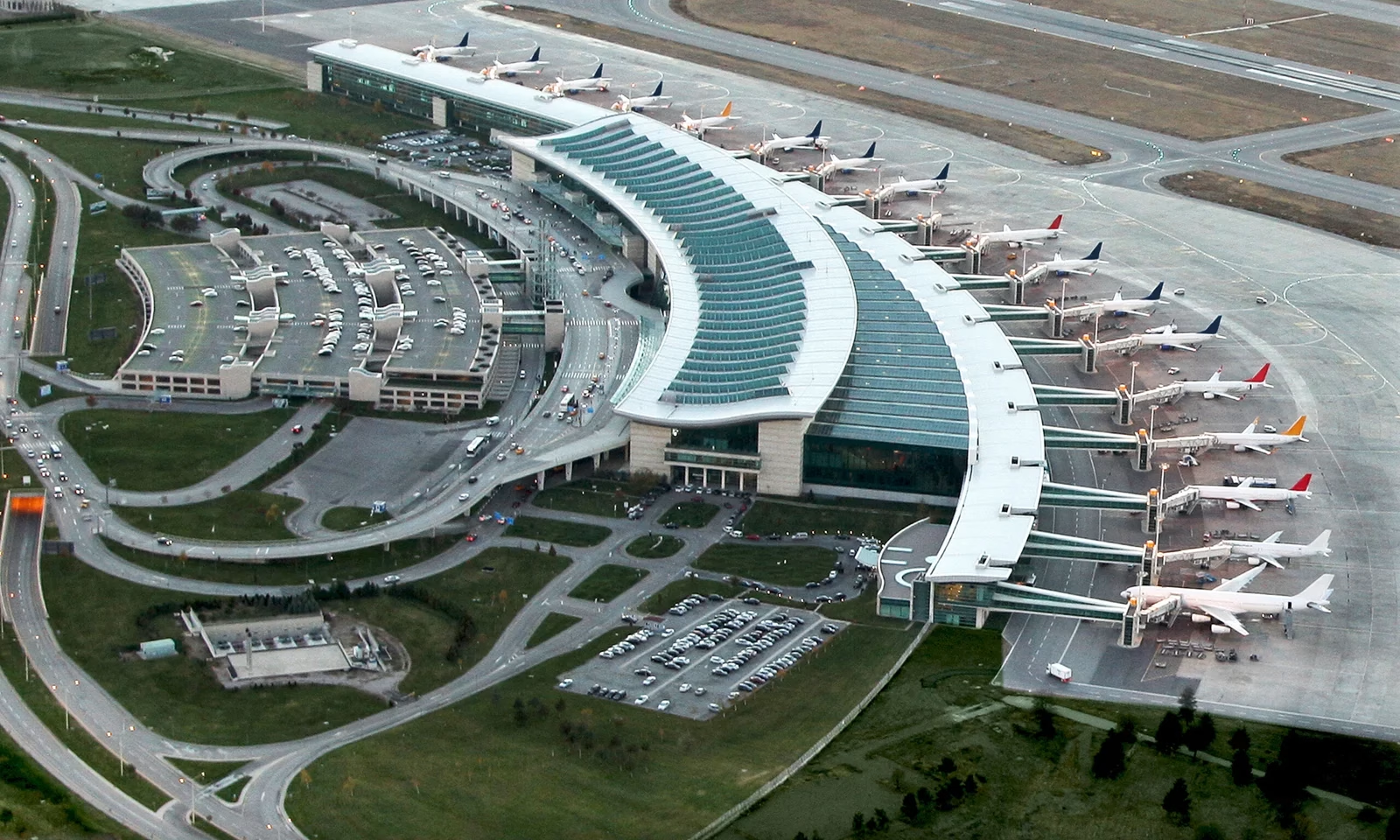
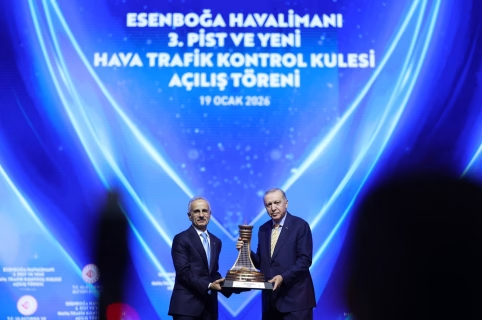
Türkiye has officially opened a massive new third runway and a state-of-the-art air traffic control tower at Esenboğa Airport in Ankara, marking the completion of the first phase of a comprehensive expansion project aimed at future-proofing the capital’s aviation capacity. The inauguration ceremony, held on Monday, January 19, 2026, was presided over by President Recep Tayyip Erdoğan and Transport and Infrastructure Minister Abdulkadir Uraloğlu. This ambitious upgrade, valued at approximately 298 million euros ($346.58 million), is designed to elevate the airport’s annual passenger capacity by at least 10 million, ensuring it can accommodate the region’s rapid growth in air traffic for decades to come.
A Triumph of Public-Private Partnership
During the ceremony, President Erdoğan emphasized the financial efficiency of the project, noting that it was executed “without a single penny coming out of our state’s coffers.” The expansion was realized through a robust Public-Private Partnership (PPP) model, a strategy Türkiye has increasingly employed to deliver large-scale infrastructure. Under this agreement, the private operating company is not only funding the construction but is also committed to paying the state a total of 560 million euros (including VAT) in rent over the course of the 25-year lease period. This approach secures vital infrastructure upgrades while generating long-term revenue for the government, serving as a benchmark for future development projects.
Esenboğa Airport Expansion: Factsheet
Location: Ankara, Türkiye
Total Investment: €298 Million (~$346.58 Million)
Funding Model: Public-Private Partnership (PPP)
State Revenue: €560 Million in rent (inc. VAT) over 25 years
Key Companies:
Developer/Operator: TAV Airports Holding (TAV Havalimanları)
Main Contractor: TAV Construction (TAV İnşaat)
Partner: Sera Group (Partner in TAV-Sera Joint Venture)
Subcontractor (Tower/Tech Block): AS Teknolojik Construction
Key Upgrades (Phase 1):
New Runway: 3,750m length x 75m width
ATC Tower: 77m height
Cargo Apron: 85,000 sq meters (Capacity for 6 aircraft)
Paved Area: ~945,000 sq meters (Taxiways/Service Roads)
Future Upgrades (Phase 2):
Terminal Expansion: +40,000 sq meters
Apron Expansion: +58,000 sq meters
Capacity Increase: From 20M to 30M passengers/year
Traffic Projections:
2025 Actual: ~13.99 Million passengers
2035 Forecast: >23.1 Million passengers
2045 Forecast: >31.5 Million passengers
Phase One: Engineering a Modern Aviation Hub
The newly inaugurated infrastructure represents a significant leap in operational capability for Esenboğa Airport. The centerpiece of this phase is the third runway, a colossal strip measuring 3,750 meters in length and 75 meters in width, engineered to handle the world’s largest long-haul aircraft. Standing watch over this new runway is a modern air traffic control tower, rising 77 meters into the Ankara skyline, equipped with advanced navigation systems to manage increased flight density safely. Beyond the runway and tower, the expansion includes a new 13,500-square-meter technical block and a dedicated cargo apron covering 85,000 square meters, providing parking space for up to six freighter aircraft. To support these additions, nearly 1 million square meters of paved areas, including taxiways and service roads, were constructed to ensure seamless ground movement.
Phase Two: Expanding Passenger Horizons
With the heavy civil works of the first phase complete, attention now shifts to the passenger experience. The second phase of the project focuses on expanding the terminal building by at least 40,000 square meters. This will be complemented by an additional 58,000 square meters of apron space and 18,000 square meters of connecting taxiways. Once these upgrades are finalized, the airport’s annual passenger capacity is set to rise from its current limit of 20 million to over 30 million, effectively eliminating bottlenecks during peak travel seasons.
Trajectory of Growth
The expansion is driven by undeniable data trends. President Erdoğan highlighted that passenger traffic at Esenboğa has exploded from just 2.8 million in 2002 to nearly 14 million in 2025. Looking ahead, government projections estimate traffic will surge to 23.1 million by 2035 and reach 31.5 million by 2045. This growth mirrors the national trend, where Türkiye’s total air passenger traffic hit a record 247 million in 2025, with expectations to exceed 260 million in 2026—a demand driving massive infrastructure projects like the new offshore Black Sea airport in Trabzon, now greenlit for construction. By proactively upgrading its capital’s airport, Türkiye is solidifying its position as a global aviation powerhouse, now boasting a network that connects to 356 destinations across 133 countries.
Leave a Reply