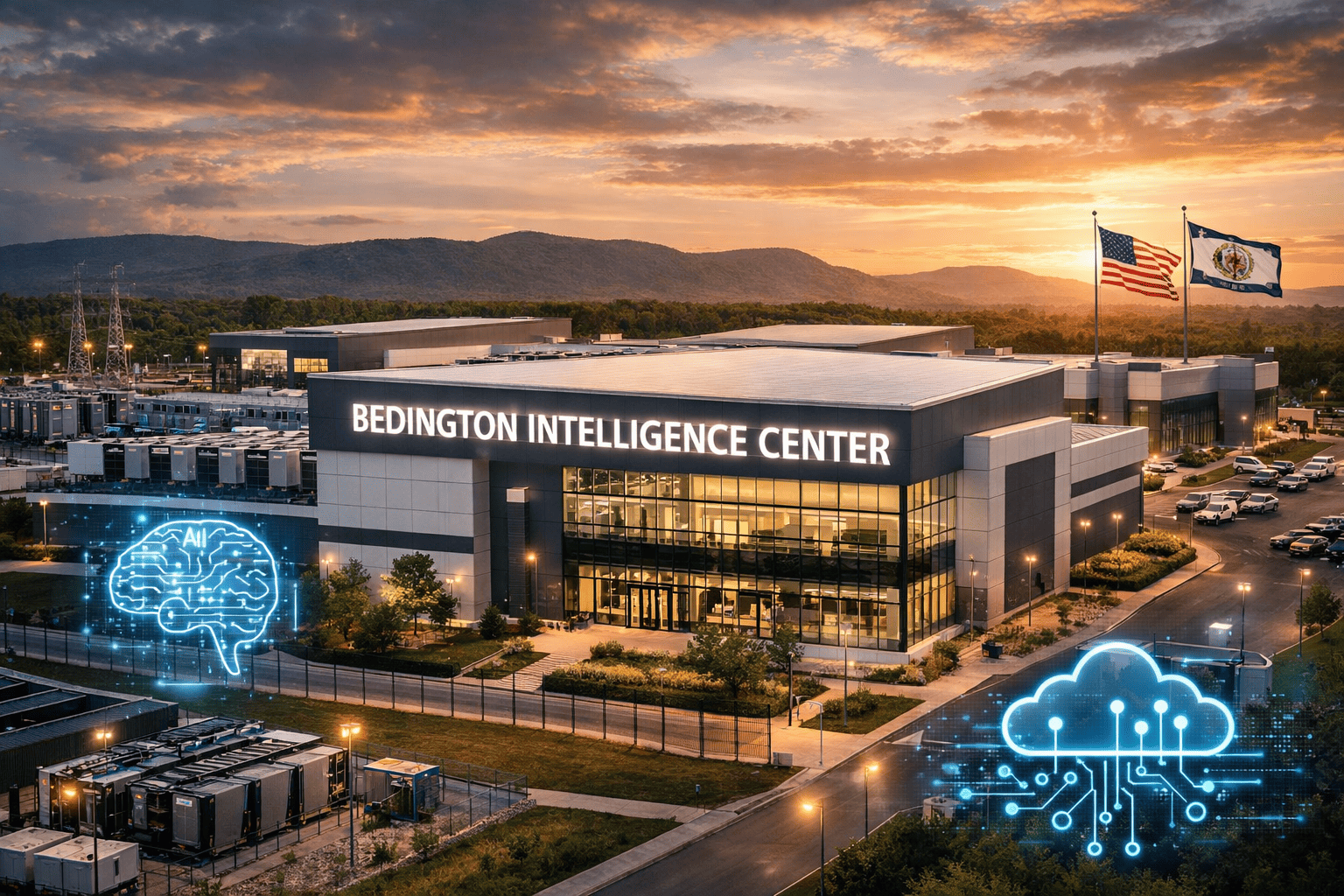
On February 26, 2026, West Virginia Governor Patrick Morrisey announced a $4 billion investment in the Bedington Intelligence Center in Berkeley County, positioning the state’s Eastern Panhandle as an emerging hub for artificial intelligence and cloud infrastructure. The 1.9 million-square-foot campus, planned on a 548-acre site in the Falling Waters District, will deliver at least 600 megawatts of computing capacity, marking one of the largest private infrastructure projects in West Virginia’s history.
“This is a transformative opportunity for our people,” Governor Patrick Morrisey said. “It’s good for Berkeley County, the Eastern Panhandle, and all of West Virginia.”
The project is anticipated to generate 1,000 construction jobs during the construction period and 125 long-term jobs after the construction is over. Unlike other large projects, the West Virginia government does not need to fund the project; Penzance Management will fund the required infrastructure for the development.
A Boost for the Economy and Tax Revenues
The West Virginia government’s House Bill 2014 states that the generated taxes will be used in the following manners:
50% for the development fund to decrease personal income tax
30% for Berkeley County where the project is located
10% for each county in the state in proportion to the population
10% to the Economic Enhancement Grant Fund and the Electric Grid Stabilization Fund
“This is a fantastic opportunity that we’ve never had before,” said Berkeley County Commission President Eddie Gochenour, emphasizing the economic and technological benefits of the project.
Tech, scale, and national relevance
While the Bedington campus is a local project in its location, it is also a strategic investment in the nation’s digital infrastructure. With 600 megawatts of computing capacity, the data center is ready to serve as a hub for artificial intelligence workloads, cloud services, and other high-performance computing applications that are essential to the nation’s economic progress.
However, data centers of this scale have also been the subject of controversy in the past. Some of the criticisms leveled against them include the stress that the data centers can put on the power grid, the water usage of the data centers, as well as the relatively low job creation compared to the scale of the data centers. Data centers of this scale can use as much as 5 million gallons of water daily, the same as a town of 10,000 to 50,000 residents.
Morrisey emphasized that careful planning will guide the project, including noise management, environmental safeguards, and tree and setback protections. He also reframed the facility as an “intelligence center” to underscore its role in innovation and digital infrastructure rather than just storage.
The Bedington Intelligence Center will be powered through a combination of utility grid integration and private microgrid infrastructure, enabled by West Virginia’s High Impact Intelligence Center designation under House Bill 2014. This approach allows the campus to incorporate on-site or dedicated generation resources and coordinate directly with utilities to meet its 600 MW power demand without overloading the regional grid. A similar strategy can be seen at Pacifico Energy’s GW Ranch power campus in West Texas, which was recently permitted for up to 7.65 GW of on-site generation to supply multiple hyperscale data centers without drawing on the broader grid. Together, these projects illustrate how states are designing next-generation AI and cloud infrastructure to balance massive computing demand with power reliability and environmental considerations.
West Virginia’s emerging tech hub
The Bedington Campus will be the second major intelligence center in Berkeley County, joining another facility in nearby Kearneysville. Together, these developments signal the Eastern Panhandle’s growing role in national digital infrastructure.
“This is about more than jobs or buildings,” Morrisey said. “It’s about putting West Virginia on the map for technology, AI, and innovation. That’s why we’re calling these intelligence centers—they will share intelligence and drive growth for our state.”

Bedington Intelligence Center Campus – Project Fact Sheet
Project Overview
Governor Patrick Morrisey on Thursday afternoon, Feb 26, 2026 announced West Virginia’s first “High Impact Intelligence Center” in Bedington, Berkeley County. Developed by Penzance Management, this $4 billion private investment positions the state as a hub for AI and cloud computing.
Key Statistics
Total Investment: $4 billion (private)
Facility Size: 1.9 million sq. ft.
Site Area: 548 acres
Computing Capacity: 600 MW
Construction Jobs: 1,000+
Permanent Jobs: 125
Legislative & Operational Framework (HB 2014)
Authorized to create its own microgrid
Exempt from local zoning and building permits
State-level funding primarily used for income tax reduction
Economic & Community Impact
50%: Personal Income Tax Reduction Fund
30%: Berkeley County (host county)
10%: Distributed per capita to all counties
10%: Economic Enhancement Grant Fund & Electric Grid Stabilization Fund
Environmental & Infrastructure Commitments
Penzance responsible for all infrastructure costs—no taxpayer funding
Water management and mitigation plans submitted
Noise control, tree setbacks, and other environmental protections included
Sustainability features include high-efficiency cooling and LEED-style designs
Project Partners
Developer: Penzance Management
Public Partner: West Virginia Data Economy Office
Local Oversight: Berkeley County Commission
Leave a Reply