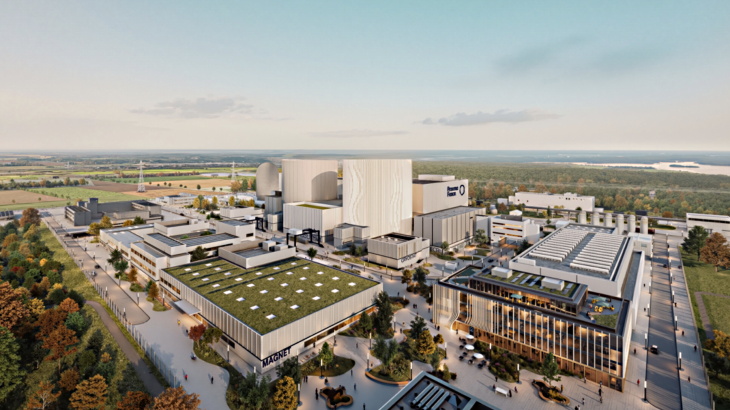
German energy giant RWE and Munich-based startup Proxima Fusion have forged a strategic partnership to develop and eventually construct a commercial nuclear fusion power plant in Bavaria. This collaboration marks a significant milestone in the European energy transition, pairing RWE’s massive utility-scale project delivery expertise with Proxima’s cutting-edge plasma physics. Born as a spin-out from the prestigious Max Planck Institute for Plasma Physics, Proxima aims to commercialize the “stellarator” fusion concept. For the heavy construction and power infrastructure sectors, this announcement signals the very early stages of a pipeline that will eventually demand unprecedented levels of civil and mechanical engineering precision.
Engineering the Stellarator
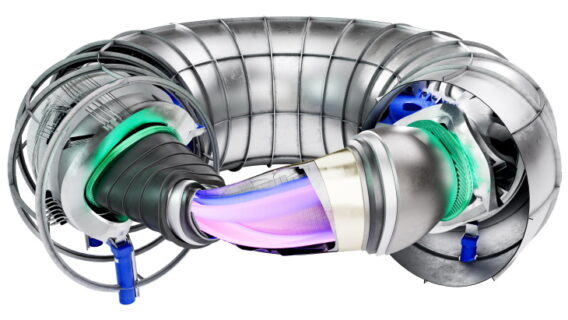
Unlike the more common “tokamak” reactor design, which uses a symmetrical donut shape and highly pulsed operations, a stellarator relies on a deeply complex, twisted ring of superconducting electromagnets to confine the superheated plasma in a continuous, stable state. Fabricating and assembling these non-planar, 3D-shaped magnetic coils requires manufacturing tolerances that border on the microscopic, despite the components weighing several tons. When the project eventually moves to the jobsite, mechanical installation contractors will face the monumental task of aligning these intricate coil modules with sub-millimeter accuracy to ensure the plasma remains suspended at temperatures exceeding 100 million degrees Celsius.
Proxima Fusion Commercial Plant: Factsheet
Project Name: RWE / Proxima Fusion Demonstration Plant
Location: Bavaria, Germany (Exact site TBD)
Technology: Quasi-Isodynamic (QI) Stellarator
Project Team:
Technology Developer: Proxima Fusion (Spin-out from Max Planck Institute for Plasma Physics)
Utility Partner / Co-Developer: RWE AG
Government Backing: State of Bavaria
EPC Contractor: [Pre-conceptual phase – TBD]
Key Infrastructure Challenges:
Manufacturing and alignment of 3D-shaped superconducting coils.
Integration of massive-scale cryogenic cooling infrastructure.
High-density concrete biological shielding (neutron containment).
Thermal-to-electric balance of plant design.
Timeline: Design and site selection phase underway; targeting commercial demonstration operations in the 2030s.
Jobsite Impact: Cryogenics and Heavy Shielding
Beyond the reactor core, the “Jobsite Impact” of a commercial fusion plant will be heavily dominated by extreme thermal and radiological management systems. To maintain the superconductivity of the electromagnets, heavy mechanical teams must integrate massive cryogenic cooling plants capable of sustaining temperatures near absolute zero. Surrounding this entire apparatus will be the “biological shield.” Heavy civil contractors will be required to execute continuous, high-density concrete pours—often utilizing specialized heavy aggregates like magnetite or baryte—to construct containment walls several meters thick. These highly reinforced structures are critical for absorbing the high-energy neutrons produced by the fusion reaction, preventing structural embrittlement and protecting the surrounding facility.
RWE’s Utility-Scale Blueprint
While Proxima Fusion drives the core physics, RWE’s involvement addresses the “balance of plant” and grid integration—the historical bottleneck for many emerging energy technologies. RWE brings decades of experience navigating complex European permitting landscapes and executing multi-billion-euro mega-projects. For electrical and civil contractors, the scope extends far beyond the reactor vault. The site will require the construction of massive step-up transformers, advanced switchyards, and thermal-to-electric conversion systems (heat exchangers and steam turbines) to capture the heat generated by the fusion process and convert it into stable, baseload electricity for the Bavarian grid.
The Road to Commercialization
Currently, the RWE and Proxima partnership is focused on site selection, preliminary conceptual design, and navigating the regulatory framework for a first-of-its-kind facility in Germany. While heavy excavators will not be breaking ground tomorrow, this agreement establishes a clear commercial roadmap targeting the 2030s for a demonstration plant. For Tier 1 engineering, procurement, and construction (EPC) firms, the race is now on to develop the specialized supply chains, fabrication facilities, and proprietary construction methodologies required to translate these highly complex physics experiments into reliable, utility-scale power stations. This push for nuclear-integrated infrastructure is gaining global momentum, notably with Amazon’s $5 billion Project Spectrum, a massive data center campus in Texas planned to collocate with the Comanche Peak nuclear plant to secure a direct, carbon-free power source.
Leave a Reply