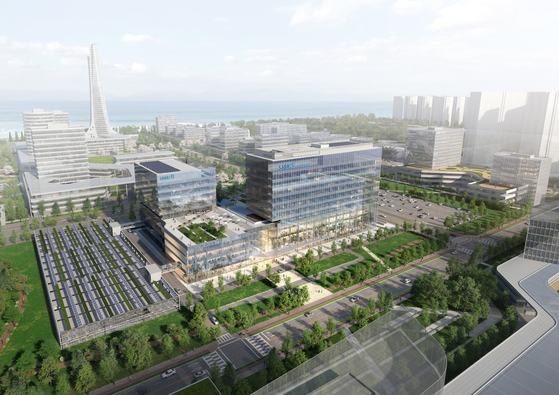
Siheung City has signed the main construction contract for the Siheung Baegot Seoul National University Hospital, advancing one of South Korea’s most significant public healthcare infrastructure projects into full-scale implementation. With a total project cost of approximately 587.2 billion won ($427 million), the 800-bed facility will anchor a new medical, research, and bio-industry ecosystem on Seoul National University’s expanding Siheung Campus.
Healing the Gap: What the Siheung Baegot Hospital Will Provide
The Siheung Baegot Seoul National University Hospital — currently operating under a tentative name — will rise on Seoul National University’s Siheung Campus with a gross floor area of 112,896 square metres. The hospital will encompass 27 clinical departments and six specialised treatment centres, focusing on areas of acute regional need: cancer, cardiovascular and cerebrovascular diseases, paediatrics, emergency care, and infectious diseases.
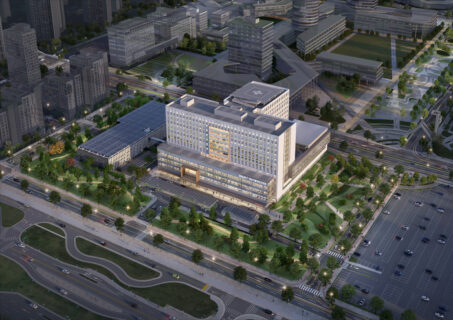
Project Fact Sheet: Siheung Baegot Seoul National University Hospital
Project Name: Siheung Baegot Seoul National University Hospital (tentative name)
Location: Seoul National University Siheung Campus, Siheung City, Gyeonggi Province, South Korea
Total Project Cost: ~587.2 billion won (approx. USD $427 million)
Gross Floor Area: 112,896 square metres
Bed Capacity: 800 beds
Clinical Scope: 27 departments, 6 specialised treatment centres
Key Focus Areas: Cancer, cardiovascular/cerebrovascular, paediatrics, emergency, infectious diseases
Procurement Method: Design-Build
Preliminary Contract: December 2024
Early Works Start: August 18, 2025
Main Contract Signed: March 4, 2026
Special Designation: AI Advanced Medical Demonstration Hub; core facility of Gyeonggi Siheung Bio Specialised Complex
Project Team: Siheung Baegot Seoul National University Hospital
Client/Owner: Siheung City Government
Mayor: Lim Byung-taek
Procurement Authority: Public Procurement Service of South Korea
Main Construction Consortium Lead: Hyundai Engineering & Construction
Hospital Operator (Planned): Seoul National University Hospital (SNUH)
Academic Partner: Seoul National University (SNU) — Siheung Campus and Siheung AI Campus
National Oversight: Ministry of Health and Welfare, Republic of Korea
Industry Ecosystem Partner: Gyeonggi Siheung Bio Specialised Complex
The project directly addresses a longstanding healthcare deficit in the West Coast region and the southwestern Seoul metropolitan area, which has historically lacked the high-acuity referral infrastructure available in Seoul’s urban core. As a national university hospital, the facility is mandated to function as an “essential public healthcare hub,” strengthening treatment capabilities for severe and emergency patients and forming the central pillar of a self-sufficient regional medical system. Beyond patient care, the hospital will integrate education and clinical research by connecting with Seoul National University Hospital’s residency training programmes, creating a pipeline of medical personnel trained within the region they will ultimately serve.
The Consortium Delivering South Korea’s Medical Landmark
The main construction contract was executed between the Public Procurement Service — South Korea’s central government procurement authority — and a consortium led by Hyundai Engineering & Construction, one of the country’s largest and most technically capable construction companies. The contract was signed on March 4, 2026, following the completion of detailed design work. Hyundai Engineering & Construction’s involvement reflects the broader ambitions of the wider Hyundai Motor Group, which is simultaneously committing $6.3 billion to its Saemangeum Innovation Hub — a sprawling campus dedicated to robotics, physical AI, and hydrogen energy that represents South Korea’s most concentrated bet on next-generation industrial technology.
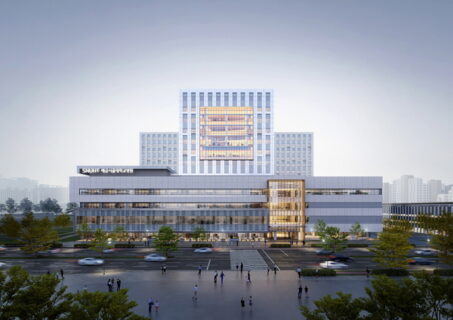
The project has been pursued through a design-build bidding method, which integrates design and construction responsibilities under a single contract structure to improve coordination and accelerate delivery. The preliminary construction contract was established in December 2024, enabling early earthwork and temporary construction to begin on August 18, 2025. With the main contract now in place, an integrated management system covering the entire hospital construction project has been formally activated. Siheung City Mayor Lim Byung-taek has served as the project’s primary public champion, framing the hospital as both a long-cherished civic goal and a strategic platform for the city’s future growth in healthcare and bio-industry.
AI, Precision Medicine, and the Hospital of the Future
What elevates the Siheung Baegot Hospital beyond a conventional public health facility is its explicit design as an AI-advanced medical demonstration hub. The hospital will be developed in direct connection with Seoul National University’s adjacent Siheung AI Campus, establishing a live clinical environment where AI-based diagnostic and treatment technologies, medical data analysis tools, and precision medicine protocols can be trialled and validated in real-world settings.
This structure is designed to create a self-reinforcing innovation loop: research outcomes generated within the hospital’s clinical setting feed directly back into the AI Campus’s development pipeline, accelerating the translation of laboratory findings into deployable medical tools. The facility will also function as a core anchor of the Gyeonggi Siheung Bio Specialised Complex, a nationally designated high-tech strategic industry zone. Within this ecosystem, the hospital is expected to catalyse an industry-academia-research-hospital collaborative network spanning biomedical devices, new drug development, and clinical research — making it as much an economic development engine as a healthcare provider.
South Korea’s Medical Infrastructure Expansion in Regional Context
The Siheung Baegot project is part of a broader pattern of South Korea investing in de-centralised high-quality healthcare infrastructure to address persistent geographic imbalances in medical access. Historically, top-tier hospital care has been concentrated in Seoul’s metropolitan core, particularly around the Jongno and Gangnam districts, creating a system where patients from the country’s expanding satellite cities routinely travel significant distances for specialist treatment.
Similar efforts to extend Seoul National University Hospital’s reach are underway elsewhere in the country — the institution already operates affiliated hospitals in Bundang and Boramae — but the Siheung project is distinguished by its explicit fusion of clinical care with digital health and AI infrastructure. This model parallels emerging international approaches, most notably in Singapore’s Ng Teng Fong General Hospital and Denmark’s Odense University Hospital, where smart-hospital frameworks have been built into the facility’s architecture from the design stage rather than retrofitted. As AI adoption accelerates in global healthcare, South Korea’s decision to embed a national university hospital at the centre of an AI campus positions Siheung as a potential benchmark for the next generation of public medical infrastructure across East Asia.
Leave a Reply