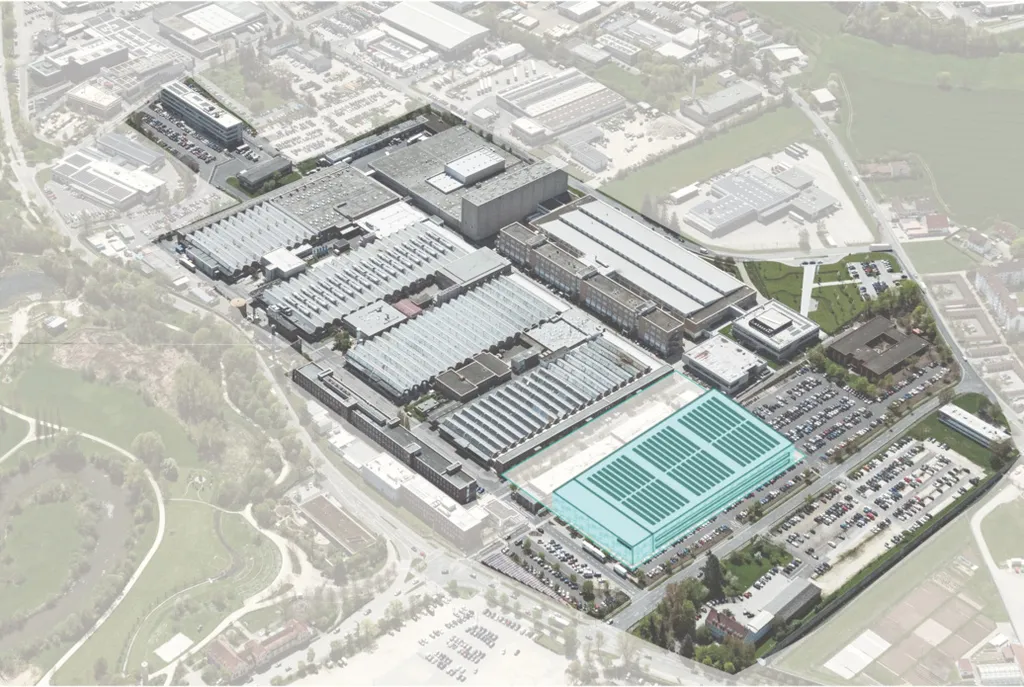
Siemens AG has announced an investment of over €200 million to construct a next-generation intelligent factory at its Amberg, Germany campus, targeting completion by 2030. The facility will serve the company’s Smart Infrastructure Business and represents one of the most ambitious industrial digitalisation commitments in Germany in recent years — combining artificial intelligence, digital twins, autonomous logistics, and advanced automation under a single purpose-built roof.
Blueprints for Tomorrow: What the Amberg Smart Factory Will Become
The new facility will be constructed on the current parking area of Siemens’ existing Amberg site, preserving continuity of operations during the build phase. At its core, the factory will be an AI-governed, self-learning manufacturing environment designed to respond dynamically to shifting production demands. Artificial intelligence will be continuously fed with real-time data to coordinate order planning, material transport, system control, and production sequencing — optimising each on an ongoing basis rather than operating on fixed programmatic schedules.
Project Fact Sheet: Siemens Amberg Smart Factory
Project Name: Siemens Smart Infrastructure Factory, Amberg
Location: Amberg, Bavaria, Germany
Developer/Owner: Siemens AG
Total Investment: Over €200 million (new build); additional investment planned for modernisation and decarbonisation
Business Unit: Siemens Smart Infrastructure
Facility Type: AI-governed, digitally integrated smart manufacturing facility
Key Technologies: Industrial AI, digital twins, Digital Twin Composer, driverless logistics, humanoid robotics, clean room electronics production
Workforce: ~2,400 Smart Infrastructure employees (on-site); ~4,500 total Amberg campus staff
Construction Site: Current parking area on existing Amberg campus
Target Completion: 2030
Strategic Framework: Siemens “Made for Germany” initiative
Project Team: Siemens Amberg Smart Factory
Owner & Developer: Siemens AG (Berlin and Munich)
President & CEO: Roland Busch
Business Sponsor: Siemens Smart Infrastructure Business
Digital Design Technology: Siemens Digital Twin Composer (applied during planning phase)
Construction Contractor: To be confirmed
Architect/Designer: To be confirmed
Initiative Partner: “Made for Germany” (124-member industry coalition)
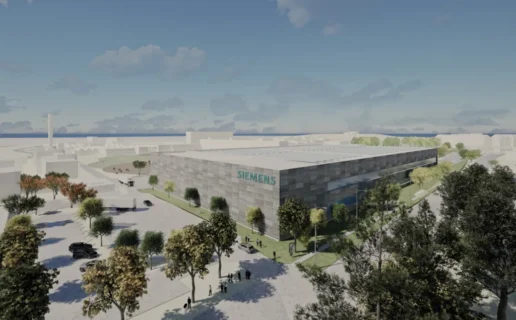
Logistics within the facility will be fully automated, driven by driverless transport systems and humanoid robotics. A dedicated clean room for electronics production will form a critical component of the build, reflecting the precision manufacturing standards required for Siemens’ Smart Infrastructure product range, which encompasses switching, protection, and monitoring devices for industrial applications as well as industrial controllers. Beyond AI and automation, the factory has been designed with decarbonisation at its core: Siemens has indicated that further investments alongside the main €200 million commitment will target the modernisation and environmental sustainability of the broader Amberg location. The factory is expected to accommodate around 2,400 Smart Infrastructure employees at the site, with extensive workforce retraining built into the transition programme.
The Digital Twin Already at Work
Even before a single structural element has been erected, Siemens is applying its own technology to the factory’s design process. The company is using its digital twin platform to simulate the entire facility — including production workflows, machinery configurations, and logistics operations — across multiple scenarios during the planning phase. This enables designers and engineers to identify inefficiencies, stress-test configurations, and refine the layout before any physical commitment is made.
Central to this process is Siemens’ newly deployed Digital Twin Composer, a tool that integrates the company’s various digital twin data streams into a unified model. The approach reflects a broader Siemens philosophy: that the factory of the future must be designed digitally before it is built physically. Siemens AG President and CEO Roland Busch oversaw the investment announcement, characterising the project as a reaffirmation of the company’s confidence in Germany as a competitive industrial location and pointing to industrial AI as the mechanism through which manufacturing competitiveness will be maintained. The investment also builds directly on Siemens’ commitments under the “Made for Germany” initiative, a coalition of 124 companies that have collectively pledged over €800 billion in German domestic investment.
Jobs, Retraining, and a Bet on Bavaria’s Industrial Future
Siemens’ Amberg campus is already a significant local employer, with approximately 4,500 people working across its two factories and development functions. The new smart factory will safeguard and in some cases transform those roles rather than eliminate them — a distinction Siemens has been deliberate about communicating. The company has committed to preparing its Amberg workforce for the operational realities of a digitally managed factory through structured training and reskilling programmes, acknowledging that AI-driven production environments demand different competencies than conventional manufacturing. It is an approach mirrored by the broader Siemens group globally, with Siemens Energy committing $1 billion to U.S. manufacturing expansion — including a new Mississippi switchgear plant that will incorporate a dedicated training centre, signalling that workforce development has become as central to the company’s growth strategy as the physical infrastructure itself.
For Amberg itself — a city of around 43,000 in the Upper Palatinate region of Bavaria — the Siemens investment carries economic weight well beyond the factory walls. The facility is a cornerstone of the local economy and a primary driver of skilled employment in the region. Construction of the new facility will generate significant activity for local contractors and suppliers over the coming years, while the long-term operational commitment reinforces Amberg’s status as a competitive manufacturing destination within a German industrial landscape increasingly subject to international cost pressures.
Germany’s Industrial AI Moment in Global Context
The Amberg investment arrives at a pivotal point for German manufacturing. Europe’s largest industrial economy has faced mounting structural challenges in recent years — high energy costs, sluggish productivity growth, and increasing competition from lower-cost producers in Asia — prompting a national conversation about the long-term viability of high-cost, high-skill manufacturing. Siemens’ project offers one answer: that advanced automation, AI, and digital twin technology can tip the economics decisively in favour of sophisticated onshore production.
Globally, this model is gaining traction. In the United States, companies such as General Motors and Lockheed Martin have invested heavily in AI-integrated production facilities, while in Asia, South Korea’s Samsung and Japan’s Fanuc have pioneered lights-out manufacturing environments driven by machine learning and robotics. What distinguishes the Amberg project is Siemens’ unique position as both the builder and the primary technology vendor for its own factory — the facility will effectively serve as the most credible possible demonstration of what Siemens sells to its own industrial customers worldwide. As demand for smart building and infrastructure technologies accelerates globally, the Amberg factory is as much a showcase and proof of concept as it is a production asset, placing Siemens at the centre of the industrial AI conversation precisely as that conversation reaches its most commercially consequential stage.
Leave a Reply