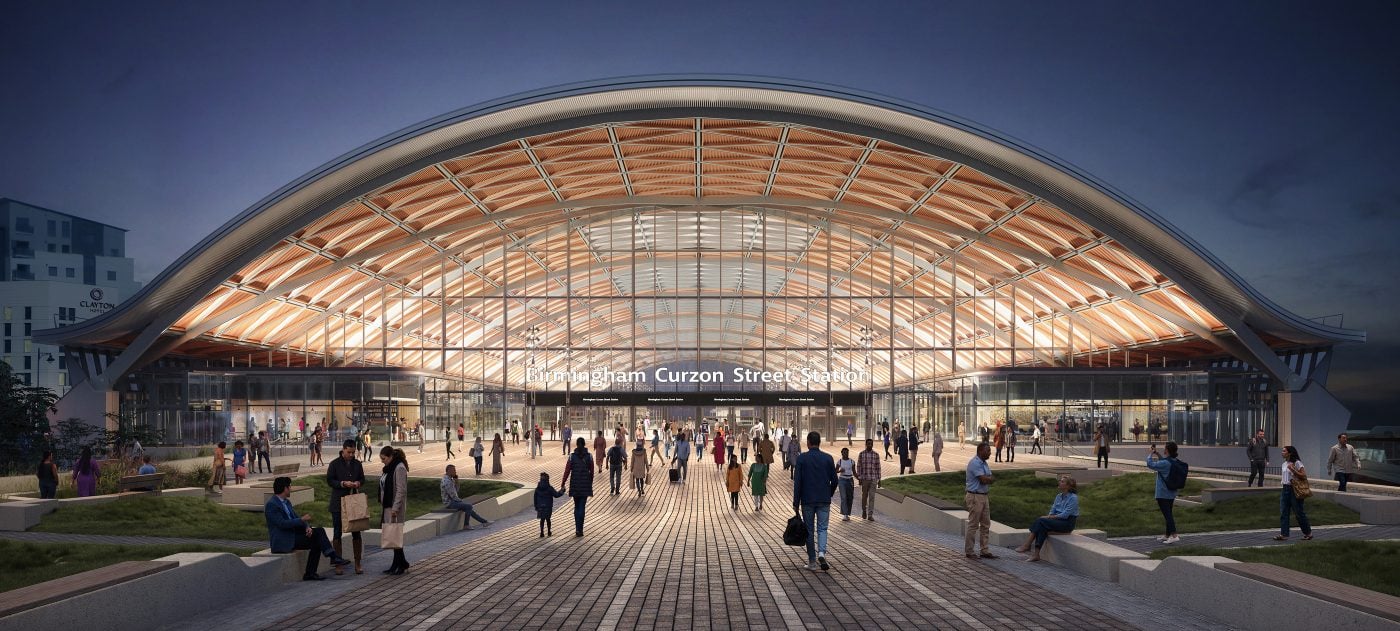
HS2 engineers have reached a landmark moment in the construction of Birmingham’s Curzon Street Station, completing the final pile in a 2,011-strong reinforced concrete foundation programme that stretches the full length of the 400-metre city centre site. With piling now finished, the project shifts its focus to above-ground construction, viaduct installation, and the integration of a new West Midlands Metro tram extension — marking the transition from groundwork to skyline.
Down to the Bedrock: The Engineering Scale of Curzon Street’s Foundations
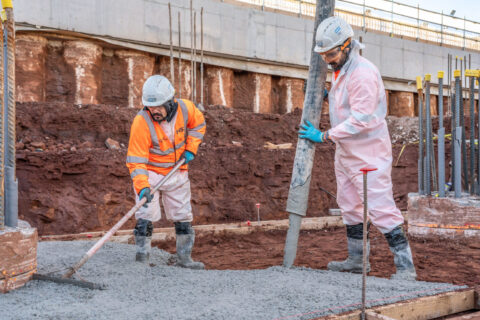
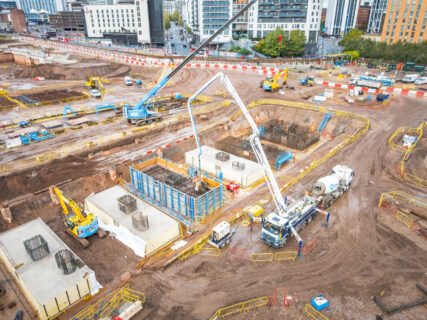
The piling programme at Curzon Street is one of the most intensive sub-surface construction operations in British rail history. Over 2,011 continuous flight auger (CFA) bored piles were installed across the site between September 2024 and early March 2026, sunk at depths ranging from 6 to 24 metres depending on ground conditions. The CFA method was selected specifically to minimise vibration adjacent to live rail assets, a critical constraint given the proximity of Network Rail infrastructure throughout the build.
HS2 Completes 2,011-Pile Foundation at Birmingham’s Curzon Street Station in Major Milestone
Project Fact Sheet: HS2 Curzon Street Station
Project Name: HS2 Curzon Street Station, Birmingham
Location: Between Moor Street Station and Millennium Point, Birmingham City Centre, UK
Programme: High Speed 2 (HS2) Phase 1, London–Birmingham
Station Length: Over 400 metres
Platform Count: 7 platforms
Piling Programme: 2,011 CFA reinforced concrete piles (6–24m depth)
Excavation: 47,000 cubic metres
Retaining Wall: 8 metres high (western end)
Total Sub-Surface Steel: 19,000+ tonnes of reinforced steel
Total Sub-Surface Concrete: 69,000 cubic metres
Piling Start: September 2024
Piling Completion: Early March 2026
Viaduct (Curzon 2): 40m high; slide-in across Cross City line scheduled summer 2026
Metro Integration: West Midlands Metro Digbeth extension (stop under station on New Canal Street)
Project Team: HS2 Curzon Street Station
Client: HS2 Ltd
Senior Project Manager (HS2): Alistair Morgan
Main Station Contractor: Mace Dragados Joint Venture (MDJV)
Senior Project Manager (MDJV): Rodger Storey
Piling Subcontractor: Keltbray
Viaduct Contractor (Curzon 2): Balfour Beatty VINCI
Network Rail: Infrastructure maintenance coordination (railway viaduct alongside site)
Local Authority: Birmingham City Council (landscape design approvals)
Metro Partner: West Midlands Metro (Digbeth extension integration)
Heritage Asset: Original Curzon Street Station building (1838) — to be preserved on site
In parallel, an 8-metre-high retaining wall was constructed at the western end of the site to manage the significant grade difference between the station formation and the existing city fabric. Approximately 47,000 cubic metres of material were excavated to create a level base for the station — a mass earthworks operation that required substantial temporary works and groundwater management throughout. When all sub-surface construction is complete, the foundations will have consumed more than 19,000 tonnes of reinforced steel and 69,000 cubic metres of concrete. As of early March 2026, 7,000 tonnes of reinforcement and 29,000 cubic metres of concrete have already been placed below ground — a figure that will roughly treble before superstructure work can begin in earnest. A brief, planned pause mid-programme allowed Network Rail to carry out essential maintenance on the railway viaduct running alongside the site, requiring careful logistics coordination to maintain overall programme momentum.
The Teams Turning Victorian Legacy into 21st-Century Rail
The piling works were carried out by Keltbray, operating as a specialist subcontractor to the Mace Dragados Joint Venture (MDJV), which holds the main station construction contract with HS2 Ltd. Mace Dragados is one of the most experienced major infrastructure delivery partnerships in the United Kingdom, combining Mace Group’s programme management and construction expertise with Dragados’s deep heritage in heavy civil and rail engineering across Europe.
HS2 Completes 2,011-Pile Foundation at Birmingham’s Curzon Street Station in Major Milestone
Alistair Morgan, Senior Project Manager at HS2 Ltd, has overseen the foundation phase and acknowledged the scale of effort involved while tempering the milestone with a clear-eyed view of the work that remains. Rodger Storey, Senior Project Manager at the Mace Dragados JV, echoed that sentiment, noting that completion of piling opens the door to the station’s construction phase proper — generating further jobs, apprenticeships, and supply chain opportunities as site activity ramps up significantly. More than 1,000 people are expected to be employed directly and through MDJV’s UK supply chain during the station’s peak construction period. Separately, the Curzon 2 viaduct — a 40-metre-high structure that will carry HS2 services into the city centre — is being delivered by Balfour Beatty VINCI and is nearing completion, with the viaduct scheduled to be slid into place across the Cross City line this summer in a precision incremental launch operation.
A Station Built for Birmingham’s Future City
When complete, Curzon Street will be the UK’s first brand-new intercity terminus since London’s St Pancras opened in 1868. Its design draws deliberately on that Victorian railway tradition: a grand arched roof will span seven platforms, framing a structure that HS2 describes as a new landmark for Birmingham and a city-centre anchor for the high-speed rail network. The station stretches for more than 400 metres between Moor Street station and Millennium Point, positioning it at the heart of Birmingham’s Eastside regeneration zone.
Landscape design refinements recently submitted to Birmingham City Council include improvements to rainwater drainage, integrated cycling and walking routes, a tree-lined promenade with landscaped terraces along the station’s flank, and a second entrance providing access to Digbeth and the east side of the city — complete with a tram stop, taxi drop-off, and improved cycle access. Facing that eastern entrance will be the original Curzon Street station building, constructed in 1838, which will be preserved as a heritage counterpoint to the new station’s contemporary architecture. A West Midlands Metro tram extension through Digbeth will also stop directly beneath the station on New Canal Street, embedding Curzon Street within Birmingham’s wider public transport network from the moment it opens.
HS2 and the Long Arc of British High-Speed Rail
The completion of piling at Curzon Street arrives as HS2’s broader programme continues to evolve under significant public and political scrutiny. The project was substantially rescoped in 2023 when the northern leg to Manchester was cancelled, concentrating the programme on the London–Birmingham Phase 1 corridor. That decision intensified the spotlight on Birmingham’s infrastructure as the northern terminus of the retained route, making Curzon Street’s delivery both symbolically and functionally central to the programme’s credibility. It also refocused attention on London’s own infrastructure pipeline, where major underground works are advancing in parallel — among them the Silvertown Tunnel, a 1.4km twin-bore road crossing beneath the Thames linking Silvertown in Newham with the Greenwich Peninsula, whose tunnelling phase has now been completed using the UK’s largest tunnel boring machine.
HS2 currently supports more than 33,000 jobs across its construction supply chain — one of the largest infrastructure employment programmes in the UK. The Curzon Street project alone will employ over 1,000 people at peak, and the station’s completion is projected to be transformative for Birmingham’s Eastside district, attracting investment and catalysing development in a corridor that has long been earmarked for urban regeneration. Internationally, Curzon Street’s design and construction complexity is comparable to major terminus projects such as Stuttgart 21 in Germany and Sydney’s new metro stations — all of which required comparable deep foundation strategies in constrained urban environments. In a British context, however, it stands apart: a genuinely new intercity station, built from the ground up, for the first time in over 150 years.
Leave a Reply