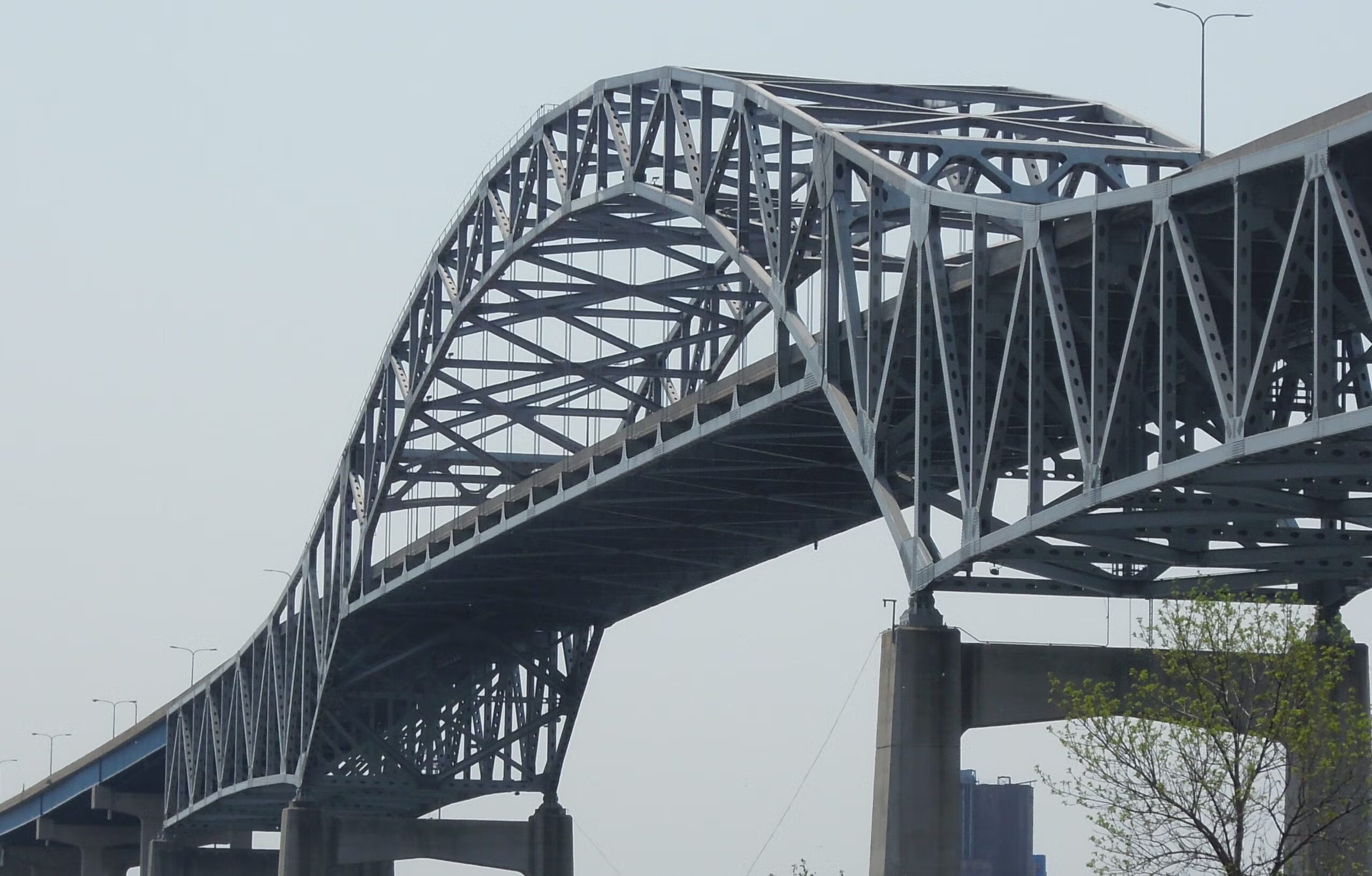
The United States Department of Transportation has officially released $1.05 billion in federal grant funding for the replacement of the John A. Blatnik Bridge, clearing the final financial hurdle for what Superior Mayor Jim Paine has described as the largest transportation infrastructure project in the living memory of any current elected official at any level of government. The release, announced on 18 March 2026 following weeks of pressure from Minnesota and Wisconsin senators and representatives, unlocks a project that has been in planning for years and will reshape the only high-capacity fixed crossing between Duluth, Minnesota and Superior, Wisconsin. Preliminary construction is expected to begin later in 2026, a full bridge closure is anticipated in 2027 and will last several years, and the new Blatnik Bridge is scheduled to open to traffic in 2031.
The Bridge, the Bay, and the Stakes of Replacement
The John A. Blatnik Bridge has carried Interstate 535 across St. Louis Bay since 1961, serving for more than six decades as the only Interstate-grade crossing between the twin cities of Duluth and Superior. More than 33,000 vehicles cross the bridge daily, and annually approximately 265,000 trucks use it to transport nearly $4 billion in goods — a freight volume that reflects the bridge’s role not merely as local infrastructure but as a critical node in the Upper Midwest’s supply chain network connecting Minnesota’s Iron Range, Wisconsin’s industrial corridor, and the Port of Duluth to highway networks extending in every direction. The bridge carries grain, steel, manufactured goods, forest products, and energy equipment, and its condition — now more than six decades since opening — has been the subject of escalating engineering concern.
Project Fact Sheet: Blatnik Bridge Replacement
Project Name: John A. Blatnik Bridge Replacement (I-535 over St. Louis Bay)
Location: St. Louis Bay, between Duluth, St. Louis County, Minnesota and Superior, Douglas County, Wisconsin, USA
Total Project Cost / Federal Grant: $1.05 billion (USDOT grant; Bipartisan Infrastructure Law)
Grant Funding Source: US Department of Transportation (USDOT); Bipartisan Infrastructure Law (2021)
Grant Released: 18 March 2026
Current Bridge: John A. Blatnik Bridge, opened 1961; carries I-535
Daily Traffic: 33,000+ vehicles
Annual Freight: ~265,000 trucks; ~$4 billion in goods
Preliminary Construction Start: Later in 2026
Full Bridge Closure Start: 2027
Full Closure Duration: Several years
Project Completion: 2031
Detour Route: Richard I. Bong Memorial Bridge (~1 mile west)
Bridge Type (replacement): New alignment (design details to be confirmed)
Existing Bridge Disposition: Demolition upon opening of new crossing
Project Team: Blatnik Bridge Replacement
Lead Agency (Minnesota): Minnesota Department of Transportation (MnDOT)
Lead Agency (Wisconsin): Wisconsin Department of Transportation (WisDOT)
Federal Funder: US Department of Transportation (Secretary: Sean Duffy)
Federal Oversight: Federal Highway Administration (FHWA)
Minnesota Senators: Amy Klobuchar; Tina Smith (joint letter to Secretary Duffy, early March 2026)
Wisconsin Senator: Tammy Baldwin (joint signatory)
Minnesota Congressman: Pete Stauber (MN-8)
Wisconsin Congressman: Tom Tiffany (WI-7)
Superior Mayor: Jim Paine
Key Stakeholders: Port of Duluth-Superior; City of Duluth; St. Louis County; Douglas County
Design and Construction Contractor(s): To be confirmed through procurement process
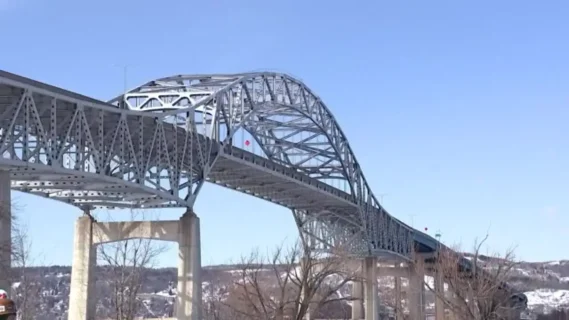
The $1.05 billion replacement project will construct an entirely new bridge on a new alignment, designed for the traffic volumes, vehicle sizes, and structural standards of the 21st century. The existing Blatnik will remain operational until the new crossing is ready to accept traffic, at which point the old bridge will be demolished. A full closure beginning in 2027 and lasting several years will require traffic to divert to the Richard I. Bong Memorial Bridge approximately one mile to the west — the only other fixed crossing in the region — creating the traffic management challenge that business owners, local government, and freight operators along the corridor are already planning to navigate. The closure period is unavoidable: the two-bridge construction and demolition sequence cannot be compressed without creating structural or safety risks during the transition.
The Politics of the Grant Release — and Why It Was Delayed
The $1.05 billion grant was originally designated under the Biden administration through the Bipartisan Infrastructure Law enacted in 2021 — legislation that authorised one of the largest federal surface transportation investments in US history and from which the Blatnik Bridge replacement funding was specifically earmarked. However, the Trump administration’s Department of Transportation, under Secretary Sean Duffy, held back a tranche of Biden-era grants for review through early 2026, citing concerns about a backlog of undelivered commitments and questioning certain provisions of those programmes. The Blatnik grant was among the stalled approvals.
In early March 2026, Senators Tina Smith and Amy Klobuchar of Minnesota, alongside Senator Tammy Baldwin of Wisconsin, sent a formal joint letter to Secretary Duffy demanding the immediate release of the $1.05 billion, warning that every week of delay added millions of dollars to project costs through escalation and disrupted the construction contractor’s mobilisation schedule. Smith’s statement upon the grant’s release made the cost risk explicit: any further delay would have cost Minnesota and Wisconsin taxpayers millions of dollars for the same bridge. Klobuchar emphasised the bipartisan origins of the funding, noting that the money would not have existed at all without the Infrastructure Law she championed. Congressman Pete Stauber of Minnesota’s 8th District — who had voted against the Infrastructure Law citing concerns about its spending provisions — also claimed credit for the release, arguing that the Trump administration’s infrastructure priorities had helped accelerate the decision. Congressman Tom Tiffany of Wisconsin’s 7th District similarly welcomed the funding. The competing claims reflect the politically charged environment in which a project with virtually unanimous local support has nevertheless been caught in federal budget and programme management disputes.
Businesses, Communities, and the Closure They Must Prepare For
For the businesses lining the approaches to the Blatnik Bridge — particularly those concentrated along Lincoln Park in Duluth — the funding release brings relief and anxiety in equal measure. The Fox 21 and Northern News Now reporting from the area captures the ambivalence clearly: business owners understand that the long-term case for the new bridge is unanswerable, and that a structurally sound, modern interstate crossing is a generational economic asset for the region. But the multi-year full closure beginning in 2027 will re-route through traffic away from corridors that depend on passing trade, and the construction disruption to surrounding streets will add friction for customers and delivery vehicles throughout the project’s duration.
Amanda Rolfe, owner of Lila Boutique in Lincoln Park, has characterised the project as a net positive for the Twin Ports in the long run, while acknowledging that the intervening years will require planning and adaptation from businesses along the affected routes. Transportation planners are working with the City of Duluth, the City of Superior, Douglas County, and St. Louis County to develop traffic management frameworks for the closure period that preserve as much freight and commuter mobility as possible while the new bridge is constructed. The Port of Duluth — which handles over 35 million tonnes of bulk cargo annually and whose truck access routes include the Blatnik corridor — has been a key stakeholder in those discussions, given the direct connection between freight routing disruption and the port’s own operational costs during the construction period.
A Once-in-a-Generation Project in a National Infrastructure Renewal Context
Superior Mayor Jim Paine’s framing of the Blatnik replacement as a once-in-a-generation project is not rhetorical inflation. The bridge was opened in 1961 during the original Interstate highway construction era, and its replacement comes more than 60 years later during what is emerging as the first systematic renewal cycle for that generation of infrastructure. Across the United States, hundreds of Interstate-era bridges — many built in the 1950s and 1960s to standards that could not anticipate modern freight truck sizes, traffic volumes, or seismic and climate loading — are approaching or exceeding their design service lives. The Infrastructure Law that funded the Blatnik replacement was partly structured around this reality, designating tens of billions of dollars specifically for large bridge replacement and rehabilitation projects that exceed the capacity of state transportation budgets to finance unilaterally. The same federal funding framework is simultaneously enabling similarly consequential bridge renewals elsewhere in the country, including the $595 million replacement of New Jersey’s 166-year-old Raritan River Bridge on the North Jersey Coast Line — a critical commuter rail link serving more than 11,000 daily passengers, now under construction by Skanska with completion targeted for 2029.
At $1.05 billion, the Blatnik replacement sits in the same tier of major bridge investment as the Fern Hollow Bridge replacement in Pittsburgh ($25M, 2022, smaller but high-profile after collapse), the ongoing Gordie Howe International Bridge between Detroit and Windsor ($5.7B, under construction), and the Francis Scott Key Bridge replacement in Baltimore (advancing in 2026 following the 2024 collapse). What distinguishes Blatnik is that it is a planned, proactive replacement rather than a post-disaster emergency — a deliberate decision to invest ahead of failure rather than wait for a catastrophic event to force action. For the 33,000 daily users of the bridge and the freight economy they represent, the release of $1.05 billion in federal funding on 18 March 2026 is the moment a long-deferred commitment to their safety and economic continuity became real.
Leave a Reply