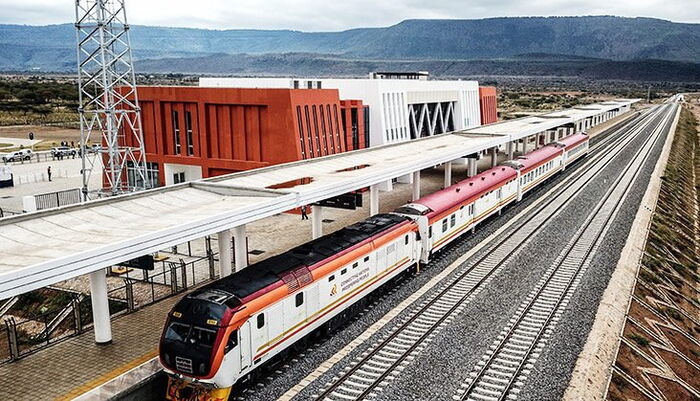
Kenya has officially revived construction of the Naivasha–Kisumu–Malaba Standard Gauge Railway (SGR), a project valued at over Ksh500 billion, marking a major step in the country’s push to strengthen regional trade and transport connectivity.
President William Ruto on Thursday, March 19, 2026 launched the multi-billion-shilling project in Narok County, signaling renewed momentum for a railway expansion that had stalled for more than six years due to funding constraints.
The extension—known as SGR Phase 2B—will link Naivasha to Kisumu and onward to Malaba at the Uganda border, completing a critical section of the Northern Corridor transport network.
The government has appointed China Communications Construction Company as the lead contractor for the project, working alongside Kenya Railways. Meanwhile, the National Land Commission is responsible for land acquisition, compensation of affected property owners, and securing the railway corridor.
A Restart After Years of Uncertainty
The railway project had previously stalled near Naivasha, falling more than 350 kilometres short of its intended endpoint at the Ugandan border. The pause was largely attributed to reduced financing, particularly following a slowdown in infrastructure lending under China’s Belt and Road Initiative.
With the revival now underway, the government is committing over Ksh500 billion to complete the line, reaffirming its strategic importance to Kenya’s long-term infrastructure and trade ambitions.
Two-Phase Expansion Across Key Regions
The project will be developed in two main sections spanning more than 370 kilometres:
Naivasha to Kisumu (264 km) – the longer and more capital-intensive segment
Kisumu to Malaba (107 km) – linking Kenya directly to Uganda
The railway will pass through nine counties, significantly improving connectivity across the Great Rift Valley, Nyanza, and Western Kenya regions.
Construction of the Naivasha–Kisumu section will begin at Emurtoto in Narok County and terminate in Kisumu. A key feature includes an 8.69-kilometre branch line connecting the railway to the proposed new Kisumu Port, aimed at enhancing lake transport and regional logistics.
Stations and Route Design
The Naivasha–Kisumu stretch will include six intermediate stations in Narok, Mulot, Bomet, Sotik, Sondu, and Ahero, along with multiple crossing stations across several counties.
Meanwhile, the Kisumu–Malaba section will feature two main intermediate stations at Yala and Mumias, supported by additional crossing points across western Kenya counties including Siaya, Vihiga, Kakamega, and Busia.
The railway’s design incorporates major engineering works, including:
13 tunnels
23 bridges
376 culverts
These structures are intended to navigate the region’s varied terrain while maintaining efficiency and safety.
Capacity and Performance
Once operational, the SGR extension is expected to significantly enhance both passenger and freight transport:
Passenger trains will carry up to 1,096 people at speeds of 120 km/h
Freight trains will haul up to 4,000 tonnes at speeds of 80 km/h
The line is designed to handle up to 22 million tonnes of cargo annually, reducing pressure on road networks while improving the speed and reliability of goods movement.
Economic and Regional Impact
The government projects that the railway will play a transformative role in boosting trade competitiveness, lowering transport costs, and accelerating the movement of goods and passengers.
By extending modern rail infrastructure to Kisumu and Malaba, the project is expected to strengthen cross-border trade with Uganda and neighbouring countries, while reinforcing Kenya’s position as a regional logistics hub.
It also builds on the existing SGR line connecting Mombasa to Nairobi, completed in 2017, which forms the backbone of the country’s rail transport system.
Completion Timeline
According to Kenya Railways Managing Director Philip Mainga, the Naivasha–Kisumu segment is targeted for completion by June 2027, although the timeline is considered ambitious given the scale of the project and past delays.

Project Factsheet: Naivasha–Kisumu–Malaba SGR Phase 2B
Country: Kenya
Total Investment: Over Ksh500 billion
Total Length: ~371 km
Naivasha–Kisumu: 264 km
Kisumu–Malaba: 107 km
Launch Date: March 2026
Expected Completion: June 2027
Key Locations:
Start: Emurtoto (Narok County)
Major Stops: Kisumu, Malaba
Counties Covered: 9
Stations:
Intermediate: Narok, Mulot, Bomet, Sotik, Sondu, Ahero, Yala, Mumias
Multiple crossing stations across western corridor
Engineering Works:
13 tunnels
23 bridges
376 culverts
Branch Line:
8.69 km link to proposed Kisumu Port
Train Capacity:
Passenger: 1,096 passengers (120 km/h)
Freight: 4,000 tonnes / 216 TEUs (80 km/h)
Annual Freight Capacity: 22 million tonnes
Key Benefits:
Reduced transport costs
Faster cargo and passenger movement
Enhanced regional trade and integration
Improved connectivity to Uganda and beyond
Leave a Reply