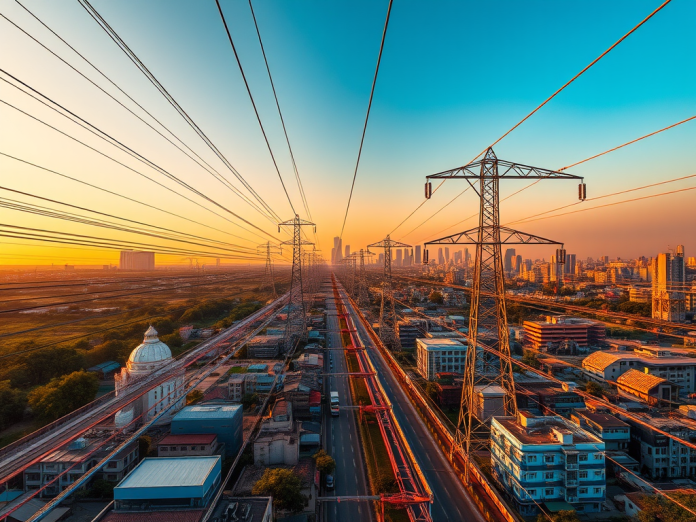
Adani Energy Solutions has obtained long term funding from a consortium of Japanese banks to advance the HVDC Green Power Corridor in Northern India. The investment promotes a high-voltage direct current flagship corridor to provide renewable energy in the region. Notably, the project enhances the power flows between the renewable generation centers in India’s national grid. Consequently, it promotes the increase in clean electricity demand in large urban and industrial areas. Renewable energy projects in India are steadily taking shape as Tata Power Renewable Energy Limited has successfully commissioned a 198 MW group captive wind power project in Karur district, Tamil Nadu.
Outlook on the Project
The HVDC Green Power Corridor in Northern India is configured as a high-capacity ±800 kV HVDC network with an evacuation capacity of 6,000 MW. Furthermore, the 950- kilometer corridor will connect Bhadla in Rajasthan to Fatehpur in Uttar Pradesh. Scheduled for commissioning by 2029, the link is expected to become a critical green transmission artery. It will also enable large-scale renewable integration. Moreover, it will strengthening grid stability for some of India’s most energy-intensive urban and industrial centers. The asset is part of the Adani Group’s integrated clean energy platform. Rajasthan remains a key generation hub for Adani Green Energy Limited (AGEL). Its projects already supply clean power to AESL’s subsidiary, Adani Electricity Mumbai Limited (AEML). AEML currently integrates more than 40% renewable energy into its supply mix. This aspect positions Mumbai among the world’s largest cities with substantial sustainable power penetration.
Project Financing
The financing is led by Japanese banking partners MUFG Bank Ltd. and Sumitomo Mitsui Banking Corporation (SMBC). The move highlights sustained international confidence in India’s renewable infrastructure build-out and in Adani. The project is further supported by advanced HVDC technology from Hitachi, delivered in collaboration with Bharat Heavy Electricals Limited (BHEL). Local sourcing of these products leverages India’s domestic manufacturing ecosystem. Adani Energy noted that “these partnerships reflect Japan’s leadership in critical transmission technologies India’s push to deepen local manufacturing under its Make-in-India push.”
Significance of the HVDC Green Power Corridor in Northern India
Kandarp Patel, CEO of AESL noted that the HDVC Green Power Corridor in Northern India is essential in advancing India’s renewable energy. “This project marks a defining step in building India’s green transmission backbone.” He also noted that the continued support from Japanese partners reflects the depth of the India–Japan partnership. Moreover, he noted it highlights their “shared commitment to enabling a sustainable energy future.” “AESL remains focused on developing resilient, future-ready transmission infrastructure to accelerate India’s energy transition,” he concluded. The financing has been raised under AESL’s sustainable debt framework, aligned with the Equator Principles.
Factsheet: HVDC Green Power Corridor in Northern India
- Project name: HVDC Green Power Corridor (Northern India)
- Country: India
- Developer: Adani Energy Solutions Limited (AESL)
- Adani Group platform: Integrated clean energy and transmission infrastructure
- Project type: High-voltage direct current (HVDC) green transmission corridor
- Technology: +-800 kV HVDC
- Evacuation capacity: 6,000 MW
- Route length: ~950 km
- Route: Bhadla, Rajasthan – Fatehpur, Uttar Pradesh
- Primary function: Evacuation of renewable power from generation hubs to major load centers
- Target commissioning: 2029
Strategic role:
- Strengthens India’s national grid
- Enables large-scale renewable energy integration
- Improves grid stability for urban and industrial demand centers
Financing:
- Long-term funding from a consortium of Japanese banks
- Lead banks: MUFG Bank Ltd. and Sumitomo Mitsui Banking Corporation (SMBC)
- Financing raised under AESL’s sustainable debt framework
- Aligned with the Equator Principles
Technology partners:
- Hitachi (HVDC systems)
- Bharat Heavy Electricals Limited (BHEL) – local manufacturing and delivery
Renewable linkage:
- Rajasthan serves as a major renewable generation hub for Adani Green Energy Limited (AGEL)
- Clean power supplied to Adani Electricity Mumbai Limited (AEML)
- AEML integrates over 40% renewable energy in its supply mix
Strategic significance:
- Anchors India’s green transmission backbone
- Reinforces India-Japan infrastructure and energy partnership
- Supports India’s energy transition and Make-in-India manufacturing push
Leave a Reply