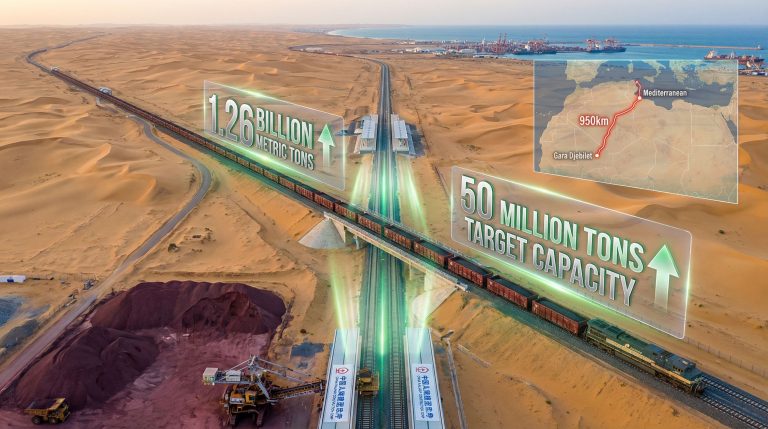
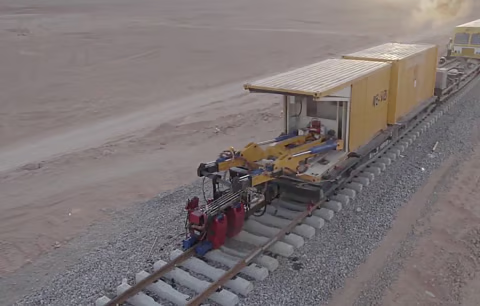
Algerian President Abdelmadjid Tebboune has officially inaugurated a 950-kilometer railway expected to tap the vast Gara Djebilet iron ore deposits in Algeria. The project was done in collaboration with China and will be key to exploiting the iron-ore deposits. Furthermore, the move effectively diversifies the OPEC member’s economy. The step gives the green light for the first shipments of ore from the Gara Djebilet mine in the western desert near the Moroccan border. The development project also sees a ray of hope after being mooted for decades.
Feraal, a subsidiary of Algeria’s state miner Sonarem, and China’s Sinosteel are among companies involved in the broader project. The companies involved in construction of the rail included Algerian state enterprises ANESRIF and COSIDER alongside China Railway Construction Corporation. The mineral reserves at Gara Djebilet represent one of the world’s largest undeveloped iron ore deposits. Conservative estimates suggest 1.26 billion metric tons of recoverable ore. Furthermore, the projections extend to 3.5 billion metric tons of total resource potential with the railway a fundamental part. Last year, Algeria inaugurated Africa’s first heavy-haul railway project in the desert to facilitate transport and other projects.
Scope of Implementation on the Algeria 950-Kilometer Railway Iron Ore Project
The scope of implementation on the 950-kilometer railway iron ore project in Algeria is expected to be completed in phases. The first phase, which was inaugurated, officially commences initial operations with a target annual production of 4 million tons. Focus is made on direct shipping ore grades and also quality optimization and customer development. On the other hand, the second phase, scheduled for between 2028 and 2030 will focus on capacity expansion. It targets about 12 million tons and will facilitate enhanced processing and concentration facilities. It will also ensure pelletisation capabilities development and international market penetration. The third phase, scheduled for post 2030 will see the project’s full development with potential annual production scaled up to 50 million tons. Furthermore, it will ensure integration with regional steel production and advanced processing technologies.
Economic Transformation Timeline
The Algeria 950-Kilometer Railway iron ore project success metrics extend beyond simple production targets. It also encompass broader economic development objectives:
- 2026-2027: Proof of concept and initial market penetration
• 2028-2030: Capacity scaling and operational optimization
• 2031-2035: Full market integration and economic impact assessment
• Post-2035: Potential expansion and replication for other mineral deposits
In addition, the broader implications extend to resource diplomacy, where nations can leverage infrastructure investments to build strategic partnerships and reduce economic dependency on single commodity sectors.
Project Overview
- Project: 950km railroad between Gara Djebilet iron ore mine.
- Country: Algeria
- Status: officially opened.
- Location: western desert – border Moroccan.
Key Stakeholders
- Government: Algerian state
- Mining: Feraal (Sonarem subsidiary), Sinosteel (China).
- Building: ANESRIF, COSIDER, China Railway Construction Corporation.
Resource Base
- Recoverable reserves: Estimated at 1.26 billion metric tons.
- The total resource potential: 3.5 billion metric tons.
- Global significance: It is also one of the largest undeveloped iron ore deposits in the world.
Phased Development Plan
Phase I (Operational)
- Output: 4 million tpa
- Target: Direct shipment, quality control, early markets.
- Phase II (2028-2030)
- Output: 12 million tpa
- Additions: processing, concentration, pelletisation.
- Phase III (Post-2030)
- Output: Up to 50 million tpa
- Also includes merging with local steel production.
Strategic Importance
- Dilutes the Algerian economy that relies on oil.
- Allows initial commercial exports at Gara Djebilet.
- Enhances the Algerian-Chinese industry collaboration
- Places Algeria as a potential iron ore supplier in the
Leave a Reply