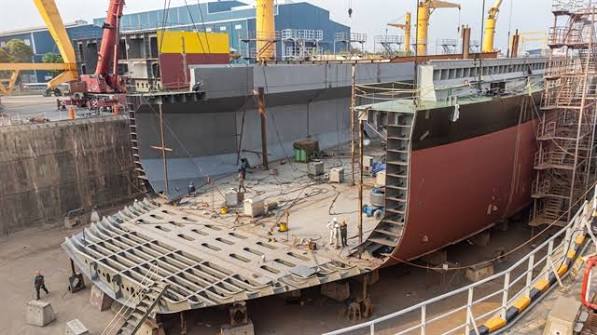
For decades, American shipbuilding was a cautionary tale, defined by shrinking yards, aging workforces, and a widening gap with Asian competitors. Today, that narrative is being tested by a scale of capital and political commitment the industry has not seen in a generation.
Billions of dollars are now flowing into shipyards, suppliers, and workforce programs across the country. The question is no longer whether Washington and private industry are willing to invest in America’s shipyard construction boom. The real test is whether those investments can translate into ships quickly enough to reshape the industry’s future.
Pennsylvania Sets the Pace
Pennsylvania has become one of the clearest examples of the renewed push to expand America’s maritime industrial base.
At the Pennsylvania Defense and Innovation Summit at the U.S. Army War College in Carlisle on July 14, 2026, officials announced nearly $10 billion in defense-related investment, including roughly $4 billion targeted at maritime and shipbuilding expansion. The announcement highlighted the state’s effort to strengthen defense manufacturing capacity and build the workforce needed to support future demand.
Separately, Hanwha Group is moving forward with the active construction and expansion of Hanwha Philly Shipyard through a reported $5 billion infrastructure commitment. The project aims to increase production capacity while introducing advanced shipbuilding methods and manufacturing practices developed in South Korea to a U.S. yard.
The broader industrial ecosystem is also receiving support. JPMorganChase recently announced a $24 million package of loans, investments, and grants aimed at expanding Philadelphia’s shipbuilding workforce, supplier network, and maritime infrastructure, including support for Rhoads Industries’ new submarine manufacturing and assembly facility at the Philadelphia Navy Yard.
The message is clear: shipbuilding capacity depends on more than new yards. It requires skilled workers, reliable suppliers, and the industrial systems needed to sustain production. Capacity without trained labor and a functioning supply chain is just steel and concrete.
A Coast-to-Coast Industrial Push
Pennsylvania is not acting alone. It is simply the most visible example of a broader transformation unfolding across the country.
On July 17, 2026, Saronic unveiled Port Alpha, a $3 billion autonomous-vessel shipyard in Brownsville, Texas, spanning 835 acres with room to expand to 4,400. In Muscle Shoals, Alabama, the Navy-backed “Factory of the Future” combines nearly $900 million in federal investment with roughly $1.5 billion in private capital. Saronic is also investing $300 million to expand its Franklin, Louisiana, facility to produce autonomous vessels, while TOTE Services recently secured a $2.2 billion contract to oversee construction of up to eight Medium Landing Ships across shipyards in Wisconsin, Louisiana, and Florida.
Another major development on July 17, 2026 underscored that rebuilding American shipbuilding will require more than individual facilities. HD Hyundai and Kiewit Offshore Services announced a strategic partnership to pursue U.S. shipbuilding opportunities, combining HD Hyundai’s global shipbuilding expertise with Kiewit’s fabrication and engineering capabilities. The companies will explore collaboration on areas including ship modules, fabrication, and advanced manufacturing methods aimed at expanding domestic production capacity.
What ties these efforts together is not geography but a shared bet on modular manufacturing, automation, and software-defined systems that can serve commercial and defense demand simultaneously. The investments stretch well beyond individual shipyards, encompassing supply chains, workforce pipelines, and the industrial infrastructure needed to sustain higher levels of production.
The strategic stakes are reflected in the Navy’s own plans. Its May 2026 shipbuilding blueprint outlines a path toward a fleet of roughly 450 vessels by fiscal year 2031, treating industrial capacity—not procurement funding—as the central constraint. The Navy has also committed $6.2 billion to strengthen the submarine industrial base, seeking to close the gap between its target of producing two Virginia-class submarines each year and the roughly 1.1 to 1.3 boats currently delivered.
The Real Test Is Execution
The administration’s goal of increasing distributed shipbuilding work from roughly 10 percent to 50 percent of total output amounts to a wager that capital investment, automation, and modular production can compensate for decades of industrial decline and lost expertise.
That is an enormous ask. Industry estimates suggest roughly 250,000 skilled workers will need to be recruited and trained over the next decade if those ambitions are to become reality.
That gap is the difference between announcement and delivery. Carlisle’s summit, Port Alpha’s launch, and the TOTE Services contract represent capital committed and intent declared. They do not yet represent ships in the water.
The industry has heard promises of a shipbuilding renaissance before, often followed by cost overruns, schedule delays, and supply chains unable to expand as quickly as policymakers had hoped. What makes the current moment different is the convergence of forces behind it: federal procurement, state-level industrial policy, and private investment are moving in the same direction at the same time rather than compensating for one another’s shortcomings.
If Pennsylvania’s shipyards, Texas’s autonomous manufacturing hubs, and the Navy’s submarine investments meet their targets on roughly the same timeline, the United States could regain something it has lacked for decades: shipbuilding capacity designed to support both commercial shipping and an increasingly demanding strategic environment.
If they fall short, the country risks adding another chapter to the same story of industrial stagnation—only this time with larger budgets attached.
The next 18 to 24 months of hiring, construction, and contract fulfillment will provide the answer. Investment announcements have created expectations, but execution will determine whether America is witnessing a genuine shipbuilding revival or merely repeating an old cycle with bigger numbers.

Leave a Reply