Argentina’s government has reached an agreement with state energy company ENARSA to resume construction of the Santa Cruz hydroelectric dam complex in the country’s deep south, ending years of stalled works, unresolved contractor disputes, and political uncertainty. Economy Minister Luis Caputo confirmed the restart, characterising the agreement as part of a broader effort to normalise Argentina’s energy sector. Completing both dams will require an estimated additional investment of $5 billion.
A Project Reborn: The Scope and Status of the Santa Cruz Complex
The Santa Cruz dam complex comprises two hydroelectric structures situated on the Santa Cruz River in the Patagonian south of Argentina — the Jorge Cepernic Dam and the Néstor Kirchner Dam. Together, when operational, the two dams are expected to generate significant renewable power for Argentina’s national grid, with the smaller Cepernic structure alone projected to contribute 1,860 GWh annually once commissioned.
Project Fact Sheet: Santa Cruz Hydroelectric Dam Complex
Project Name: Santa Cruz Hydroelectric Dam Complex (Jorge Cepernic Dam + Néstor Kirchner Dam)
Location: Santa Cruz River, Patagonia, southern Argentina
Operator/Client: ENARSA (Empresa Argentina de Energía S.A.) — Argentine state energy company
Original Tender: 2013 (under President Cristina Fernández de Kirchner)
Construction Commenced: 2017
Project Stalled: 2016–2026 (contract disputes, unresolved price redeterminations)
Contractor Claims (accumulated): Over $700 million
Total Spent to Date: ~$1.8 billion
Additional Investment Required: ~$5 billion
Priority Structure: Jorge Cepernic Dam (46% complete)
Expected Contribution (Cepernic): 1,860 GWh/year to national grid
Target Completion (Cepernic): 2030
Original Completion Target (both dams): 2023
Project Team: Santa Cruz Hydroelectric Dam Complex
Client/Owner: Government of Argentina / ENARSA
Economy Minister: Luis Caputo (confirmed restart, March 2026)
Head of State: President Javier Milei
Original Construction Consortium: China Gezhouba Corporation & Electroingeniería (Argentine group)
Original Financing Structure: Chinese state-backed bilateral financing (2013–2017 arrangement)
Regulatory/Oversight Framework: Argentine Economy Ministry; ENARSA
Contractors for Resumed Works: To be confirmed under new agreement
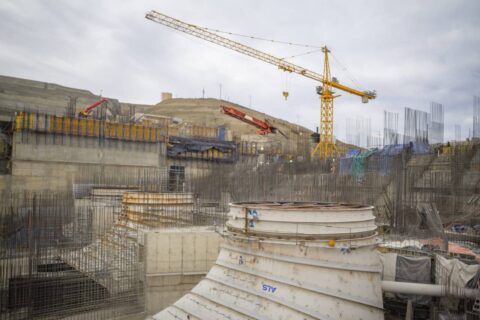
The government has identified the Jorge Cepernic Dam as the immediate priority for resumed construction, given that it is currently 46% complete — the more advanced of the two structures. Under the timetable outlined by the Milei administration, Cepernic is expected to be fully operational by 2030, subject to construction progress and further regulatory steps. The Néstor Kirchner Dam, the larger of the pair, will follow as works ramp up across the broader complex. Approximately $1.8 billion has been spent on both dams to date since construction first commenced, making the additional $5 billion requirement a substantial but necessary commitment to protect the sunk investment already made and bring the project to a generating state.
From Kirchner to Milei: A Decade of Delay and the Agreement That Ends It
The Santa Cruz dam complex has one of the most politically turbulent histories of any infrastructure project in South America. The project was first tendered in 2013 under President Cristina Fernández de Kirchner, with construction contracts awarded to a consortium of China Gezhouba Corporation and Argentine construction group Electroingeniería. Financing was structured around Chinese state-backed capital as part of a broader bilateral agreement between Argentina and China.
Construction officially commenced in 2017 under President Mauricio Macri’s administration, but the project stalled in 2016 when the original contract lapsed and price redeterminations — adjustments to contract values to account for inflation and cost changes over time — were never completed. The impasse compounded over subsequent years, with the contractor consortium accumulating claims against the Argentine state exceeding $700 million. The dams were originally due for completion in 2023; instead, they became an emblem of the dysfunction that has historically plagued large Argentine infrastructure projects. The agreement announced by Economy Minister Caputo, who confirmed it via the platform X, marks the formal resolution of those longstanding disputes — clearing the legal and commercial obstacles that had kept construction dormant and enabling ENARSA to mobilise works once again.
Energy Security, Patagonian Power, and What the Dams Mean for Argentina
Argentina faces persistent structural challenges in its electricity sector: ageing generation infrastructure, chronic underinvestment, and an increasingly stressed national grid that struggles to meet demand during peak periods, particularly in summer. The Santa Cruz complex, positioned in the water-rich Patagonian region, represents one of the most significant untapped domestic hydroelectric resources available to the country. Renewable hydropower of this scale would reduce Argentina’s dependence on expensive imported gas and fuel oil for electricity generation, with direct implications for the trade balance and fiscal position.
Under President Milei’s libertarian economic programme, which has prioritised fiscal adjustment and the normalisation of contracts and market relationships across the economy, the Santa Cruz restart signals a pragmatic recognition that completing existing large-scale infrastructure is economically necessary even where it conflicts with ideological preferences for reduced state involvement. The involvement of ENARSA, the state energy company, as the counterparty to the new agreement reflects the practical reality that private capital alone is unlikely to assume the risk of completing a project with such a fraught contractual history without substantial state backing. Minister Caputo’s public endorsement on social media was a deliberate signal to markets and trading partners that Argentina is serious about stabilising its energy commitments.
Patagonia’s Dams and the Wider Latin American Hydro Landscape
The Santa Cruz restart places Argentina back in a regional conversation about large-scale hydroelectric development that has been reshaping Latin America’s energy mix for over a decade. Brazil has long dominated the continent’s hydro landscape, with projects like the Belo Monte Dam (11.2 GW installed capacity) defining the scale of ambition possible in the region. Chile’s recent hydropower investments in its own Patagonian rivers, however, provide a more immediately comparable reference point for Argentina — both countries share a similar geography of glacially fed rivers with high flow rates and low upstream development, making them naturally productive hydropower environments.
Argentina is also increasingly attracting international capital for broader water infrastructure, as demonstrated by a $100 million joint water canal project between Santa Fe and Córdoba financed through a soft loan from the Saudi Fund for Development — the fund’s first foray into South America — signalling growing multilateral confidence in Argentina’s infrastructure pipeline beyond the energy sector alone.
The Chinese financial and construction involvement at Santa Cruz also reflects a broader Belt and Road Infrastructure pattern across Latin America, where China Gezhouba, PowerChina, and other state-backed construction groups have taken leading roles in financing and building large energy assets from Ecuador to Bolivia to Argentina. The resolution of the contractor dispute and the restart of works under a new agreement will be watched closely across the region as a test case for how Chinese-financed infrastructure projects can navigate changes of government, economic crises, and extended contractual disputes in politically volatile markets — an increasingly common challenge in developing-world infrastructure development. For Argentina, the stakes are more immediate: two dams that were supposed to generate power three years ago are finally, after a decade of effort, moving toward the finish line.
Leave a Reply