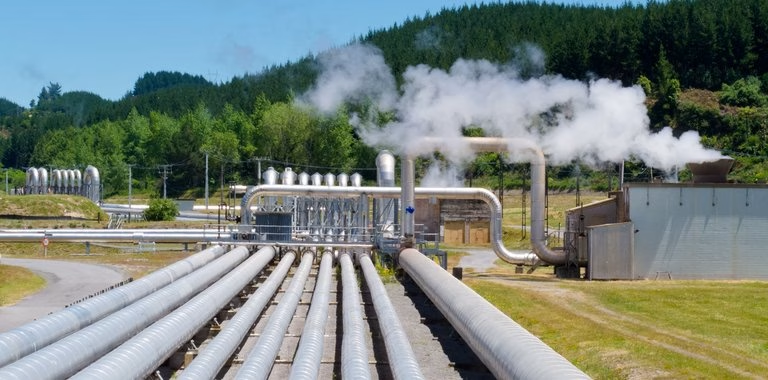
On March 9, 2026, the Hell’s Kitchen project reached a critical financial milestone when its developer, Controlled Thermal Resources (CTR), announced a definitive agreement to go public on the Nasdaq. This was achieved through a merger with Plum Acquisition Corp. IV, valuing the combined company at approximately $4.7 billion. This move transitions the project from a privately funded venture to a publicly traded entity (set to trade under the ticker CTRH), providing the transparent corporate structure needed to manage such a massive industrial undertaking.
The Hell’s Kitchen Power and Lithium Project is designed for a massive total capacity of approximately 1,100 MW of carbon-free geothermal power and up to 300,000 tonnes of battery-grade lithium carbonate per year at full buildout. Developed in stages to meet the surging electricity demands of AI data centers and the electric vehicle supply chain, the project’s initial phase targets 50 MW of power and 25,000 tonnes of lithium. This multi-billion dollar “Lithium Valley” initiative, supported by technology from Baker Hughes, represents one of the world’s largest integrated renewable energy and critical mineral developments.
By utilizing a closed-loop system, the facility integrates geothermal power and lithium extraction into a single process, using the same superheated brine to generate 24/7 electricity before recovering battery-grade minerals on-site.
Impact of the Funding
This announcement directly supports the project by securing an estimated $300 million in fresh capital specifically earmarked to accelerate Stage 1 construction. These funds are vital for moving beyond the testing and permitting phases into full-scale building of the 50 MW power plant and the lithium carbonate production facility. By providing the “dry powder” necessary to finalize drilling and infrastructure, the merger ensures that the project can meet its long-term delivery commitments to major partners like General Motors and Stellantis.
Strategic Validation
Furthermore, going public at this stage provides the “Lithium Valley” vision with significant institutional backing. It validates the commercial viability of integrating Baker Hughes’ advanced geothermal technology with direct lithium extraction. With $185 million already spent on long-lead equipment and federal FAST-41 status in place, this recent infusion of capital acts as the final green light to begin the heavy construction required to turn the Salton Sea into a global hub for clean energy and battery materials.
Project Definition & Core Mission
The Hell’s Kitchen Power and Lithium Project represents a massive shift in renewable energy, combining geothermal power generation with direct lithium extraction at California’s Salton Sea. As a designated FAST-41 federal priority project, it is designed to deliver reliable, 24/7 baseload electricity while producing battery-grade lithium for the North American electric vehicle market. Key global technology partners, including Baker Hughes, provide the specialized high-temperature drilling systems and power generation equipment necessary to harness the region’s intense geothermal brine.
Current Construction Status
Current development is focused on the Stage 1 phase, which aims to establish an initial 50 MW of clean power and a significant annual yield of lithium carbonate. This milestone is the first step in a multi-stage expansion plan intended to scale the facility into one of the world’s largest integrated green energy hubs. Major off-take agreements with global automakers like General Motors and Stellantis underscore the project’s strategic importance to the domestic battery supply chain and California’s broader transition to a carbon-free grid.
Baker Hughes on board
In September 2025, US-based Baker Hughes officially joined the development of the Hell’s Kitchen Power and Lithium Project in California’s Salton Sea as a primary technology and industrial partner. Collaborating with Controlled Thermal Resources (CTR), Baker Hughes is providing the specialized high-temperature drilling systems and Organic Rankine Cycle (ORC) power plants required to harness the region’s intense geothermal brine.
While CTR has spent over a decade developing the site, Baker Hughes’ involvement is most critical for the project’s massive 500 MW Phase 2 expansion, a scale that positions Hell’s Kitchen as one of the world’s largest single geothermal power developments. By integrating this industrial expertise, the companies aim to market 24/7 baseload electricity to the surging AI and hyperscale data center market, fulfilling a critical need for reliable, carbon-free energy in the U.S. power grid.
Dubbed it’s “Hell’s Kitchen” the company has worked on the project for 13 years in California’s Salton Sea region. The firm noted that Baker Hughes will partner in the project’s second phase, which involves producing 500 MW. The amount will be enough to power approximately 375,000 homes with the possibility of expansion. Baker Hughes has been involved in various geothermal projects over the years, such as the 300 MW geothermal power project at Cape Station in Utah.
Recently, Fervo Energy closed $421 million in non-recourse debt financing for the first phase of its flagship Cape Station project, underscoring the accelerating push to expand reliable energy supply across the United States. As electricity demand surges—driven by rapid data center growth, AI workloads, industrial expansion, and widespread electrification—the need for stable, around-the-clock power sources has become increasingly urgent. Projects like Cape Station highlight how next-generation geothermal can help fill this gap by delivering consistent, carbon-free energy that complements intermittent renewables and strengthens grid resilience.
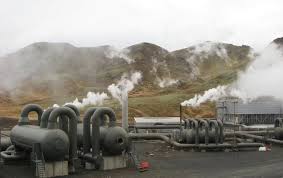
Hell’s Kitchen Power & Lithium Project Factsheet
Location: Salton Sea (Imperial Valley), California, USA
Developer: Controlled Thermal Resources (CTR)
Total Capacity:
1,100 MW Geothermal Power
300,000 tonnes Lithium Carbonate per year
Stage 1 Goals:
50 MW Power
25,000 tonnes Lithium per year
Status: Active construction; designated FAST-41 federal priority project
Major Milestone: March 9, 2026 – Definitive agreement for $4.7B Nasdaq merger (Ticker: CTRH)
Technology Partner: Baker Hughes (providing high-temp drilling and 500 MW Phase 2 power systems)
Core Design: Single closed-loop system integrating 24/7 geothermal power and direct lithium extraction
Off-take Partners: General Motors (GM), Stellantis
Target Markets: North American EV supply chain and AI/Hyperscale data centers (via American Data Power)
Challenges:
Geothermal electricity today supplies less than 0.5% of U.S. electricity.
High upfront capital costs present financing hurdles for large-scale production.
Requires trade-offs between supplying energy and mining necessary minerals like lithium.
The Scope of Implementation the Baker Hughes Geothermal Project
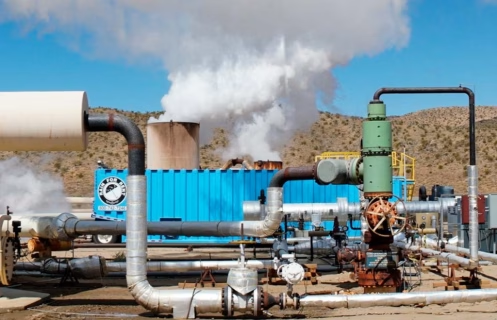
The implementation on the Baker Hughes geothermal project will entail aspects such as using high-temperature drilling technologies. Moreover, it will include power systems and services historically used for oil and gas field production. Through these measures, the project will be streamlined and reduce costs while helping raise capital for the project. Geothermal energy comprises less than 0.5% of the electricity supply in the United States. One of the reasons for this is partially due to high upfront costs. However, geothermal producers have been starting to find new customers in Big Tech that need vast amounts of electricity.
The boom of AI expansion and data centers has played a major role in this energy surge, as tech companies embrace artificial intelligence. Meta said earlier this year that it had signed power purchase agreements for geothermal in New Mexico. On the other hand, Google reached a deal last year for geothermal power in Nevada. These companies have turned to renewable energy sources to power centers, with Google even signing a $3 billion hydropower deal, the largest clean energy agreement of its kind.
Future Outlook
Looking ahead, the project continues to evolve to meet the surging power demands of the digital economy by focusing on AI and hyperscale data centers. It delivers a “behind-the-meter” solution for 24/7 renewable energy, enabling it to support the massive infrastructure needs of next-generation computing. As construction and drilling progress, the facility anchors the “Lithium Valley” vision and aims to prove that industrial-scale mining and clean energy production can coexist sustainably.
Leave a Reply