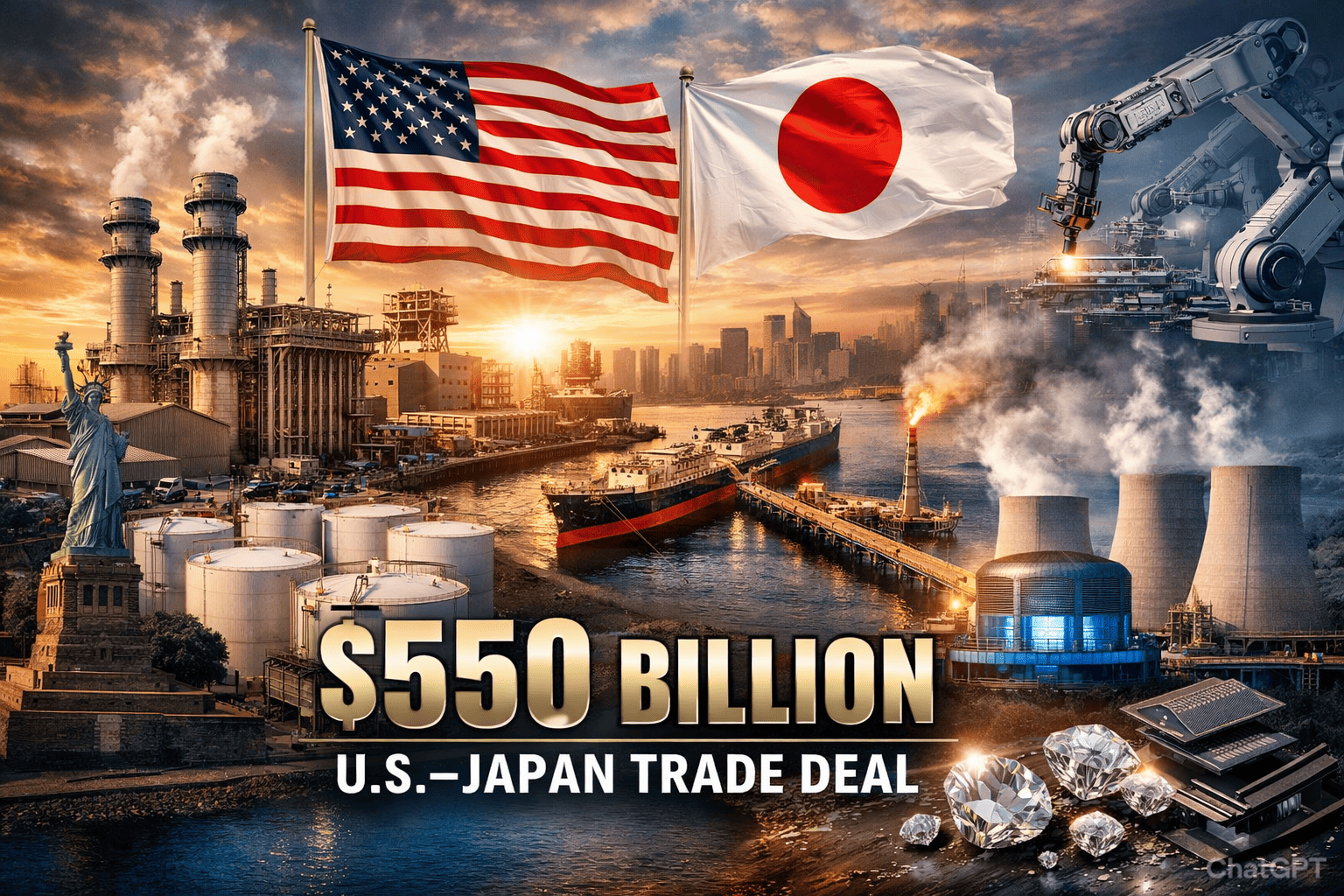
When Washington and Tokyo formalized their latest trade and strategic investment framework in 2025, much of the early attention centered on tariff adjustments and diplomatic choreography. But the real substance of the agreement is now visible in steel, turbines and export berths.
Under the framework, Japan committed up to $550 billion in U.S.-based investment. The first tranche — $36 billion announced in mid-February 2026 — demonstrates that this is not a symbolic pledge. It is a targeted capital deployment strategy centered on energy, export capacity and advanced industrial manufacturing.
According to a fact sheet released by the U.S. Department of Commerce, the initial projects include:
A $33 billion natural gas power facility in Portsmouth, Ohio, designed for approximately 9.2 GW of capacity and described as one of the largest gas-fired power investments ever proposed in the United States. The project is being advanced by SB Energy, a subsidiary of Japan’s SoftBank Group.
A $2.1 billion deepwater crude oil export terminal in Texas, known as the Texas GulfLink project, to be operated by Sentinel Midstream. The offshore facility is intended to expand U.S. very large crude carrier (VLCC) export capacity from the Gulf Coast.
A $600 million synthetic industrial diamond manufacturing plant in Georgia, led by Element Six, a subsidiary of De Beers Group. The facility will produce diamond grit and advanced materials critical for semiconductors, precision tooling and high-performance industrial applications.
Japanese government statements from the Ministry of Economy, Trade and Industry and the Ministry of Foreign Affairs of Japan frame these investments as part of a broader “strategic investment initiative” focused on economic security, supply chain resilience and allied industrial alignment.
The pattern is not accidental.
Energy as the Foundation
The Ohio gas plant alone anchors the first tranche around dispatchable generation. Paired with expanded crude export infrastructure in Texas, the initial investments reveal a clear priority: energy reliability and export strength form the base of the bilateral strategy.
For years, trade agreements emphasized goods flows and tariff balances. This framework leans heavily into infrastructure — particularly assets that underpin power supply, petrochemical production, and advanced manufacturing.
That emphasis reflects a broader recognition in Washington and Tokyo: digital economies and AI ambitions cannot scale without firm, large-scale power capacity. Manufacturing reshoring requires stable grid supply. Export leverage requires physical terminals.
In short, this deal is built on megawatts and maritime capacity.
The Second Round: Nuclear and Strategic Expansion
The agreement does not stop at the first $36 billion.
As of February 20, 2026, officials in both countries indicated that a second round of investments is under discussion, with advanced nuclear power generation emerging as a potential candidate. Reports suggest that next-generation reactor construction — potentially small modular reactor (SMR) technology or advanced large-scale units — is being evaluated as part of the next phase.
If nuclear projects are formally included, the investment framework would expand beyond gas and oil infrastructure into long-term baseload capacity aligned with decarbonization goals and energy security objectives.
That would deepen the strategic architecture of the deal.
It would also reinforce a critical reality: while political rhetoric around energy can fluctuate, allied governments are quietly prioritizing durable, large-scale generation assets capable of sustaining industrial expansion.
Trade Deal or Industrial Policy Instrument?
Although formally presented as a trade agreement, the structure increasingly resembles a bilateral industrial capital corridor.
Tariff adjustments created diplomatic space. But the substance lies in where the money is flowing: generation capacity, export infrastructure, and advanced material production.
The Georgia synthetic diamond facility, for example, is not a traditional trade headline. Yet its output is essential for semiconductor fabrication and precision industrial tooling — sectors central to economic security.
This suggests that the deal is less about short-term trade balance correction and more about long-term industrial alignment between two advanced economies.
In that sense, the $550 billion headline figure may be less important than the sectoral concentration.
The Execution Risk
Ambition, however, is not execution.
Mega-projects of this scale face structural constraints in the United States:
Extended permitting timelines at federal and state levels
Transmission and interconnection bottlenecks
Skilled labor shortages
Inflationary pressure on construction inputs
Community-level political friction
If these obstacles slow even the first tranche, investor confidence in later rounds could weaken.
To ensure the agreement translates into tangible infrastructure gains, several priorities stand out:
- Regulatory Predictability
Federal and state agencies must coordinate to create predictable permitting pathways for energy and export infrastructure.
- Grid Modernization
Generation expansion without transmission upgrades risks stranded capacity. Parallel investment in grid infrastructure is essential.
- Workforce Scaling
States benefiting from the projects — particularly Ohio, Texas and Georgia — must accelerate technical training and apprenticeship pipelines.
- Transparent Capital Tracking
Announced commitments should be matched with milestone reporting mechanisms to maintain credibility across future investment rounds.
A Strategic Inflection Point
What distinguishes this U.S.–Japan framework is not merely its size, but its orientation.
Rather than dispersing capital broadly, the initial tranche concentrates on foundational infrastructure — power plants, export terminals, industrial materials manufacturing. The second-round nuclear discussions reinforce that pattern.
The agreement signals a recalibration in how allied economies think about competitiveness. Before AI clusters, before advanced fabrication plants, before reshoring accelerates — the physical backbone must be secured.
Energy. Materials. Export capacity.
Whether the full $550 billion commitment ultimately materializes will depend on disciplined implementation, regulatory coordination and sustained political support on both sides of the Pacific.
The signing of the agreement may have been diplomatic.
Its success will be infrastructural.
Leave a Reply