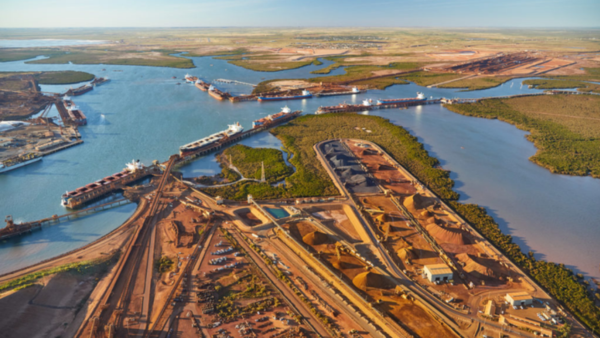
BHP has commenced construction of a sixth car dumper at its Nelson Point iron ore port facility in Port Hedland, Western Australia, marking the formal start of works on the $1.4 billion (approximately US$900 million) Port Debottlenecking Project 2 (PDP2) — one of the largest port infrastructure investments in the company’s history. The project, sanctioned in September 2025 and with construction commencing in December 2025, will install a new sixth car dumper unit (CD6) together with additional conveyors and supporting infrastructure designed to sustain BHP’s Western Australian Iron Ore (WAIO) business at its medium-term production target of 305 million tonnes per annum. First ore handling from CD6 is expected by late 2028, with the project also providing critical resilience headroom ahead of a planned programme of major car dumper renewal works beginning in the 2028–29 financial year.
What a Car Dumper Does — and Why CD6 Changes the Equation
Port Hedland is the world’s largest bulk export port by tonnage, and BHP’s Nelson Point and Finucane Island terminals within it together form the single most important link in the supply chain that connects the Pilbara’s iron ore mines to global steel mills. At the heart of those terminals are the car dumpers — massive rotating structures that grip fully loaded iron ore rail cars, tilt them through approximately 160 degrees, and pour the contents into receiving hoppers at rates that make every other form of unloading look trivial. Each BHP car dumper processes two 135-tonne rail cars simultaneously, discharging up to 16,000 tonnes of Pilbara iron ore per hour. From the hoppers, ore travels via approximately five kilometres of conveyor systems to stockpiles or directly to ship loading facilities for export.
Project Fact Sheet: BHP Port Debottlenecking Project 2 (PDP2) — Car Dumper 6
Project Name: Port Debottlenecking Project 2 (PDP2) — Car Dumper 6 (CD6)
Location: Nelson Point, Port Hedland, Western Australia, Australia
Project Owner: BHP Western Australian Iron Ore (WAIO)
Total Investment: A$1.4 billion (~US$900 million)
Key Infrastructure: Sixth car dumper (CD6) + additional conveyors and supporting port infrastructure
Car Dumper Throughput: Up to 16,000 tonnes per hour (two 135-tonne rail cars simultaneously)
Project Sanctioned: September 2025
Construction Start: December 2025
First Ore from CD6: Late 2028 (FY2028)
Car Dumper Availability Improvement: ≥5 car dumpers available >60% of time → >90% of time
Production Target Supported: 305 million tonnes per annum (Mtpa) — WAIO medium-term target
FY2029 Significance: CD6 provides headroom for planned major car dumper renewal programme beginning FY2029
Predecessor Project: Port Debottlenecking Project 1 (PDP1) — now complete
Procurement Commitment: Contracts prioritised for Indigenous/Traditional Owner businesses and local Port Hedland suppliers
Project Team: BHP PDP2 / Car Dumper 6
Project Owner: BHP Western Australian Iron Ore (WAIO)
WAIO Asset President: Tim Day
Key Contractor: Monadelphous Group (ASX: MND) — A$175 million contract for civil, structural, mechanical, piping, electrical works (Finucane Island car dumper planned shutdown component)
Monadelphous Managing Director: Zoran Bebic
Previous Contractor (CD3 rebuild): Monadelphous / Tadano CC88 crane (1,600-tonne capacity)
Previous PDP contractor: CPB Contractors (PDP1 Nelson Point Debottlenecking Works)
Traditional Country: Kariyarra Country, Port Hedland, Western Australia
Regulator / Port Authority: Pilbara Ports Authority (Port Hedland)
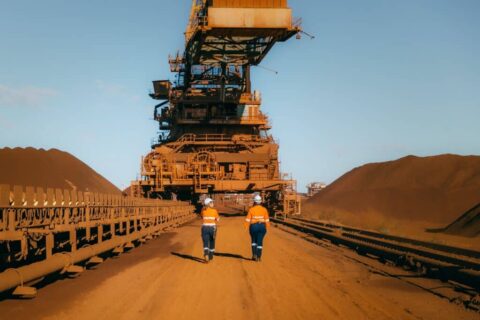
BHP currently operates five car dumpers spread across Nelson Point and Finucane Island. The challenge those five machines create is not a capacity ceiling in theory — it is availability in practice. When any single car dumper goes offline for planned maintenance or unplanned repair, the remaining four must absorb its workload or production throughput falls. Under BHP’s current five-dumper configuration, the port can run with at least five car dumpers operational for only around 60 per cent of the time. CD6 fundamentally resets that equation: with a sixth car dumper on the system, the port will be able to operate with at least five car dumpers available more than 90 per cent of the time — lifting the benchmark by 30 percentage points and creating a structural buffer that allows major maintenance on individual machines without compromising throughput. PDP2 will also enhance ore blending and screening capabilities at the port, improving the consistency of the product shipped to customers.
The Team Delivering PDP2 and the Broader Investment Context
BHP’s Western Australian Iron Ore (WAIO) Asset President Tim Day is the executive driving force behind PDP2, having announced the project at the 2025 Hedland Economic Forum and committed more than $1 billion in new Port Hedland investment in the same presentation. Day has framed PDP2 as both an operational necessity — providing the supply chain resilience needed to sustain 305 Mtpa through a period of major car dumper renewals — and as an economic catalyst for the Port Hedland community. BHP has committed to prioritising contract awards to Indigenous and Traditional Owner businesses as well as local Port Hedland suppliers over the project’s three-year construction period, a commitment consistent with the company’s broader Reconciliation Action Plan and the cultural and economic importance of Port Hedland to the Kariyarra people on whose country the port sits. That emphasis on Indigenous partnership agreements in Western Australian mining mirrors practices being adopted across the state’s broader project pipeline, including the Bellevue Gold Project in the Sir Samuel region — an underground gold mine that secured a native title agreement with the Tjiwarl RNTCB as a foundational step in its development, reflecting the deepening integration of Traditional Owner engagement into the commercial and regulatory structure of major Western Australian mining projects.
The contractor ecosystem for PDP2 is anchored by Monadelphous Group (ASX: MND), which secured a $175 million construction contract from BHP in January 2026 for civil, structural, mechanical, piping, and electrical works associated with major equipment replacement during a planned shutdown at the Finucane Island car dumper facility — a contract that forms part of the wider PDP2 programme. Monadelphous Managing Director Zoran Bebic confirmed the award reflects the company’s deep track record in car dumper delivery for BHP, noting the successful completion of the Car Dumper 3 (CD3) project at Nelson Point in 2025. That CD3 rebuild — a major renewal that extended the unit’s operational life by another decade — was itself delivered through Monadelphous using one of the Southern Hemisphere’s most powerful cranes, the 1,600-tonne Tadano CC88, and the lessons learned from it are directly informing PDP2’s execution strategy.
Nelson Point, Finucane Island, and the Pilbara’s Port Infrastructure History
The decision to site CD6 at Nelson Point rather than Finucane Island reflects the broader strategic logic of PDP2 within BHP’s port master plan. Nelson Point has been BHP’s primary iron ore export terminal since the early years of the Pilbara’s development, and Nelson Point’s three existing car dumpers (CD1, CD2, and CD3) form the backbone of BHP’s inner harbour operations. Finucane Island, developed in stages from the early 2000s, added two further car dumpers and significantly expanded port capacity, enabling the blending of ores from multiple Pilbara mines. CD6 at Nelson Point completes the symmetry of the two-terminal system and provides the redundancy architecture that BHP’s production planners have been targeting as the company plans for a decade-long wave of major renewals beginning FY2029.
PDP2 follows the recently completed Port Debottlenecking Project 1 (PDP1), which delivered targeted improvements to car dumper performance and ship loader throughput without adding new major equipment. PDP1’s lessons — particularly around contractor sequencing, brownfield civil works in an active port environment, and the critical importance of shutdown planning — have been incorporated into PDP2’s execution framework. The scale of PDP2 relative to PDP1 is considerably larger: at $1.4 billion, it represents one of BHP’s most capital-intensive single port investments, and it sits within a broader Pilbara infrastructure investment programme that includes ongoing maintenance capital across BHP’s 1,000+ kilometre rail network, mine site expansions at South Flank and other Pilbara assets, and the longer-term planning work associated with the company’s Pilbara Energy Connect decarbonisation initiative.
Port Hedland, Iron Ore, and BHP’s Role in the Global Steel Supply Chain
Port Hedland’s position in the global commodities economy is without direct parallel. It is the exit point for approximately 550–600 million tonnes of iron ore annually from the Pilbara region, handling product from BHP, Fortescue, Roy Hill, and Mineral Resources. BHP alone exports roughly 270–285 million tonnes per year through its Nelson Point and Finucane Island terminals — a volume that accounts for approximately 17 per cent of total global seaborne iron ore trade, making the company’s Port Hedland operations a systemic node in the supply chains of Chinese, Japanese, South Korean, and European steel mills. Any disruption to car dumper availability at Nelson Point or Finucane Island has immediate downstream consequences for global steel production and iron ore pricing — a reality that gives PDP2 strategic significance well beyond its dollar value.
The broader global context for PDP2 is a world in which iron ore demand from China — the destination for approximately 70 per cent of BHP’s Pilbara exports — is undergoing a structural transition driven by the maturation of Chinese urbanisation, the growth of electric arc furnace steelmaking using scrap, and the country’s stated steel production caps. Against that backdrop, BHP’s commitment to sustaining 305 Mtpa output capacity and investing $1.4 billion in port resilience is a deliberate statement of confidence in the long-run demand case for Pilbara iron ore, grounded in the company’s assessment that high-grade, low-impurity ore from the Pilbara will retain a premium position in the global steel mix as the industry decarbonises. CD6’s commissioning in late 2028 will provide BHP with the operational platform to defend that position through the decade that follows.
Leave a Reply