
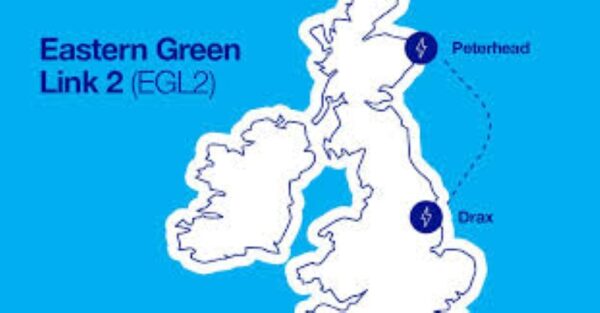
Eastern Green Link 2 (EGL2) project is one of the most ambitious electricity transmission developments in the United Kingdom. It is under construction since September 2024 following regulatory approval by Ofgem in August the same year, with commissioning expected in 2029. Developed as a joint venture between SSEN Transmission and National Grid Electricity Transmission, the £4.3 billion project will deliver a 2 GW high-voltage direct current (HVDC) subsea “electricity superhighway” linking Peterhead in Scotland to Drax Power Station in England.
EGL2 spans over 500 km of subsea and underground cable. It is designed to transmit enough renewable electricity to power around two million homes. This will significantly reduce grid constraints and enable the large-scale integration of offshore wind and other renewable resources from northern Scotland into high-demand regions in England. With construction activities now underway across both onshore and offshore segments, the project is widely regarded as a cornerstone of the UK’s energy transition and grid modernization plan.
Project Partners and Stakeholders Behind Eastern Green Link 2
Developers and Transmission Owners
- SSEN Transmission
- National Grid Electricity Transmission
Main EPC and Technology Contractors
- Hitachi Energy – HVDC converter stations (Peterhead & Drax)
- BAM Nuttall – major civil works & converter station construction
- Prysmian Group – subsea and underground HVDC cable systems
- Balfour Beatty – supporting civil and cable installation works
Financiers
- Swedish Export Credit Corporation – major loan facility (€800 million)
Regulators
- Ofgem – project approval under ASTI framework
What Makes EGL2 Stand Out?
- It is arguably the UK’s largest single electricity transmission investment.
- It directly addresses renewable curtailment (constraint costs). This is a major issue in UK wind.
- It enables north-to-south energy balancing, which is critical as offshore wind scales.
- It forms part of a broader “electricity superhighway” network (Eastern Green Link 1 to Eastern Green Link 4) reshaping Britain’s grid.
Construction Underway at Eastern Green Link 2: The Longest Subsea HVDC Cable Project in the UK
Reported September 27, 2024 – UK based utilities, National Grid and SSEN Transmission have started work on the new Eastern Green Link 2 (EGL2), 2GW subsea electricity interconnector between Scotland and Yorkshire.
The EGL2 is a subject subsea electricity link intended to improve renewable power connection between the Scottish and England territories. When fully constructed it will be the longest high-voltage direct current (HVDC) link in the United Kingdom about 436 km in length from Peterhead in Scotland to Fraisthorpe Sands in Yorkshire. A two-part project is a single project proposed by Scottish and Southern Electricity Networks (SSEN) Transmission and National Grid Electricity Transmission (NGET), which would cost £4.3 billion.
Why is Eastern Green Link 2 Important to the UK Grid?
This project is to deliver 5600MW of renewable electricity, enough to provide power to more than two million homes. EGL is part of the UK’s plan to reach its net-zero carbon goals by increasing the capability to transport renewable energy throughout the nation. It is one of four planned Scotland to England HVDC connections together with EGL1, EGL3 and EGL4.

Read also Mersey Tidal Project Development in the UK: World’s Largest Tidal Power Project
This infrastructure will comprise a subsea cable and terrestrial cables and will comprise two converter stations in each of Peterhead and Drax. These stations provided by Hitachi Energy and BAM will be important in transforming the waveform of the electricity for efficient big long-distance transmission. It will measure 68 kilometres to link with the converter station in Drax, onshore cable. The subsea section will be kilometres long; 150 of these in Scottish waters and the remaining 286 in English waters.
At the groundbreaking ceremony, Akshay Kaul, Ofgem director general for infrastructure group, said: Today is a historic occasion. It is not only that construction is beginning on EGL2, which is the largest electricity transmission project in Britain’s history, but we are here, or at least some of us are, two years sooner than we might have been if it were not for the new fast track process settled on by Ofgem which reduces bureaucracy so as to get people right across the country hooked up to renewable energy quicker.
Read also Manchester United Plans to Build UK’s Largest Stadium Instead of Redeveloping Old Trafford
Kaul also stated that the regulator ‘is ready to intervene if necessary to optimise the outcome and hence the consumer value’ regarding Ofgem involvement with EGL2 ‘it does not end here’.
EGL2 Project Completion Date
The construction for the EGL2 project is expected to be completed by 2029. This timeline enables the evaluation of planned effects on the environment and where in the coastal area, there were onshore surveys between 2020 and 2021 and seabed surveys in 2021. Different planning permissions including for converter station, cable routes were received from the councils and marine authorities in the period of 2022 and 2023.
This development is a clear step forward for the UK to become a constituent of the global renewable energy plan. This will also increase the capacity to transmit offshore wind or green energy generated and produced from renewables in Scotland to the demand areas in England as the country transitions to clean energy systems.
In this particular case, the project is expected to yield great economic and environmental favor. It will also add to both to strengths of the energy grid and the UK sustainable development agenda.
Project Fact Sheet
Constructor: Prysmian and Hitachi Energy
Construction Start date: September 2024
Target Completion date: 2029
Construction cost: £4.3 billion
Location: link between Scotland and Yorkshire
Key Infrastructure Components:
- Peterhead Converter Station (Scotland)
- Drax/Wren Hall Converter Station (England)
- 436 km subsea HVDC cable plus a 69 km underground cable
Read also UK’s Largest Solar PV Plant: The 600MW Cottam Solar Project
Leave a Reply