Intel’s “Silicon Heartland” project in New Albany, Ohio, is experiencing a period of renewed momentum following several strategic shifts and timeline adjustments. While the project initially faced delays that pushed the expected start of chip production into the late 2020s, recent reports indicate a significant ramp-up in construction activity. Intel has spent over $1.5 billion on the Ohio site as of early 2026, with the current schedule aiming to complete construction of the first fabrication unit (Mod 1) by 2030, with full commercial operations beginning shortly thereafter. The site is currently a massive active construction zone, with critical infrastructure like air separation units and the foundations for the main fabs now clearly visible.
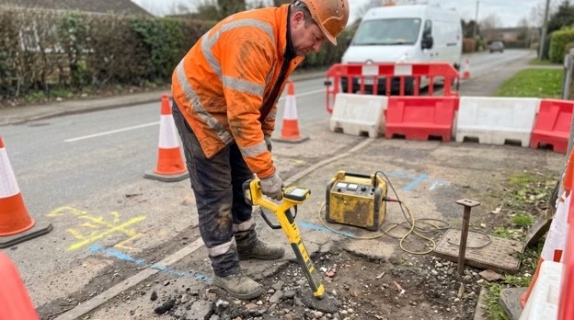
The optimism surrounding the Ohio plant has been bolstered by Intel’s broader corporate turnaround under CEO Lip-Bu Tan. This is particularly relevant for the Ohio site, as the facility is being specifically engineered to house the Intel 14A process, which is critical for high-density AI chips and next-generation mobile processors. To support this technology, local infrastructure projects, including massive road expansions like the five-lane widening of Mink Street, are being completed throughout 2025 and 2026 to handle the specialized logistics of “tool-in” (the installation of multi-million dollar chip-making machinery).
Beyond the hardware, the project is cementing its role as an economic anchor for the region. The state of Ohio is currently tracking nearly $50 billion in total industrial projects, with Intel’s gigafab accounting for more than half of that investment. The project continues to support thousands of union construction jobs, and Intel has maintained its commitment to community benefits, including partnerships with local colleges to build a specialized semiconductor workforce.
Also, it is set to boost AI infrastructure development alongside others such as the Gigawatt-Scale AI Factory facility that recently broke ground in Independence Missouri. These facilities produce critical products that are essential in the setting up of AI infrastructure.
Despite the long lead time for production, the 2026 outlook for the Ohio plant is one of stabilized growth, positioned to become a central pillar of America’s domestic semiconductor supply chain.
March 26, 2024
American semiconductor maker Intel wants to build the largest AI chip factory in the world in Columbus, Ohio. The AI chip factory will be the centrepiece of Intel’s ambitious US$100 billion, five-year expansion plan in the US.
Intel CEO Pat Gelsinger informed the reporters this week that the chipmaker is focused on construction of a manufacturing site on empty land near Columbus, Ohio. One of the four states the company is investing in, and the construction work could start as early as 2027.
The move comes after securing nearly $20 billion in federal grants and loans, with hopes of securing an additional $25 billion in tax breaks. The centrepiece of Intel’s formidable five-year spending plan is the development of what CEO Pat Gelsinger described as “the largest AI chip manufacturing site in the world” near Columbus, Ohio. Intel’s funding from the act was announced by the U.S. Department of Commerce on Wednesday, March, 20.
Intel’s funding approach additionally includes modernizing centers in New Mexico and Oregon, in addition to scaling up operations in Arizona, where the rival, Taiwan Semiconductor Manufacturing Co (TSMC) is also expanding its presence with support from Biden’s semiconductor manufacturing initiative.
Intel’s funding plan additionally consists of procurement of present day chip-making system from enterprise leaders inclusive of ASML, Tokyo Electron, Applied Materials, and KLA.
“Today is a victory for Americans’ national economy, but also our national security, “ Intel CEO Pat Gelsinger said Wednesday at an announcement of of Intel’s plan to build the largest AI chip factory in the world in Columbus, Ohio featuring U.S. President Joe Biden at Intel’s Ocotillo Campus in Chandler, Arizona. “In the modern world, everything relies on chips. Every aspect of humanity is going digital and relies on chips. And their production shapes the future of all of humanity.”
The Intel’s investment into U.S. semiconductor factories is anticipated to create around 80,000 jobs, Gelsinger said, including company and construction jobs, and indirect jobs for suppliers and adjacent industries. Intel stated that it plans to benefit from an investment tax credit through the U.S. Treasury Department of up to 25% on over $100 billion in qualified investments.
Read also: $20 billion Intel Chip Manufacturing Plant coming to Ohio
Construction timeline for Intel’s ‘largest AI chip factory in the world in Columbus, Ohio’.
These investments are vital for bringing the largest AI chip factory in the world on-line through 2027 or 2028, despite the fact that Gelsinger counselled that marketplace situations should affect the construction timeline.
Industry analysts anticipate that it will take Intel three to five years to establish itself as a formidable player in the foundry market for advanced chips. However, they notice that additional funding will be vital for Intel to surpass TSMC, which is expected to maintain its leadership position in the foreseeable future.
Read also: Intel’s $20B Ohio Chip Plant: On Track or Derailed?
Gelsinger has underscored the necessity of continued government support for them to realize their vision of building largest AI chip factory in the world in Columbus, Ohio and to ensure the United States remains a leader in semiconductor manufacturing. Despite the backing from federal initiatives, Intel faces strain to illustrate its competitiveness in opposition to worldwide rivals, especially in Taiwan and South Korea.
However, Intel’s importance, to U.S. Interests is still crucial considering its workforce, technological expertise and local supply chain. Despite the growing presence of competitors such as TSMC and Samsung in the U.S. Intel’s ongoing leadership in the semiconductor industry is seen as vital for sustaining a domestic technology sector. The decision to establish the worlds AI chip manufacturing facility, in Columbus Ohio comes at a significant juncture.
Project Factsheet
Developer: Intel Corporation
Location: New Albany, Licking County, Ohio (approx. 1,000-acre site)
Initial Investment: $28 Billion (originally $20B, increased in March 2024)
Total Potential Investment: Up to $100 Billion over the next decade
Direct Jobs Created: 3,000 Intel jobs (permanent)
Construction Jobs: 7,000+ during the peak of the build
Education Pledge: $100 Million toward local talent and research pipelines
Updated Project Timeline
- Groundbreaking: September 2022 (Completed)
- Infrastructure Maturity (2025–2026): Major road widening (SR 161) and utility installations are largely completed or in final phases.
- Factory Construction (Mod 1): Completion of the first factory shell is expected by 2030.
- Operational Start: Production of leading-edge chips is currently projected for 2030–2031.
- Full Build-out: The second factory (Mod 2) is scheduled for construction completion in 2031.
Read also: Intel Delays its $20 Billion Ohio One Project by at Least a Year