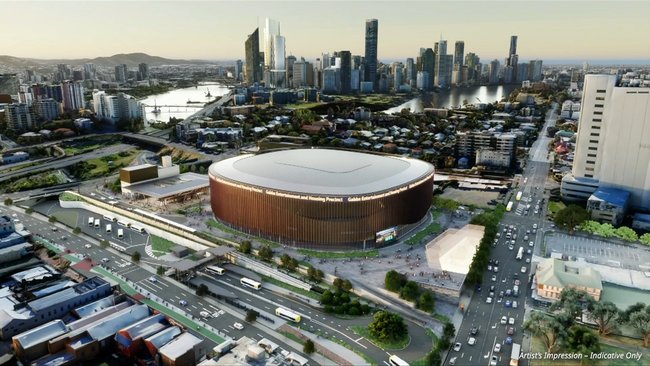
Brisbane Olympic Stadium has moved into focus following the unveiling of a major stadium plan valued at approximately $2.5 billion , equivalent to about AUS $3.8 billion. The Queensland Government presented the updated concept as part of its delivery roadmap for the 2032 Olympic and Paralympic Games, confirming Victoria Park as the preferred site for the city’s flagship venue.
Brisbane Olympic Stadium Design and Vision
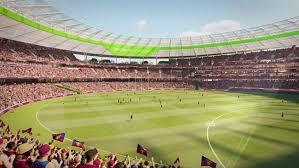
The Brisbane Olympic Stadium design introduces a 63,000-seat venue shaped to deliver both Olympic performance standards and long-term usability. According to the reports, the concept emphasizes a sunken bowl structure that integrates into the parkland while enhancing atmosphere and sightlines.
Moreover, the design team led by COX Architecture, Hassell and Azusa Sekkei focused on climate-responsive architecture. As a result, the stadium will feature shaded seating, open-air circulation, and natural ventilation suited to Brisbane’s subtropical conditions.
In addition, planners confirmed that the playing field will match international benchmarks, ensuring compliance with Olympic athletics requirements. The venue will also incorporate digital infrastructure and fan engagement technologies to enhance spectator experience during major events.
Brisbane Olympic Stadium Construction Timeline
The Brisbane Olympic Stadium project will enter construction in 2026 following site preparation and early works. Reports indicate that preliminary investigations, including geotechnical studies, are already underway to prepare Victoria Park for development.
Subsequently, the project will progress through structured construction phases to maintain delivery certainty. Officials expect completion by 2031, allowing sufficient time for operational testing before the 2032 Games.
Meanwhile, authorities plan to close sections of Victoria Park during construction to enable efficient execution. This approach will support large-scale earthworks and structural development without disruption.
Scope and Citywide Impact
The stadium will anchor Brisbane’s Olympic precinct while supporting athletics and opening ceremonies during the Games. Afterward, it will transition into the city’s primary venue for major sporting events, effectively replacing the The Gabba.
Furthermore, the project forms part of a broader urban transformation strategy across inner Brisbane. Government projections suggest the development will stimulate housing delivery, improve transport connectivity, and unlock new economic activity.
However, the plan has drawn scrutiny regarding environmental impacts and the use of public green space. Even so, officials maintain that the project balances development with sustainability outcomes, positioning the stadium as a long-term civic asset.
Innovation and Long-Term Legacy
The Brisbane Olympic Stadium will incorporate advanced operational systems designed to improve efficiency and reduce lifecycle costs. At the same time, passive design strategies will minimize energy consumption while enhancing user comfort.
After the Games, the venue will host a wide range of events including professional sport, concerts, and community gatherings. Consequently, the stadium will continue generating economic and social value well beyond 2032.
Ultimately, the project reflects Brisbane’s ambition to deliver a globally competitive Olympic Games while investing in enduring infrastructure. It also reinforces the city’s position as a future hub for international sport and entertainment.
Australia has been steadily advancing infrastructure projects to support long-term urban growth and major global events. Brisbane to build main stadium on parkland for 2032 Olympics report highlights how earlier developments continue to shape the delivery environment for projects such as the Brisbane Olympic Stadium.
Project Fact Sheet: Brisbane Olympic Stadium
Project Name: Brisbane Olympic Stadium
Location: Victoria Park, Brisbane, Australia
Estimated Cost: A$3.8 billion (USD $2.5B)
Capacity: 63,000 seats
Project Type: Multi-purpose Olympic stadium
Construction Start: 2026
Completion: 2031
Primary Use (Olympics): Opening and closing ceremonies, athletics events
Post-Games Use: AFL, cricket, major entertainment events
Key Features:
- Sunken bowl stadium integrated into parkland
- Climate-responsive design with natural ventilation
- Olympic-standard athletics configuration
- Advanced digital and fan engagement systems
- Catalyst for urban regeneration in Brisbane
Project Team: Brisbane Olympic Stadium
Client / Owner: Queensland Government
Delivery Authority: Games Independent Infrastructure and Coordination Authority
Architects:
- COX Architecture
- Hassell
- Azusa Sekkei
Engineering Consultants:
Key Stakeholders:
- Australian Government
- Brisbane City authorities and transport agencies
Contractors: To be appointed through competitive tender
Future Tenants:
Leave a Reply