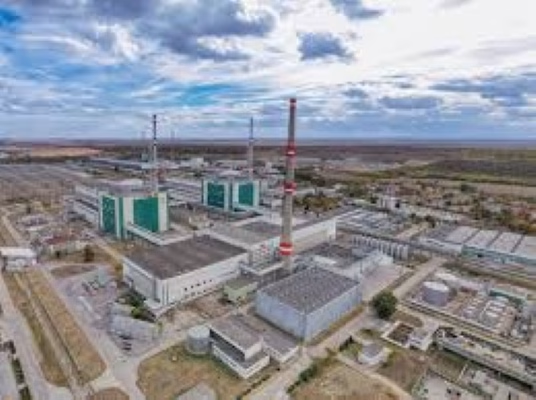
Updated December 2, 2025 – Kozloduy NPP-New Builds PLC and a multinational consortium composed of BWX Technologies, Laurentis Energy Partners, and its subsidiary Canadian Nuclear Partners have signed engineering consultancy agreement for new reactors at the Kozloduy nuclear power plant. The contract spans ten years, and the consortium will act as Owner’s Engineer (OE). They will be responsible for front-end engineering, design oversight, constructability reviews, and project management. This will be through to potential final investment decision (FID) and, if greenlit, construction and commissioning of the new reactors.
The OE Contract and Kozloduy Nuclear Power Plant Expansion
The new units, 7 and 8 will use AP1000 technology from Westinghouse Electric Company. This continues the path set by earlier agreements. The previous engineering contract signed in late 2024 between Westinghouse, Hyundai Engineering & Construction and Kozloduy laid technical groundwork. The OE contract continues to builds on that by assigning a dedicated oversight and delivery management structure for the nuclear project.
Officials expect a final construction contract for the reactors to be signed by the end of 2026. This is ahead of anticipated reactor commissioning by 2033 to 2035. First to come online will be unit 7 reactor, followed by Unit 8, 2 to 3 years later. This is assuming everything, including financing remains on-track.
Project Factsheet for Kozloduy Nuclear Power Plant Units 7 and 8 Expansion
Plant Site: Kozloduy NPP, Bulgaria. The site continues to operate two VVER reactors.
New Reactor Design: AP1000 Generation III reactor by Westinghouse.
BWXT Role: Owner’s Engineer (OE). Will cover engineering consultancy, project oversight, EPC contract review, regulatory and safety assurance.
Contract Duration: 10 years, with phase 1 covering the first 12 months.
Consortium Members: BWXT, Laurentis Energy Partners (LEP), Canadian Nuclear Partners S.A. (CNPSA).
Target Operational Date: Unit 7 expected online by 2035.
Bulgaria Expands Nuclear Power Generation with New Reactors
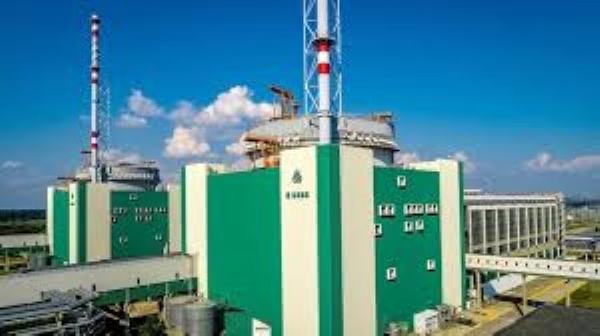
Reported October 26, 2023 – Bulgaria expands nuclear power generation with new reactors as an alternative to fossil fuels. The government recently initiated the construction of two additional reactors at its sole nuclear power plant, Kozloduy. These reactors, utilizing Westinghouse’s advanced technology, are poised to deliver a combined capacity of 2,300 megawatts. This development represents a pivotal shift in Bulgaria’s energy strategy. The shift is aimed at reducing the country’s dependence on fossil fuels and enhancing energy security, as also evidenced by the signing of agreements for battery storage systems with SUNOTEC and Sungrow.
Westinghouse Agreement for Reactor Units
U.S.-based nuclear equipment manufacturer Westinghouse Electric Co. signed an agreement earlier this year with Kozloduy plant for one or two AP1000 pressurized water reactor units. Prime Minister Nikolay Denkov confirmed that an initial allocation of 250 million euros has been set aside for the project. This is approximately 270 million dollars. The first reactor will be operational by 2033, while the second follows within two to three years.
Bulgaria’s Nuclear Energy Landscape
Currently, Bulgaria’s energy landscape relies on two Russian-designed VVER-1000 reactors, each generating 1,000 MW of electricity at the Kozloduy facility. Together, these reactors account for roughly one-third of the country’s electricity production. While their operational licenses are set to expire in 2027 and 2029, there’s a possibility of extending their operation, subject to regulatory approval.
Bulgaria’s history with nuclear energy has been marked by the closure of four older VVER-440 units in 2006 as a condition for the country’s accession to the European Union. However, the new reactors’ collective capacity is set to significantly surpass the 1,760 MW capacity of the retired units, ensuring greater energy output for the nation.
Prime Minister Denkov emphasized that the new reactor technology is well-suited for maintaining a stable energy system. This move towards nuclear expansion also aligns with Bulgaria’s efforts to diversify its energy sources and reduce its reliance on Russia, especially in the wake of Russia’s invasion of Ukraine.
As part of these diversification efforts, Bulgaria inked agreements last year with international partners, including France’s Framatome and Westinghouse Electric, to receive fresh nuclear fuel for its existing reactors.
Also read: SuedLink Power Transmission Line Takes Shape
Kozloduy Nuclear Power Plant Expansion
The construction of these two new reactors at the Kozloduy nuclear power plant marks a significant step forward in Bulgaria’s energy pursuit. This predominantly features sustainable, secure, and diversified energy sources. The energy ministry will soon initiate the selection of a contractor for the design, construction, and commissioning of the seventh and eighth power units at the site. Construction of the seventh unit will be completed by 2033. It will also be funded with an additional 500 million leva (approximately $270.7 million). This is in addition to previously allocated funds.
Prime Minister Denkov emphasized the importance of this decision, especially considering the country’s past commitments and future energy needs. The eighth unit’s construction will follow and is expected to be operational “2-3 years” after Reactor VII, further enhancing Bulgaria’s energy production capacity.
The combined power output of these two reactors, totaling 2,300 megawatts, promises to provide a substantial boost to Bulgaria’s energy production. This capacity notably exceeds that of the closed first to fourth units of the Kozloduy nuclear power plant.
Furthermore, Bulgaria is actively engaging in partnerships to ensure the success of this expansion. Westinghouse is already involved in preliminary engineering activities, and several Bulgarian companies are participating as subcontractors in the project.
Also in a recent development, Greece has expressed interest in investing or entering into long-term electricity purchase contracts with the Kozloduy plant. This will potentially solidifying Bulgaria’s energy diversification efforts.
Kozloduy nuclear power plant is the largest producer of electrical energy in Bulgaria. It plays a crucial role in the nation’s energy sector. Kozloduy expansion project not only supports Bulgaria’s energy security but also aligns with its commitment to reducing reliance on fossil fuels. This is also aimed at creating a sustainable energy future.
Leave a Reply