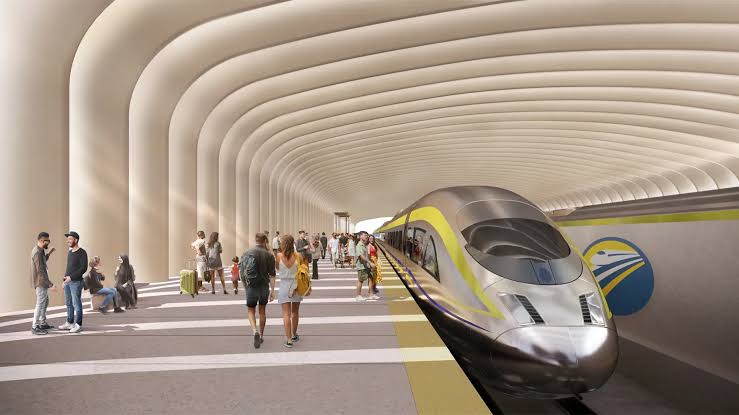
After over a decade of construction in the Central Valley, the California High-Speed Rail Authority could be fewer than six months from laying the system’s first tracks. This project shows the efforts US is putting to boost railway infrastructure in bid to enhance connectivity and mobility. Other ambitious railway projects that will join the California High-Speed Rail include the proposed Los Angeles-New York High-Speed Rail.
The rail authority’s board on Monday awarded a track and systems construction contract of up to $3.5 billion to an operation between rail and engineering contractors. These contractors include Kiewit, Stacy Witbeck and Herzog. The joint venture is expected to do the track work between Merced and Bakersfield in various phases. Each of the phases will require board approval before implementation.
Also, the board’s new chair, Steve Kawa, described the award as a turning point for the project. The project has been slow to clear environmental rules, acquire the necessary right-of-way and build out infrastructure. “Today the conversation changes,” he said during the meeting. “Track and system construction is the moment this project truly begins to become a railroad.”
California voters first approved $9.95 billion in bonds for a Los Angeles-to-San Francisco system initially projected to cost $45 billion. The rail authority today is focused on first completing a 171-mile Merced-to-Bakersfield route by 2033 for $34.76 billion on the low end.
Commencement and Completion Date for Laying of the Tracks
The rail authority expects work to begin on the first 22 miles that are ready for tracks, a space between the Shafter area and the Tulare-Kern County line by Nov. 30.
Additionally, that work is expected to be completed by June of next year. The rail authority Chief of Construction Ed Fenn revealed this during the meeting. From there, track work will advance north toward Fresno until it is complete on the initial 119 miles between Shafter and Madera County.
In recent months, the rail authority started awarding contracts to manufacturers who will be shipping track and system materials . These materials include overhead poles, rails, ballast and more. The materials will be stored at the agency’s 150-acre railhead yard near Wasco. From there, the materials will be moved north as needed.
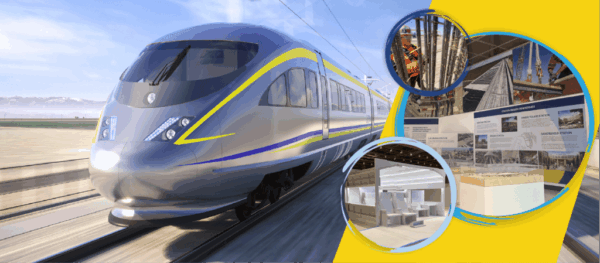
Preferred Bidder Selection Process: How the Winner was Awarded the Contract
Though the process for choosing the track construction contractor was competitive, only the joint venture that was chosen actually bid a price to the rail authority. Unfortunately, the only other bidder was disqualified for failing to show it had at least one key personnel who was a professional engineer registered in this state. Board member Jeffrey Worthe stated during the meeting he was concerned whether “locking ourselves” into a single bidder is a responsible use of taxpayer dollars.
Board member Jeffrey Worthe said during the meeting he was concerned whether “locking ourselves” into a single bidder is a responsible use of taxpayer dollars.
Contractor’s Work to be Broken into 9 Packages
The contractor’s work will be broken into nine packages, each requiring board approval. Fenn, the rail authority’s construction chief, said this strategy allows the agency to “ensure we have the proper pricing going forward for each package.” “We always have the opportunity to off ramp, but that’s certainly not what we want to do,” he said. “We have to trust that our partners are going to come to terms with us.”
California High-Speed Rail Project Factsheet
Top Design Speed: 220 mph (350 km/h)
Target Travel Time: San Francisco to Los Angeles in under 2 hours and 40 minutes.
Propulsion System: 25 kV AC overhead catenary line, featuring regenerative braking to supply energy back to the grid.
Track Technology: Double-track steel-wheel-on-steel-rail.
Phase 1: San Francisco to Los Angeles/Anaheim (494 Miles)
- Key Stops: San Francisco, San José, Gilroy, Merced, Madera, Fresno, Kings/Tulare, Bakersfield, Palmdale, Burbank, Los Angeles, and Anaheim.
- Initial Operating Segment (IOS): The first active construction block covers a 171-mile line from Merced to Bakersfield in the Central Valley. It targets early revenue passenger operations between 2030 and 2033.
Phase 2: System Extensions
- Northern Extension: Connecting the Central Valley branch up to Sacramento (including Stockton and Modesto).
- Southern Extension: Pushing from Los Angeles down to San Diego via the Inland Empire (including San Bernardino and Riverside).
Construction Progress and Milestones
- Active Guideway: 119 miles of active construction corridor spanning Madera, Fresno, Kings, Tulare, and Kern counties.
- Completed Infrastructure: Over 80 miles of guideway and 59 distinct structures (such as viaducts, overpasses, and underpasses) have been completely built.
- Central Valley Track Contract: Engineering consortia (including SYSTRA, TYPSA) are designing track, signaling, and overhead electrical systems for the initial passenger segment.
- Blended Corridors: In the “bookend” urban regions, high-speed rail will utilize shared tracks with upgraded conventional rail. Notably, the 51-mile Caltrain electrification project in the San Francisco Bay Area was fully completed in 2024. Also, it was launched into service in the same year.
Funding
- State Special Funds: Initial funding was established by Proposition 1A (2008 voter-approved bond). This is heavily augmented by a permanent 25% continuous appropriation from California’s Cap-and-Trade Program. The program was extended in 2025 to secure up to $1 billion annually through 2045.

Leave a Reply