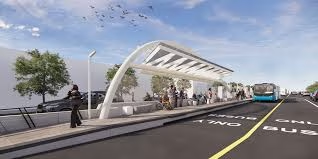
The Colorado Department of Transportation (CDOT) has announced that the Federal Boulevard Bus Rapid Transit (BRT) project will be delivered using a Construction Manager/General Contractor (CM/GC) model. The decision was outlined in a December 3 update to industry partners and follows CDOT’s completion of its Project Delivery Selection Matrix evaluation earlier this year.
According to the update, CDOT determined that the CM/GC method is the most suitable approach for the 18-mile corridor due to project complexity, right-of-way constraints, and the number of agencies involved. The delivery method allows the contractor to participate in preconstruction planning and enables CDOT to sequence the work in multiple packages.
Current Status
The project is currently at 30% design, with environmental review continuing into 2026. CDOT expects to complete NEPA and move into final design by spring 2026. Under the schedule presented, construction could begin as early as late 2027, with full corridor delivery targeted for 2030, depending on funding availability and the final packaging of work.
CDOT now estimates the Federal Boulevard BRT Project will cost $318 million. The agency, its local partners, and the Denver Regional Council of Governments plan to allocate about $150 million through their 10-Year Strategic Plan budgets for fiscal years 2027–2028. CDOT also expects to secure additional funding from federal and regional programs, including the Federal Transit Administration’s pending Small Starts grant.
The December 3 update states that CDOT will likely split construction into multiple phases and continue procurement planning through 2026.
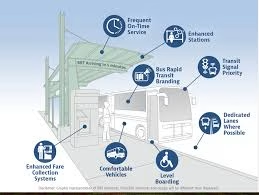
Cities across the United States are increasingly adopting Bus Rapid Transit (BRT) as a cost-effective way to provide faster, more reliable public transportation along key corridors. The Federal Boulevard BRT Project in Denver and the Blue Line BRT Project in Indianapolis illustrate this trend. While Denver’s project is moving through design and preconstruction, Indianapolis began construction on the Blue Line in early 2025, with full service expected by 2028. Both projects aim to improve transit speed, increase ridership, and provide dedicated infrastructure that separates buses from general traffic, reflecting a growing focus on high-capacity, rapid bus solutions in urban corridors.
Federal Boulevard BRT Project Factsheet
Project Overview
Project: Federal Boulevard Bus Rapid Transit (BRT)
Length: 18-mile corridor
Goal: Achieve BRT revenue service by January 2030
Delivery Method
Selected Approach: Construction Manager/General Contractor (CM/GC)
Rationale: Enables earlier construction start through multiple packages, provides financial flexibility, and better risk allocation
Budget & Funding
Total Estimated Cost: $318 million
Secured Funding: $150M (CDOT Strategic Funds, DRCOG TIP funds, local funds) – available FY27-FY28
Projected Funding: FTA Small Starts Grant (up to $150M, 50% cap), NAAPME funds, additional local dollars
Project Timeline
Final Design Start: Spring 2026
Construction Start: Late 2027
Construction Complete: Early 2030
Revenue Service: January 2030
Implementation Approach
The project will be delivered in construction packages, with scope determined by funding availability:
Phase 1 – Core Service ($150M):
Alameda Ave to 52nd Ave segment with 14 BRT station pairs, 5.5 miles of bus lanes, Transit Signal Priority, and 6 queue jump locations
Phase 2 – Corridor Completion ($170M):
South segment (Dartmouth to Alameda) and North segment (52nd to 120th Ave) with full capital infrastructure and upgraded stations
Current Status
30% design completed
NEPA environmental review ongoing (completion Spring 2026)
Request for Qualifications: Spring 2026
Industry feedback meeting: December 17, 2025
Leave a Reply