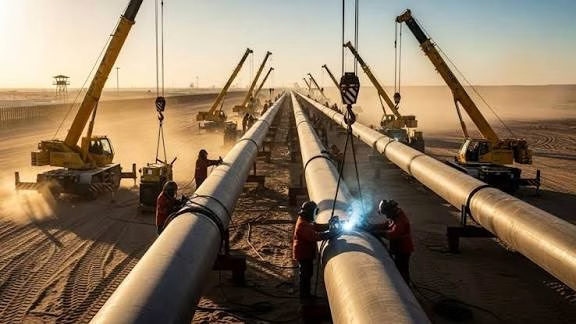
The planned Nitzana natural gas pipeline is an onshore export corridor linking Israel’s domestic transmission network with Egypt at the Nitzana border crossing. The project is progressing from planning into execution as Chevron and Israel Natural Gas Lines advance construction under recently approved transmission agreements that allocate capacity to major producers and align with a multi-billion cubic-metre Israeli gas export framework. Once built, the approximately 67-km, 36-inch pipeline and associated compressor station near Ramat Hovav are expected to enable roughly 6 billion cubic metres per year. This is about 600 million cubic feet of natural gas exports from Israel to Egypt per day. The project is also expected to strengthen regional energy ties between the two countries and also underpin long-term commercial supply deals tied to Leviathan field production expansion.
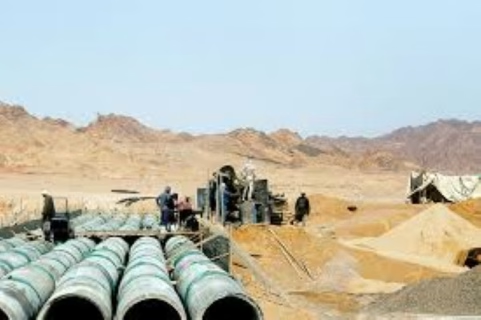
Chevron, Israel Natural Gas Lines to Construct Nitzana Natural Gas Pipeline to Egypt
Reported September 17, 2025 – Chevron has inked a deal with state-owned pipeline operator Israel Natural Gas Lines to kickstart construction of the Nitzana Natural Gas Pipeline. This pipeline will transport natural gas from the Leviathan gasfield to Egypt. This information was revealed by the U.S. company on Tuesday.
Additionally, Nitzana is expected to ease an energy crisis in Egypt. The North African country has spent billions of dollars on the importation of liquefied natural gas. This pipeline project is part of a concerted effort to boost Israeli gas exports to the Arab world’s most populous nation.
Nitzana Natural Gas Pipeline Project Factsheet
Location: The pipeline is a 65-kilometer onshore line connecting the Ramat Hovav area in Israel to the Egyptian border near Nitzana.
Purpose: To increase the volume of natural gas exports from Israel to Egypt.
Capacity: The pipeline is designed to transport an additional 6 billion cubic meters (BCM) of natural gas per year. This will increase Israel’s total gas export capacity to Egypt to more than 2.2 billion cubic feet per day.
Source of gas: The primary source of the gas will be Israel’s offshore Leviathan field. Some gas is also expected from the Katlan field.
Cost and funding: The project is estimated to cost around $610 million. The Leviathan consortium has agreed to bear the full cost of the pipeline’s construction. Egypt is also expected to invest $400 million on its side of the border.
Timeline: The project has faced delays, but construction is set to begin. Gas is expected to start flowing by 2028.
Key players and stakeholders
- Leviathan consortium: The primary driver of the project, which includes:
- Chevron: The operator of the Leviathan field, with a 39.66% stake.
- NewMed Energy: An Israeli company and the largest owner of the Leviathan field, with a 45.34% stake.
- Ratio Energies: An Israeli company with a 15% stake.
- Israel Natural Gas Lines (INGL): The state-owned company responsible for building and managing Israel’s natural gas transmission infrastructure. They have also signed an agreement with the Leviathan consortium for the use of the pipeline.
- Energean: Another gas producer that plans to use the pipeline to export gas from its Katlan field.
- Egyptian Government and Blue Ocean Energy: The buyers and recipients of the natural gas.
Capacity of the Nitzana Pipeline
The Nitzana pipeline route will transport around 600 million cubic feet of natural gas per day. Also, the construction of the pipeline is expected to take about three years. Additionally Chevron stated that the pipeline would bring Israel’s total export capacity to Egypt to more than 2.2 billion cubic feet daily.
Lastly, gas producer Energean has said it plans to send up to 2 billion cubic metres of gas a year on Nitzana. This is from its Katlan field offshore Israel due to start production in 2027.
Leave a Reply