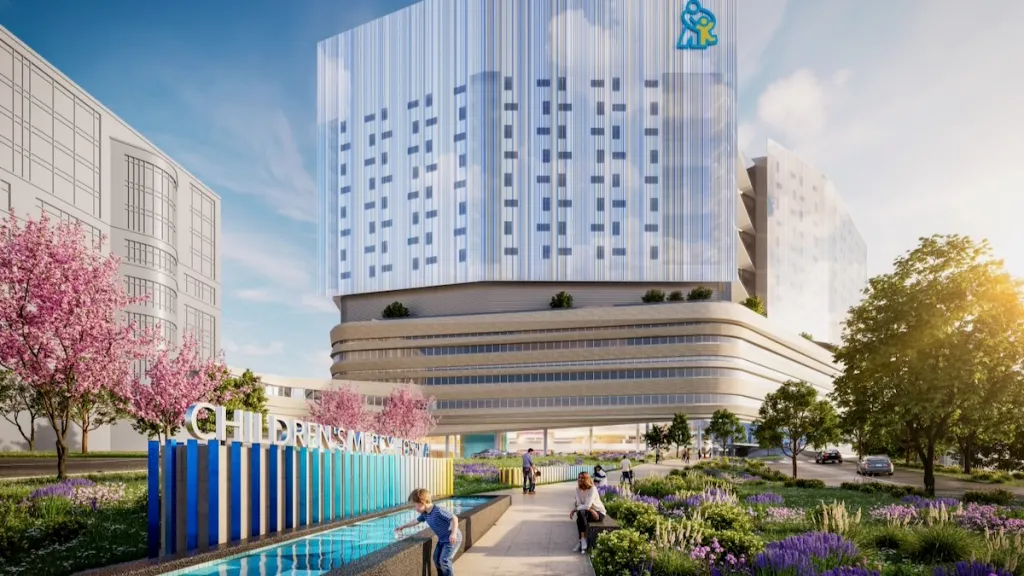
Children’s Mercy Hospital has unveiled plans for a new acute care tower expected to cost more than $1 billion, which will be built on the Gillham Road side of the hospital’s Adele Hall campus on Hospital Hill in Kansas City. The new tower will expand the hospital’s overall capacity by 25% to 30%, with construction set to begin in fall 2026 and a targeted completion of 2031. Without the expansion, officials said, within five years the hospital would have capacity for only 67% of patients needing beds, and for only 40% of newborns requiring a spot in the neonatal intensive care unit. The tower is the first phase of a broader seven-phase master plan for the Hospital Hill campus that Children’s Mercy filed with the City of Kansas City in March 2026, with the Kansas City Plan Commission expected to consider that master plan on May 6, 2026. Among the confirmed features of the new tower are expanded space for the PICU and NICU, an emergency department expansion, a surgical centre with future-ready technology including robotics, improved clinical flow and adjacency, additional natural light and green spaces, a new lobby, and dedicated space for research and translational medicine. The project will be supported by a combination of private-public investments, community philanthropy and long-standing civic collaboration, though the hospital has not released a detailed breakdown of its financing structure. In 2025, Children’s Mercy reported more than $2 billion in revenue and $418.5 million in excess revenue, four times more than a decade earlier.
Children’s Mercy is one of only 28 stand-alone children’s hospitals in the United States, and the forces driving its expansion reflect a structural shift in how paediatric care is being consolidated and delivered across the country rather than anything specific to Kansas City. Paediatric beds in general acute hospitals are becoming less common, pushing more patients toward dedicated children’s hospitals, while in rural communities, hospitals face the risk of closing altogether. At the same time, the clinical complexity of paediatric care has risen dramatically: children who would not have survived even a decade ago now receive treatments including genetic therapies and advanced surgical interventions that demand prolonged inpatient stays, specialised equipment, and infrastructure that only purpose-built facilities can reliably accommodate. That dynamic is playing out at children’s hospitals across the Midwest simultaneously. Cincinnati Children’s Hospital Medical Center, Nationwide Children’s in Columbus and Ann and Robert H. Lurie Children’s in Chicago have all either recently completed or are actively planning major capacity additions, and in each case the capital investment rationale is the same: demand for high-complexity paediatric care is rising even as birthrates decline, because more children are surviving into ongoing care relationships with the hospital system. A similar investment cycle is also visible in Missouri, where the SSM Health Cardinal Glennon Children’s Hospital topping-out project marks a US$600 million expansion aimed at modernising critical care infrastructure and increasing specialist capacity across emergency, ICU, and inpatient services. What is worth watching at Kansas City specifically is the financing question, which remains publicly unresolved. The announcement event drew Missouri Governor Mike Kehoe and Hallmark Chairman Don Hall Jr., a long-standing hospital benefactor, but neither made public commitments to the project’s capital campaign. That ambiguity, set against a federal Medicaid policy environment that threatens to reduce coverage for thousands of Missouri children, means the funding path for a project of this scale will need to be resolved early in the design and preconstruction phase if the 2031 delivery target is to hold.
Tower Clinical Programme, Campus Master Plan and Capacity Rationale
- New acute care tower located on the Gillham Road side of the Adele Hall campus, Hospital Hill, Kansas City, Missouri
- Total cost: more than $1 billion (precise figure not yet confirmed publicly)
- Capacity expansion: 25% to 30% increase in overall hospital capacity upon completion
- Construction start: fall 2026
- Target completion: 2031
- Capacity crisis context: without the tower, within five years the hospital would have capacity for only 67% of patients needing beds and 40% of NICU patients
- PICU and NICU: expanded dedicated spaces incorporated into the tower clinical programme
- Emergency Department: expanded within the new tower
- Surgical Centre: future-ready technology including robotic surgery platforms
- Clinical flow and adjacency: redesigned for improved care team collaboration
- Research and translational medicine: dedicated spaces to support science-to-treatment pathways
- Natural light, green spaces and a new lobby: embedded in the design concept
- Master plan context: seven-phase Adele Hall campus master plan filed with the City of Kansas City in March 2026; Kansas City Plan Commission review expected May 6, 2026
- Geographic context: the tower will be visible from the Royals’ proposed $1.9 billion new stadium across Gillham Road
- Funding model: combination of private-public investment, community philanthropy and civic partnership (detailed financing not yet publicly disclosed)
Project Fact Sheet
- Project Name: Children’s Mercy Hospital Adele Hall Campus Acute Care Tower
- Owner/Operator: Children’s Mercy Hospital (nonprofit, stand-alone paediatric hospital)
- Location: Adele Hall Campus, Gillham Road, Hospital Hill, Kansas City, Missouri
- Project Value: more than $1 billion
- Project Type: Acute care inpatient tower (new build, campus expansion)
- Capacity Increase: 25% to 30% of total hospital capacity
- Construction Start: fall 2026
- Projected Completion: 2031
- Storeys: not yet publicly confirmed
- Beds Added: not yet publicly confirmed
- Clinical Programme: expanded PICU, NICU, Emergency Department, surgical centre with robotic technology, research and translational medicine spaces
- Campus Master Plan: seven-phase Hospital Hill campus plan filed with Kansas City March 2026; Phase 1 is the acute care tower
- Institutional Age: 128 years (founded 1897)
- Hospital Classification: one of 28 stand-alone children’s hospitals in the United States
- 2025 Revenue: more than $2 billion
- 2025 Excess Revenue: $418.5 million
- Recent Expansions: Overland Park, Wichita and Springfield campuses already operational
- Financing Model: private-public investment, community philanthropy and long-standing civic collaboration
Project Team
- Owner/Client: Children’s Mercy Hospital — a nonprofit, stand-alone paediatric academic medical centre serving children across Kansas City and a multi-state regional catchment area, with campuses in Kansas City, Overland Park, Wichita and Springfield
- President and Chief Executive Officer: Dr. Alejandro Quiroga — announced the tower publicly on April 29, 2026, and has been the principal spokesperson for the capacity rationale and clinical vision behind the expansion; has led the hospital through its most significant revenue growth period, with 2025 excess revenue four times greater than a decade earlier
- Architect and Design Team: not yet publicly confirmed; master plan drawings filed with the City of Kansas City in March 2026 are under Plan Commission review
- General Contractor: not yet publicly confirmed; procurement expected ahead of fall 2026 construction start
- City Planning Authority: Kansas City Plan Commission — scheduled to consider the full seven-phase Adele Hall campus master plan on May 6, 2026
- State Government Representative: Governor Mike Kehoe, State of Missouri — delivered remarks at the April 29 announcement event, characterising healthcare as a cornerstone of government responsibility
- Philanthropic Community Representative: Don Hall Jr., Chairman of Hallmark Cards — spoke at the announcement event as a long-standing hospital benefactor and neighbour of the proposed tower site; no capital gift announced at the event
- Competing Capital Campaign Context: BJC Health (owner of St. Luke’s Hospital) has announced a master planning process for its Country Club Plaza campus, representing a potential competing draw on Kansas City’s philanthropic capital over the same fundraising period

Leave a Reply