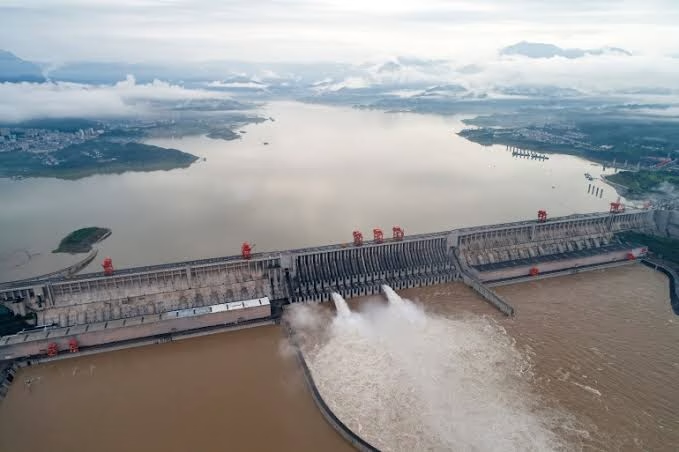
In July 2025, China formally commenced construction on the Yarlung Tsangpo Lower Reaches Hydropower Project, commonly referred to as the “Super Dam” in Tibet. Located near the “Great Bend” where the Yarlung Tsangpo, which is known as the Brahmaputra in India, makes a sharp U-turn toward the Indian border, this project is designed to be the largest hydroelectric plant in history. With a planned capacity of roughly 60 to 70 gigawatts, it is expected to generate three times the power of the Three Gorges Dam. While Beijing frames the $160+ billion initiative as a cornerstone of its “green transition” to meet carbon neutrality goals, the project has sparked intense geopolitical friction. The project will reinstate China’s position as a global renewable energy leader, with the country boasting other projects such as the Songyuan Hydrogen Energy Industrial Park Phase I, which now stands as the World’s Largest Integrated Green Hydrogen-Ammonia-Methanol Project.
Other projects
Other than the world’s largest hydropower project, China is also working on the world’s largest hybrid pumped-storage power project.
The power station is located on the Western Sichuan Plateau at an altitude of 3,000 meters. The station is known as the Lianghekou hybrid pumped storage project. Earlier this week, it achieved two major construction milestones, with one being the completion of excavation on the underground powerhouse.
On the other hand, concrete pouring commenced for the downstream reservoir. It uses the Lianghekou Reservoir, Sichuan’s largest super reservoir, as the upper reservoir. Conversely, the Yagen Level-1 hydropower station reservoir is also used as the lower reservoir. The plant is equipped with four reversible units of 300 megawatts each. Operating jointly with the 3,000-MW conventional units of the Lianghekou project, the total installed capacity will also reach 4.2 gigawatts.
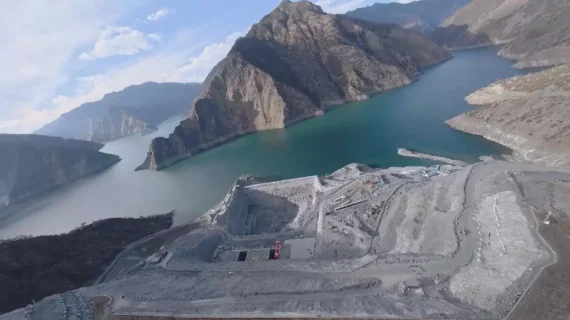
Challenges Facing the Tibet Dam Project
Headlines in India have already dubbed the project a potential “water bomb” – and its proximity to the disputed China-India border put it at risk of becoming a flashpoint in a long-simmering territorial dispute between the two nuclear-armed powers.
Also, experts say the potential impact on the ecosystem, including on fishing and farming, remain understudied. Furthermore, geologists have warned of significant risks due to the site’s location in a high-seismic zone prone to landslides and earthquakes.
Reported on September 26, 2025
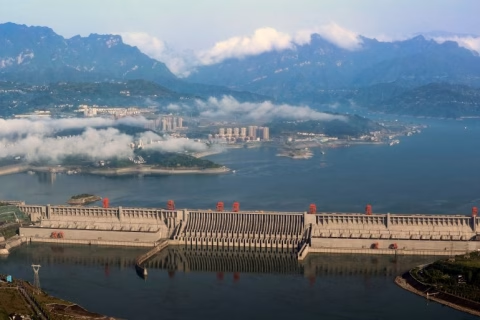
China has set its sights on building the world’s largest hydropower station — the Tibet Dam — an ambitious project that will dwarf the iconic Three Gorges Dam in scale and power generation. It will also be larger than the planned Grand Inga Dam across the Congo River in Africa which was slated to become the largest Hydro dam when constructed.
When completed, the Tibet Dam is expected to produce three times more electricity than the Three Gorges Dam, which has held the record as the world’s largest hydropower facility since it began operations in 2012.
The new mega-dam will harness the force of the Yarlung Tsangpo River, which flows through the world’s deepest canyon. Dropping more than 25,000 feet (7,667 meters) from its source, the river’s dramatic elevation provides enormous potential for clean energy production.
Engineers estimate the project could generate nearly 300 billion kilowatt-hours (kWh) of electricity every year — enough to supply power to around 300 million people. Just one stretch of the river’s lower reaches drops over 6,500 feet (2,000 meters) in only 31 miles (50 kilometers), offering the potential to produce up to 70 million kilowatts of power on its own.
To tap into this energy, China plans to bore a network of tunnels — some stretching up to 12.5 miles (20 kilometers) — through the Namcha Barwa mountains. These tunnels will divert about half of the river’s flow, channeling roughly 2,000 cubic meters of water per second toward massive turbines.
Cost of the Project
With an estimated budget of one trillion yuan (about US$137 billion), the Tibet Dam ranks among the most expensive and technically challenging infrastructure projects ever attempted.
Chinese Premier Li Qiang officially announced the project’s launch in July 2025, confirming its location on the lower reaches of the Yarlung Tsangpo River on the Tibetan Plateau. This came after the government of China had greenlighted the project at the end of 2024.
While the dam promises unprecedented clean energy capacity, it has also raised serious concerns about environmental impacts and water supply risks for downstream countries like India and Bangladesh, which depend on the river’s flow.
Project Factsheet
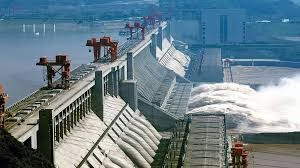
Location: it is located in the lower reaches of the Yarlung Tsangpo River. This is near the “Great Bend” in Medog County, Nyingchi (Linzhi) Prefecture in the Tibet Autonomous Region, China. This location is strategically close to the Line of Actual Control (LAC) with India.
Capacity:it is exotic to have a capacity of up to 60 Gigawatts (GW). This is similar to an annual capacity of 300 billion kilowatt-hours (kWh).
Cost: approximately more than $137 billion
Developer/operator: Power Construction Corporation of China (PowerChina). They will be in partnership with the Tibet Autonomous Region government. Also, a new company, China Yajiang Group, has been unveiled to oversee the project.
Funding: The project will be primarily funded by the Chinese government. Also, it will have significant investment from state-owned entities like PowerChina and the newly established China Yajiang Group.
Groundbreaking Ceremony
Li attended the dam’s groundbreaking ceremony that was held in Nyingchi. Nyingchi is a southeastern city in the Tibet autonomous region as reported by state news agency Xinhua on Saturday.
The Yarlung Tsangpo becomes the Brahmaputra River once it leaves Tibet and flows south into India’s Arunachal Pradesh and Assam states. Finally, the river flows into Bangladesh.
Official Announcement of the Project
Additionally, Beijing first made an announcement on the plans for the dam in 2020 under its five-year plan. This was part of a broader strategy by China to exploit the hydropower potential of the Tibetan Plateau. Furthermore, the plan was given a greenlight last December.
The Tibet Dam project is said to be the largest of its kind in the world. The dam is estimated to posses an annual capacity of 300 billion kilowatt-hours of electricity . Lastly, this project is deemed to be three times that of the Three Gorges Dam.
Other than the Tibet dam, China Three Gorges Group continue to push the boundaries of the energy sector worldwide with the world’s largest hybrid solar plant. The firm commissioned the world’s largest hybrid solar plant which is a 1 GW hybrid concentrated solar power and photovoltaic complex. The plant was commissioned in Hami, Xinjiang and is described as the world’s largest integrated facility of its kind. Before this achievement, the world’s largest solar plant of its kind was in the UAE. The Noor Energy 1 project has a total capacity of 950 MW, of which 700 MW of concentrated solar power (CSP) and 250 MW of PV. The project is located in 1,817 hectares of desert at the southern foot of Tianshan Mountains.
Also read: Beyond Limits: “The Three Gorges Dam Above Earth” Project Unveiled by China


Leave a Reply