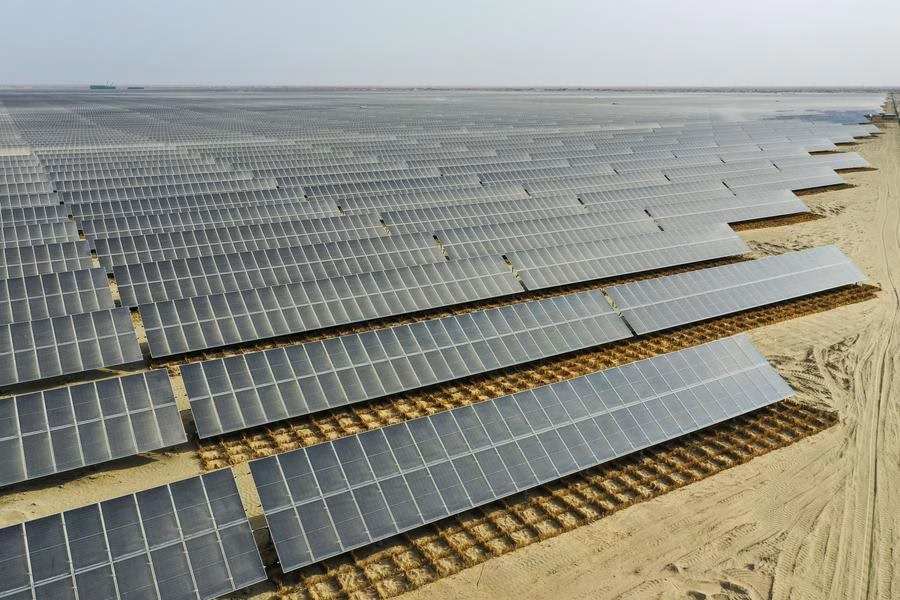
China’s Tarim Oilfield’s five solar power plants have pushed annual photovoltaic electricity generation beyond 2 billion kilowatt-hours, setting a new milestone for integrated fossil fuel and renewable energy development in China.
China’s largest ultra-deep oil and gas production base, the Tarim oilfield, has reached a major clean energy landmark after its annual solar power generation exceeded 2 billion kWh, according to data released by PetroChina and reported by CCTV. Daily peak output has also crossed 10 million kWh, underscoring the rapid scaling up of renewable energy in one of the country’s most challenging environments.
Located deep in the Taklimakan Desert in the Xinjiang Uygur Autonomous Region, the Tarim oilfield is a critical energy hub and the main gas source for China’s west-to-east gas transmission project. The latest achievement signals the formation of a coordinated energy system that combines oil, natural gas and large-scale renewable power in the heart of the desert.
Solar power scaling up in the desert
Within the Tarim oilfield, five large-scale solar power stations have been developed, with a combined installed capacity of 2.6 GW. These facilities form the backbone of a broader renewable rollout that also includes 239 distributed photovoltaic projects installed at individual oil and gas wells and field stations.
The growth in generation has been dramatic. Solar output rose from 260 million kWh in 2023 to 1.34 billion kWh in 2024, before surpassing 2 billion kWh this year — a progression described by PetroChina as “three leaps in three years.”
Of the green electricity produced, around 8 percent is consumed directly by oil and gas operations at the Tarim oilfield, while 92 percent is transmitted through Xinjiang’s power grid to external users. This shift has reduced local energy consumption and carbon emission intensity by more than 10 percent.
Supporting both energy and ecology
Beyond power generation, the photovoltaic rollout is also playing a role in environmental management. Completed solar projects now cover around 100,000 mu (approximately 6,667 hectares) of desert sand.
By installing solar panels on shifting sands, the project helps reduce wind speeds, create shaded zones and support drip irrigation systems laid beneath the panels. These measures contribute to sand control and ecological protection while enabling large-scale renewable energy production in a harsh desert climate.
CNPC’s largest solar project comes online
In January 2025, China National Petroleum Corporation (CNPC) commissioned its largest-ever solar project at the Tarim oilfield. The 1.3 GW photovoltaic facility has been connected to the national grid and is paired with a large energy storage system rated at 130,000 kW / 260,000 kWh. The project has now generated over 2.1 billion kWh of clean electricity annually, further strengthening renewable output from the region. China is also paring up the Three Gorges Dam with a solar project to create the worlds largest hybrid solar plant further signaling the countries ambitions to go green.
According to CNPC, the green power will be transmitted to load centers in eastern China, helping ease power shortages during peak demand and improving the overall energy mix. Part of the electricity will also supply a local petrochemical complex, enabling CNPC’s 1.2 million-ton-per-year ethylene project to operate entirely on renewable power.
Project factsheet: Tarim Oilfield solar developments
- Location: Taklimakan Desert, Xinjiang Uygur Autonomous Region, China
- Operator: PetroChina / China National Petroleum Corporation (CNPC)
- Solar power plants: 5 large-scale stations
- Installed solar capacity: 2.6 GW (Tarim oilfield total)
- Largest single project: 1.3 GW PV plant with energy storage
- Energy storage capacity: 130,000 kW / 260,000 kWh
- Annual solar generation: Over 2 billion kWh
- Peak daily generation: Over 10 million kWh
- Land area covered: ~100,000 mu (6,667 hectares)
- Power usage: 8% onsite oil and gas operations, 92% exported to grid
Leave a Reply