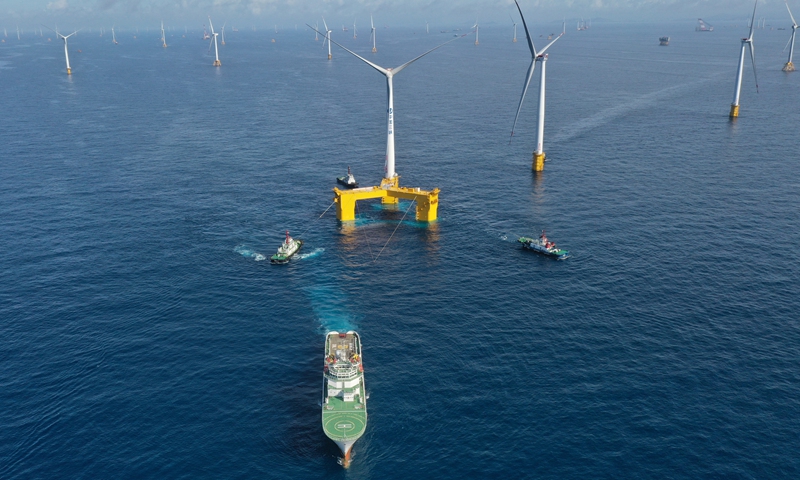
In the space of just a few days in April 2026, the Yangjiang Offshore Wind Farm in Guangdong Province and the Shandong Peninsula North Wind Farm off the coast of Yantai, Shandong Province delivered two landmark milestones that collectively illustrate the pace and ambition of China’s push into deeper and more distant ocean environments. On 7 April, the Shandong Peninsula North wind farm, developed by China Huaneng Group and rated at 504 MW, became the country’s deepest commercial offshore wind project to achieve full grid connection, operating at water depths between 52 and 56 metres roughly 70 kilometres off the Shandong coastline. Two days later, on 9 April, construction formally commenced on what is now China’s farthest offshore wind project, located in the waters south of Hailing Island in Yangjiang, Guangdong Province, with its farthest point reaching 89 kilometres from shore. Together, these two events mark a decisive shift in China’s offshore wind strategy from nearshore, shallow water development toward the deeper, more resource rich and more technically demanding waters that will define the next phase of the country’s clean energy expansion.
A New Frontier Being Built off Yangjiang
The Yangjiang project, developed by China Huadian Corporation, sits at the centre of the week’s headlines as the more structurally novel of the two developments. With a total installed capacity of 500 MW spread across 54 square kilometres of ocean, the farm will deploy 31 turbines, each rated at 16.2 MW, marking the first commercial application of turbines of this capacity in China’s offshore sector. The site’s centre is located 82 kilometres from the coast, with its outermost boundary reaching the 89 kilometre mark, a distance that would have been considered operationally impractical for fixed bottom offshore wind just a decade ago.
What makes the Yangjiang project particularly notable beyond its raw distance from shore is its integration of intelligent operation technology. The farm will deploy big data analytics and intelligent algorithms to enable real time condition monitoring across all 31 turbines, supporting predictive fault diagnosis and coordinated operations and maintenance scheduling. According to project documentation, these systems are expected to increase wind power generation output by approximately 2 per cent, reduce the overall equipment failure rate by 20 per cent, and improve wind farm financial returns by between 5 and 10 per cent over the asset’s operational life. Once commissioned, the farm is projected to deliver approximately 1.6 billion kilowatt hours of clean electricity annually to the Guangdong and Hong Kong and Macao Greater Bay Area, enough to meet the yearly power demands of around 700,000 households, while displacing 500,000 tonnes of standard coal and reducing carbon dioxide emissions by 1.26 million tonnes each year.
Project Fact Sheet
Project Name: Yangjiang Offshore Wind Farm (China’s Farthest Offshore Wind Project)
Developer: China Huadian Corporation
Location: Waters south of Hailing Island, Yangjiang City, Guangdong Province, South China
Distance from Shore: 82 kilometres to the site’s centre, with the farthest point at 89 kilometres offshore
Total Installed Capacity: 500 MW
Site Area: 54 square kilometres
Water Depth: 46 to 50 metres
Number of Turbines: 31 units
Turbine Capacity: 16.2 MW each, the first commercial deployment of this turbine class in China
Annual Electricity Generation: Approximately 1.6 billion kilowatt hours
Equivalent Households Powered: Approximately 700,000 per year
Annual Coal Displacement: 500,000 tonnes of standard coal
Annual CO2 Reduction: 1.26 million tonnes
Technology Features: Big data and intelligent algorithms for real time monitoring, fault diagnosis and coordinated operations and maintenance
Construction Start Date: 9 April 2026
Grid Service Area: Guangdong, Hong Kong and Macao Greater Bay Area
Project Team
Developer: China Huadian Corporation, one of China’s five major state owned power generation enterprises, responsible for project development, financing and operations
Construction Lead: Huadian Heavy Industries, the engineering and heavy equipment subsidiary of China Huadian Corporation, leading offshore installation works
Turbine Technology: 16.2 MW turbine units, representing the first commercial scale deployment of this turbine class in the Chinese offshore market
Intelligent Operations Provider: In house digital systems developed under China Huadian’s smart wind farm programme, integrating big data analytics and AI assisted fault diagnosis
Grid Connection Authority: Southern Power Grid, the state owned utility responsible for power transmission and distribution across Guangdong, Guangxi, Yunnan, Guizhou and Hainan provinces
Regulatory Framework: National Energy Administration of China, operating under the 15th Five Year Plan for renewable energy development covering 2026 to 2030
Shandong’s Deepest Farm: A Parallel Milestone Worth Understanding
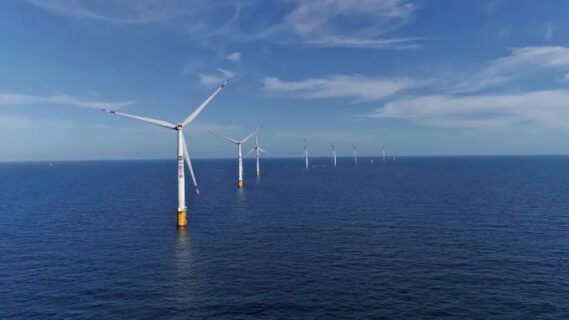
While Yangjiang captured most of the construction headlines, the simultaneous full commissioning of the Shandong Peninsula North wind farm adds important context to the week’s developments. Built by China Huaneng Group roughly 70 kilometres off the coast of Yantai in Shandong Province, the 504 MW farm features 42 turbines rated at 12 MW each, installed on four legged jacket foundations that reach a maximum height of 83.9 metres, making them the tallest of their kind deployed in China. Water depths at the site range between 52 and 56 metres, a range that presents significant structural engineering challenges compared to the shallower nearshore environments where most of China’s early offshore capacity was installed.
The technical innovations employed at Shandong Peninsula North are as instructive as the project itself. To address the challenge of seabed pile driving at depth, the project adopted millimetre level precision positioning using China’s homegrown BeiDou Navigation Satellite System, combined with intelligent assisted sinking technology that reduced the pile driving time for a single turbine foundation from 48 hours to just 29 hours. For subsea cable installation across the farm’s 95.6 kilometre cable network, engineers used a combined approach integrating drones with artificial magnetic field guidance systems. The project is expected to save around 500,000 tonnes of standard coal annually and, according to project data, each turbine operating at full capacity for a single hour can generate enough electricity to cover the daily needs of approximately 1,200 average households.
Why This Week’s Announcements Matter for the Global Energy Transition
China has officially advanced its onshore renewable pipeline with the awarding of bids for eight onshore wind projects totaling 779.5 MW. Distributed across the provinces of Hebei, Guangdong, Henan, and Gansu, these projects—including 100 MW installations in Qinhuangdao and Yumen—have moved into the construction pipeline following the publication of candidate shortlists. Major domestic manufacturers like Dongfang Wind Power are leading the transition, with competitive bids highlighting significant cost compression in the supply chain, as seen in the ¥206.5 million (~$27.5 million) bid for the Sheqi project in Henan.
The significance of China’s back to back wind milestones extends well beyond the technical specifications of individual projects. As of the end of February 2026, China’s total installed wind power capacity stood at 650 million kilowatts, representing a year on year increase of 22.8 per cent. The country has held the top position globally for cumulative offshore wind installations for five consecutive years, and the 15th Five Year Plan published for the 2026 to 2030 period sets out an explicit ambition to exceed 100 million kilowatts of cumulative offshore wind grid connected capacity by 2030, with development activities planned across the Bohai Sea, Yellow Sea, East China Sea and South China Sea, as well as initial exploration of genuinely deep sea floating wind technology.
For the rest of the world, particularly markets in Europe, Southeast Asia and the emerging economies of the Global South where offshore wind programmes are at much earlier stages, the pace of China’s progress carries a pointed message. The unit cost reductions, supply chain depth and engineering capability that China has accumulated through its rapid nearshore buildout are now being redeployed to crack the far harder technical problems of deep water and long distance installation. Analysts at the Chinese Academy of Social Sciences have noted that offshore wind’s combination of abundant far shore resources, continued technological progress and declining per unit costs means the sector is well positioned to lead the next phase of China’s capacity expansion. Whether the rest of the world can access the technology, turbines and expertise being developed at sites like Yangjiang and Shandong Peninsula North will be one of the defining questions of the global clean energy transition in the decade ahead.



Leave a Reply