
The U.S. Department of Energy (DOE) continues its push for commercial small modular reactors (SMRs), confirming a $400 million fund award to Tennessee Valley Authority (TVA) for the deployment of the GE Vernova and Hitachi Nuclear Energy BWRX-300 at the Clinch River nuclear site in East Tennessee. The project has been called the ‘first full scale commercial SMR build’ in the U.S. The DOE also set aside $800 million for the Palisades nuclear plant.
U.S. Energy Dept.’s Generation III Plus Small Modular Reactor Program
The DOE’s grant falls under the ‘Generation III and SMR’ program. The program is designed to reduce development risk and support licensing activities. Also in its scope is supply chain mobilization, early site works, and full construction. For the Clinch River nuclear site in Tennessee, TVA and GE Vernova target readiness for full construction by end of the decade.
DOE’s Award to GE Vernova and Hitachi, and What it Means for Clinch River Nuclear Site
For GE Vernova and Hitachi, the funding marks a commercial breakthrough. Officials describing the BWRX-300 as the “only commercial SMR technology actively being built in the Western hemisphere,” is testament to this.
On policy, DOE’s $400 million funding to Clinch River site in Tennessee and the $800 million to Palisades shows the priority status of nuclear energy in the US. Nuclear is also being treated as a complementary cleaner power asset that can stabilize grids – grids that are increasingly being shaped by variable renewable sources like solar and wind, and energy hungry data centers.
TVA expects commercial operation of the first unit at Clinch River nuclear plant in the early 2030s. This is also consistent with most of the other awardees under the program—a wave of progress recently exemplified as Deep Fission breaks ground on the world’s first mile-deep nuclear reactor in Kansas. Additionally, while the full cost of GE Vernova’s BWRX-300 deployment remains sensitive, DOE’s million-dollar support pulls up confidence to the development and the US’s nuclear supply chain. The latter is especially so as the domestic manufacturing base for advanced reactor components continues to grow.
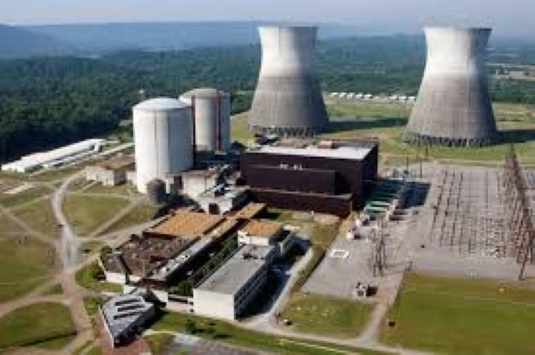
Project Factsheet for Clinch River Nuclear Site Development in Tennessee
Developer: Tennessee Valley Authority (TVA)
Technology Provider: GE Vernova and Hitachi Nuclear Energy
Technology: BWRX-300 small modular reactor (SMR)
Capacity: 300 MW
Federal Support: 400 million US dollars DOE grant under Generation 3 SMR program.
Commercial Operation Target: Early 2030s
Project Role: First commercial SMR deployment in the U.S. It is also an anchor project for America’s domestic SMR supply chain.
Utility: To offers firm, dispatchable, low-carbon baseload to complement renewables like solar and wind. Also to help counter the rising energy demand from the numerous data center outcrops in the country.
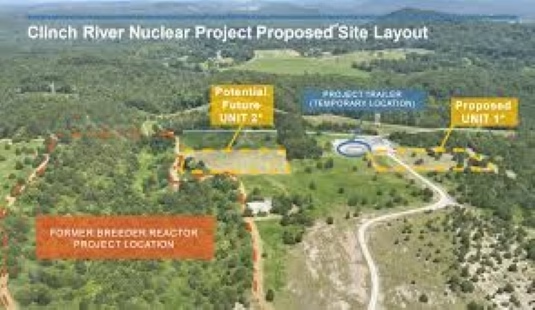
Timeline for GE Vernova’s BWRX-300 Deployment at the Clinch River Site
2023-24: TVA, GE Vernova, and Hitachi advance engineering, pre-licensing, and supply chain logistics.
Early 2025: TVA submits proposal for DOE’s Generation 3 SMR funding.
Dec 2025: DOE awards $400 million to TVA.
2026-2028: Licensing and site preparation expected.
Late 2020s: Targeted start of construction at Clinch River.
Early 2030s: Expected start of commercial operation.
Leave a Reply