The $17 billion Trans-Guinean infrastructure megaproject has officially crossed into its active operational and export phase, transforming Guinea’s macroeconomic landscape. Anchored by the co-development of the Simandou iron ore deposit, the world’s largest untapped high-grade iron ore reserve. The project hit a milestone as the historic first shipments of iron ore departed from the newly built maritime export facilities bound for Chinese steel mills. Led by the Compagnie du TransGuinéen (CTG), a joint venture between the Guinean government and international industrial consortiums, the scheme centers on a 650-kilometer trans-national heavy-haul railway and multi-user deep-water port systems in the Forécariah prefecture. Beyond hauling massive mineral volumes, the state-backed infrastructure is aggressively expanding its secondary footprint, with construction underway on ten regional stations to launch public passenger and commercial agricultural freight services by the end of 2026.
This infrastructure push directly accelerates Guinea’s strict industrialization agenda, serving as the strategic catalyst for the $1 billion Chalco alumina refinery project in Boffa, finalized through a landmark signing between Chalco Hong Kong and the Guinean government. Chalco’s parent company, Chinalco, is already heavily embedded in the Simandou iron ore pipeline as a core joint-venture partner alongside Rio Tinto in the SimFer consortium, making China’s largest state-owned aluminum producer a central pillar of Guinea’s dual-track mineral strategy. By leveraging the logistical blueprints, national workforce skills programs, and policy precedents established by the massive Trans-Guinean network, Chalco’s new greenfield refinery will process raw ore into 1.2 million metric tons of alumina annually. Governed under the same “Simandou 2040 Vision” led by strategic state committee chairs, this synergy allows Chalco to transition its localized Boffa bauxite extraction into a higher-value downstream processing hub, fulfilling Guinea’s mandated shift away from unrefined raw mineral exports.
May 22, 2024
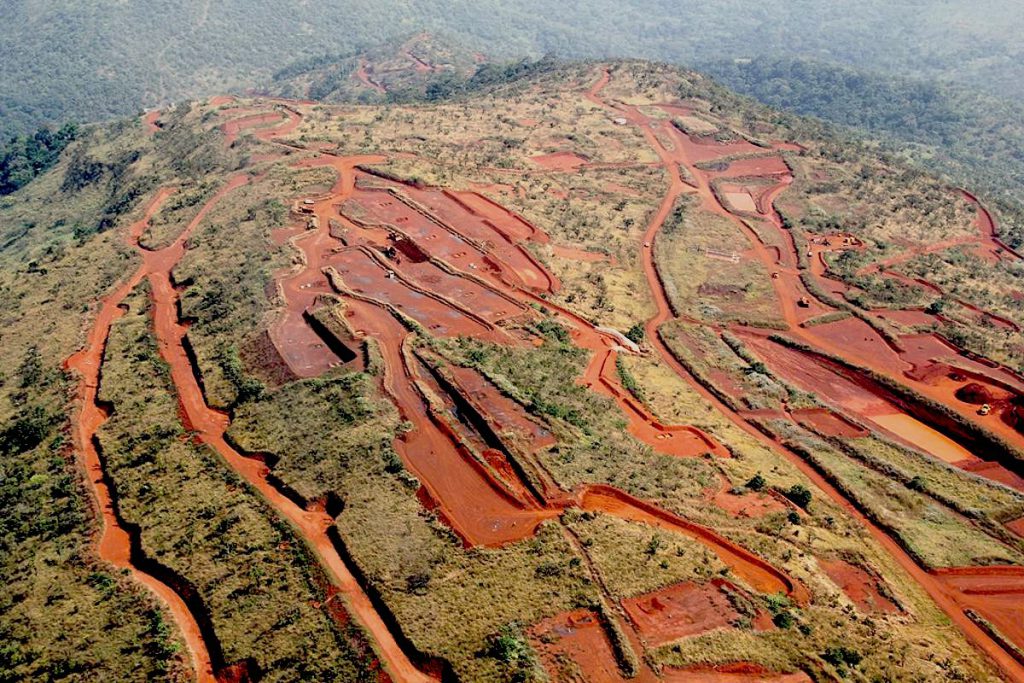
Construction has commenced on the West African state of Guinea’s mega $17 billion iron ore rail-and-port scheme. A consortium of companies including the mining giant Rio Tinto are all hands on deck to ensure its implementation. The project’s scope entails the construction of a 650km railway in Guinea to facilitate the shipment of iron ore. Dubbed the Trans-Guinean Railway, the railway line will link the Simandou iron ore deposits to a port to be built at Matakong.
The island is strategically placed as it is near the Sierra Leone border facilitating effective linkage. The infrastructure cost is expected to be in the region of $17bn. It is an expense the consortium justifies by the size and purity of the Simandou reserves. The contracted company, Rio Tinto, which is involved in mining the ore acclaims that the hills contain the world’s largest remaining untapped reserve of high-grade iron ore. Estimated to be about over 2 billion tonnes of iron in the reserves, the ore will be elemental in Guinea’s mining industry.
The Scope of Works for the Iron Ore Rail-and-Port Scheme in Guinea
Guinea’s iron ore rail-and-port scheme in Guinea is a rail system that will be dual-tracked and will ensure it adheres to professional standards. The rail is expected to be built to higher standards than a typical line based on the workload. It will have to carry trains weighing approximately 10,000 tonnes occasionally. The line will include 12 stations, 213 bridges and four tunnels to facilitate transportation. As with any significant development project, the project will ensure that challenges will need to be carefully managed.
This includes minimizing adverse social, health, safety and environmental impacts. It will also ensure it simultaneously fosters positive and tangible change for local communities and other key stakeholders. Rio Tinto is working hand in hand with the government of Guinea to ensure these aspects are met. It also includes the Winning Consortium Simandou (WSD), a subsidiary of the Winning International Group. The Winning International Group is a conglomerate based in Singapore with offices in various regions across the globe. It includes bases in Guinea, China, and even in Indonesia.
Also Read:
Top Mining Countries in the World
The Significance of the Trans-Guinean Railway in Iron Ore Mining
The iron ore rail-and-port scheme is one of the most significant construction projects in West Africa. From the associated infrastructure corridor to the thousands of jobs the project will create, the project will positively impact the Guinean economy. This will be elemental in creating opportunities and development potential. Furthermore, it will benefit the people of Guinea for generations to come. Rio Tinto plans to invest $6.2bn in the mine, rail and port project, in conjunction with several other companies. Five of these companies are headquartered in China. The iron ore project is expected to revolutionize Guinea’s economy and bolster revenue income. It will also ensure that Guinea’s mining industry leaves a hallmark on the country’s economy through employment and job opportunities.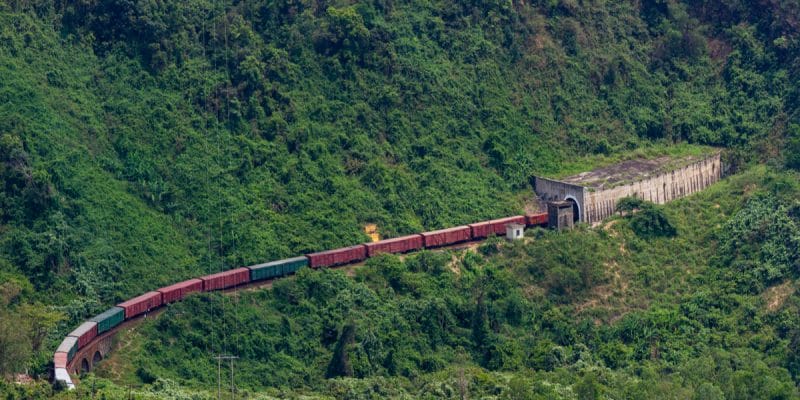
The State of Affairs Regarding the Simandou Project
In November 2019, WSD was awarded a concession to develop two blocks of the Simandou deposit. This is one of the major contracts awarded in conjunction with the iron ore rail-and-port scheme in Guinea. La Compagnie du TransGuinéen (CTG), formed by WSD and Rio Tinto, is undertaking the work. The companies involved in the project are committed to developing the Simandou project in line with internationally recognized standards. It entails the environmental, social and governance standards. It also includes transparently reporting on impacts of our mining operations, and continuing to work alongside local stakeholders on ways of mitigating these impacts. These companies recognize the responsibility entrusted to them and see themselves as long-term stewards of natural resources. They aim to continue to work alongside communities to ensure the Simandou project is developed.
Project Factsheet
Infrastructure Operator: Compagnie du TransGuinéen (CTG), a joint-venture company formed to manage all co-developed infrastructure and rolling stock upon final handover.
Equity Breakdown:
- SimFer Consortium: 42.5% (Joint venture between Rio Tinto and Chalco Iron Ore Holdings, alongside Baowu, China Rail Construction Corporation, and China Harbour Engineering).
- Winning Consortium Simandou (WCS): 42.5% (Comprising Winning International Group, Weiqiao Aluminium, United Mining Suppliers, and Baowu Resources).
- Government of Guinea: 15% (Non-dilutable state stake).
Technical Specifications and Scope
- Total Estimated Investment: USD 17 billion to USD 20 billion
- The Trans-Guinean Railway: A newly constructed 652-kilometer heavy-haul standard gauge (1435mm) railway. It cuts horizontally across Guinea, connecting the southeastern Nzérékoré region through Kankan, Faranah, Mamou, and Kindia to the Atlantic coast.
Port Infrastructure: Located in the Forécariah prefecture, featuring:
- The Port of Morebaya, utilizing a specialized shallow-water barge system and a 20-kilometer coastal pier to ferry ore to deep-water Transshipment Vessels (TSVs).
- A dedicated SimFer Mineral Terminal featuring multi-user, deep-water export capacity.
Total Logistical Capacity: Up to 120 million metric tons per year (Mtpa) of bulk mineral exports at full commissioning.
Operational Timeline and Current Status
- First Export Milestone: The first commercial cargo successfully sailed from Morebaya bound for China, marking the formal start of the project’s export phase.
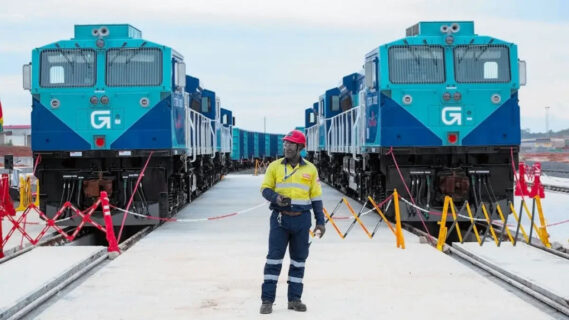
- Current Phase (2026): Infrastructure is undergoing rolling commissioning and capacity ramp-up. Initial 2026 export guidance targets 15 to 20 million tons total (with SimFer targeting 5–10 million tons), as operators actively deploy a fleet of heavy heavy-haul locomotives to clear initial rail capacity bottlenecks.
- Peak Capacity Target: Full multi-user ramp-up is projected to step up through 2028, with both WCS and SimFer aiming to hit up to 60–80 Mtpa each.
Also read:
Rio Tinto’s $20B Guinea Iron Ore Mining Project: World’s Biggest