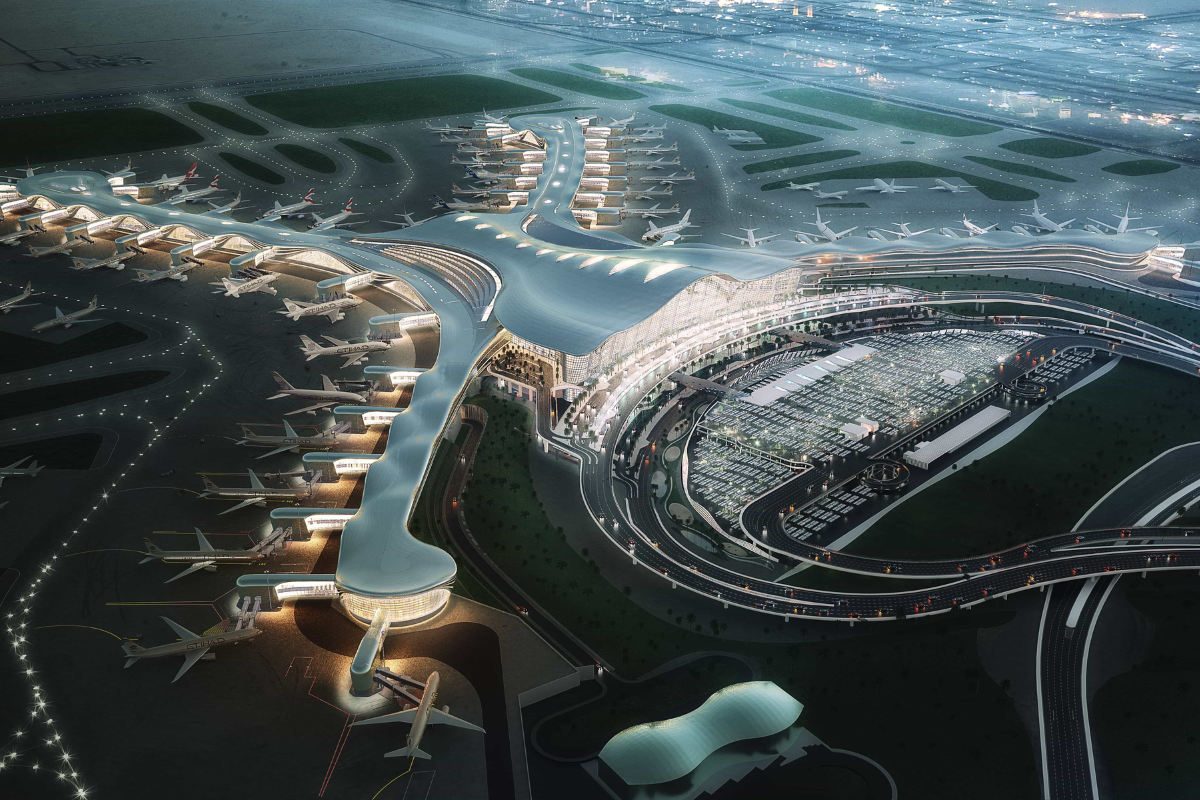
Abu Dhabi Midfield Terminal has moved from a delayed construction project into a major operating aviation hub at Zayed International Airport. The terminal opened commercially in November 2023 before receiving its official Zayed International Airport identity in February 2024. The transformation now supports Abu Dhabi’s growing passenger demand while creating additional capacity for future aviation and logistics development.
The terminal originally faced a six-year delay after construction began in 2012. The project initially targeted completion in 2017, but operational and construction challenges pushed delivery significantly beyond that deadline. Construction Review Online previously reported the delayed project ahead of its planned opening.
The completed facility now forms the centrepiece of Abu Dhabi’s airport infrastructure. It has an annual capacity of 45 million passengers and can process 11,000 passengers hourly.
Zayed International Airport replaces delayed Midfield Terminal
The former Midfield Terminal became Terminal A at Zayed International Airport after authorities introduced the new airport name. The official renaming took effect on February 9, 2024.
Terminal A spans about 700,000 square metres and includes 65 gates. Its infrastructure supports large aircraft while improving passenger processing through extensive automation.
The facility also incorporates biometric technology across the passenger journey. Self-check-in, self-bag drop, electronic registration and automated border gates support faster processing.
Furthermore, the terminal provides 163 food, beverage and retail outlets across approximately 36,000 square metres. The airport also connects Abu Dhabi with more than 100 passenger destinations.
The terminal’s architecture and engineering required substantial construction resources. The original project included 7,425 foundation piles and approximately 69,000 tonnes of structural steel.
Its roof structure features 18 steel arches supporting a large-scale terminal roof. The central arch reaches 180 metres across and 52 metres high.
Zayed International Airport expands beyond passenger facilities
The airport’s construction programme has continued beyond the former Midfield Terminal. Abu Dhabi Airports broke ground on the East Midfield Cargo Terminal in December 2024.
The new cargo facility covers approximately 90,000 square metres. It will handle between one million and 1.5 million tonnes of cargo annually when fully operational.
Construction of the cargo terminal supports Abu Dhabi’s broader ambition to strengthen its logistics infrastructure. The facility will connect with the airport’s Logistics Free Trade Zone and Al Falah District.
The cargo development will support consolidation, warehousing, distribution and re-export activities. It therefore extends the airport’s economic role beyond passenger aviation.
Meanwhile, Abu Dhabi Airports recorded more than 33 million passengers across its five airports during 2025. Zayed International Airport handled 32.5 million journeys, representing 12.6% growth year-on-year.
That growth has created additional pressure for supporting infrastructure around the airport. Abu Dhabi Airports is therefore pursuing further terminal, cargo, access and logistics investments.
In February 2026, consultants submitted bids for a delivery partner role covering upcoming Zayed International Airport packages. The proposed programme has an estimated value of AED10 billion, or about $2.7 billion.
The planned works include a new satellite concourse east of Terminal A. An underground tunnel will connect the concourse while housing an automated people mover and baggage-handling system.
Zayed International Airport strengthens UAE airport construction
The continuing development illustrates how the UAE is expanding airport infrastructure to accommodate long-term passenger and cargo growth.
Abu Dhabi’s approach also provides a useful comparison with Dubai’s larger Al Maktoum International expansion. Construction Review Online recently examined the $35 billion project targeting more than 260 million passengers annually.
That Dubai development will feature five parallel runways and extensive terminal infrastructure. Its first phase remains targeted for operations in 2032.
The comparison highlights the UAE’s broader investment in aviation construction. While Zayed International focuses on current capacity and phased expansion, Al Maktoum targets unprecedented long-term scale.
For Abu Dhabi, the priority now shifts from completing the delayed terminal to expanding the wider aviation ecosystem. Cargo infrastructure, passenger facilities and logistics development will determine the airport’s next growth phase.
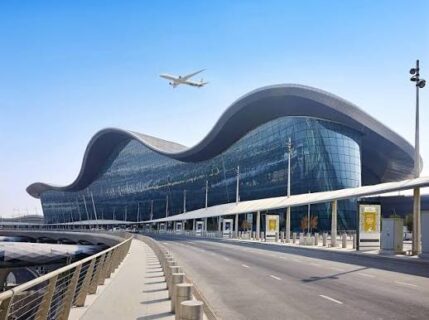
Read Also: Abu Dhabi to refurbish City of Rabdan
Abu Dhabi Midfield Terminal Total Area
In total, the Abu Dhabi Midfield Terminal spans 700,000 square meters, As a whole, the development boasts a value of $2.94 billion (10.8 billion dirhams). Furthermore, it will have the capacity to accommodate well up to 11,000 passengers per hour. At an estimate, it is said to cater up to 30 million passengers annually, upon completion.
Back in 2019, Bryan Thompson, former CEO, made an announcement, confirming that the project was 97% complete. Furthermore, he said that the development had incorporated the use of technology to transform the digital journey for travelers. Additionally, he revealed that the project’s scope of work was inclusive of a road tunnel that connects it to the existing terminal. This, in turn, will lead to a better simplification of passenger transfers, providing a more seamless experience.
In preparation for the opening of the Abu Dhabi Midfield Terminal, Etihad Aviation Group (EAG) and Abu Dhabi Airports formed a partnership in 2020. According to WAM, the purpose of the collaborative partnership was to train 17,000 employees in total. The training program, known as FIT, also plans to provide a seamless transition into work for the employees. Bryan Thompson stated that the program plays an instrumental role in ensuring operational readiness as well as smooth airport activities. Conclusively, he said that the program will thoroughly familiarize, induct and train (FIT), the employees to efficiently operate the terminal.
Project Fact Sheet
Project: Zayed International Airport Terminal A, formerly known as the Abu Dhabi Midfield Terminal.
Location: Abu Dhabi, United Arab Emirates.
Terminal area: Approximately 700,000 square meters.
Annual passenger capacity: 45 million.
Passenger processing capacity: 11,000 passengers per hour.
Gates: 65 contact gates.
Commercial operations: Began in November 2023.
Official airport renaming: February 9, 2024.
Original construction start: 2012.
Original completion target: 2017.
Construction delay: Approximately six years.
Structural steel: Approximately 69,000 tones.
Foundation piles: Approximately 7,425.
Baggage handling capacity: Up to 19,000 bags per hour.
Retail and food facilities: Approximately 36,000 square meters.
Cargo expansion: East Midfield Cargo Terminal.
Cargo terminal area: Approximately 90,000 square meters.
Baggage system: More than 22 kilometers.
Cargo capacity: One million to 1.5 million tones annually.
Cargo terminal target: Operational capacity expected in 2027.
Current passenger traffic: 32.5 million journeys at Zayed International Airport in 2025.
Project Team
Developer: Abu Dhabi Airports.
Airport operator: Abu Dhabi Airports.
Architectural design: Kohn Pedersen Fox Associates.
Engineering: Ove Arup.
Airport planning: NACO.
Engineering consultancy: BNP Associates.
Program management: Parsons.
Terminal development: Abu Dhabi Airports.
Cargo terminal contractor: RAQ Contracting.
Aviation operations: Etihad Airways and other airlines operating through Terminal A.
Cargo terminal operator: Etihad Airport Services.
Cargo development partner: Abu Dhabi Airports Free Zone.

Leave a Reply