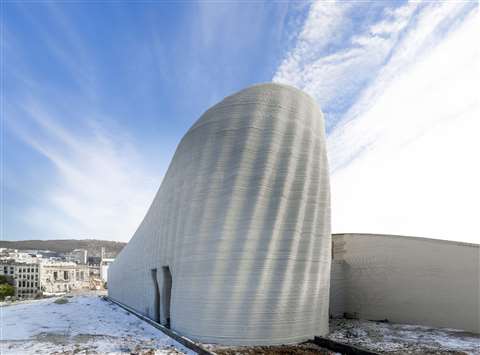
The Wave House data center project involved the construction of a data center facility in Heidelberg, Germany, developed using 3D printing technology. Construction on the facility was completed, with the structure built using approximately 450 tons of printing concrete supplied by Heidelberg Materials.
The concrete material was designed to be fully recyclable and incorporated a binder, with reports indicating it could achieve up to a 55 percent reduction in CO₂ emissions compared to pure Portland cement. Project partners included Peri 3D, part of the Peri Group, along with architecture firms Mense-Korte and SSV. Construction works began the previous year using a BOD2 3D construction printer, after which Heidelberg iT proceeded with the internal fit-out of the white space and electrical room.
Design details
The data center will offer 500kW and have capacity for around 100 racks. The fit-out is expected to be complete towards the end of the summer. The IT firm has a long-term lease on the site. Furthermore, the building’s measurements – spanning 600 m2 (approximately 6.600 SF), with dimensions of 54m in length, 11m in width, and 9m in height – were achieved with the walls printed in 140 hours.
The team behind Europe’s largest 3D-printed building
The architects SSV and Mense Korte faced a challenge in the Heidelberg project by designing walls with a wave-like shape. Cobod, a privately owned by General Electric, with CEMEX, Holcim, and Peri as key shareholders, manufactured the BOD2 construction printers. The actual printing took around 140 hours, equivalent to printing four square meters of building per hour. Peri highlighted that conventional construction methods could not have been used to achieve this design. Thus, 3D construction printing technology was utilized because of its design freedom.
Dr. Fabian Meyer-Brötz, the managing director of PERI 3D Construction, commented on the project, “We are very proud to have realized our largest building to date with this project. “Not only because of the size of it, but in particular due to the special shape and the parametric design used, which documents the immense design freedom of COBOD’s technology.”
World’s largest 3D-printed structure
Not too far off from Germany, the world’s largest 3D-printed structure has been planned in Switzerland. Intended to attract tourists to the tiny village of Mulegns. The five storey, 30 meter tall structure is named the Tor Alva. Further, it has been designed with a lacelike white concrete that appears to weave gracefully into the sky. Nova Fundaziun Origen is the organization behind the structure that is located in the town with a population of 16 people.

To inspire visitors to spend the night too, the tower will function as a cultural venue and multifunctional space, with a calendar of performances, installations, music, and theatre. Additionally, a coiling series of columns, each uniquely “printed” with their own pattern, will lead visitors to a penthouse chamber for up to 45 people where concerts can be held. The 3D-printing process began in February and is expected to take around 900 hours, it is expected to be completed by July this year.
Related Projects
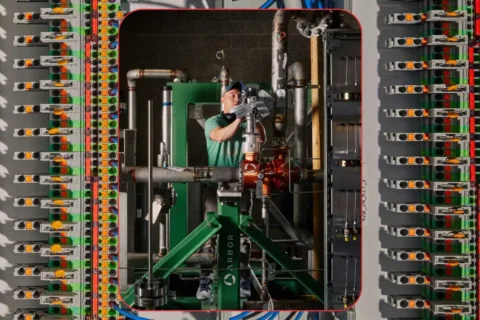
On a related note, California-based Arbor company aims to produce 3D printed, modular, fuel-agnostic turbines to power data centers. The move shows the rise of 3D printed data center components and facilities. Moreover, the turbines will be developed for GridMarket, a platform that matches clean energy projects with sites and buyers. The 3D printed turbines will largely run on natural gas.
Arbor will both manufacture the turbines and build the initial projects, rather than passing things off to a traditional energy developer, said CEO and co-founder Brad Hartwig. “At the beginning, we’re working with data center developers…so that we can transact for power, rather than turbines,” Hartwig, a former SpaceX engineer, explained. Once implemented the project will not only benefit data centers across Europe but also around the globe. This includes projects such as the Microsoft Crusoe data center campus in Abilene, Texas. Moreover, reliable energy is becoming fundamentally essential for these projects across the world and innovation provides a clear path to achieve it.
Project Overview
- Project Type: 3D-printed data center facility.
- Capacity: 500 kW (~100 racks).
Key Stakeholders
- Developer / Operator: Heidelberg iT
- Technology Partner: Peri 3D Construction.
- Supplier of Materials: Heidelberg Materials.
- Architects: Mense-Korte and SSV Architekten.
Location
- City: Heidelberg
- Country: Germany
Scope
- A 600 m2 data center built with 3D printing technology.
- Consumption of about 450 tons of recyclable printing concrete.
- White space and electrical infrastructure installation.
Technology / Design
- Constructed with the BOD2 3D printer.
- Wave-shaped wall design made possible by 3D printing.
- Also printed in approximately 140 hours.
Sustainability Features
- Recyclable concrete.
- As much as 55 percent less CO2 than conventional Portland cement.
Timeline
- Construction Start: 2024.
- Structure Completion: 2025.
- Fit-Out Completion: Anticipated by the end of summer 2025.
Status
- Status: Construction is finished; fit-out is in progress.
Strategic Significance
- The largest 3D-printed building in Europe.
- Also evidences increasing use of 3D printing in data center design and sustainable building practices.
Also Read:
The Worldwide Data Center Construction Market Expected to Hit $429 Billion by 2032
Google announces US$1 billion London data centre investment
Meta to construct a new data center campus in Jeffersonville, Indiana.
Microsoft completes land purchase deal for new Mount Pleasant Data Centre