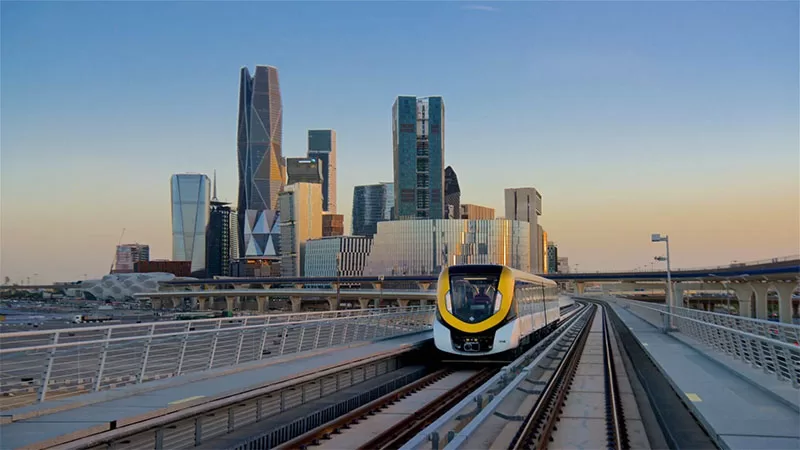
The Riyadh Metro is a $22.5–25 billion, 176km, fully automated driverless rapid transit system serving the Saudi capital, comprising six colour-coded lines connecting 85 stations — including four architecturally iconic stations — and forming the centrepiece of the broader King Abdulaziz Project for Riyadh Public Transport, which also encompasses over 840 buses on 80 routes and park-and-ride facilities. Conceived in 2013, groundbroken in April 2014, and delivered as the world’s largest single-phase metro construction programme, the system was built simultaneously across all six lines by three international consortia. Inaugurated by King Salman on November 27, 2024, the metro opened to the public from December 1, 2024, with Lines 1, 4 and 6 first; Lines 2 and 5 followed on December 15; and Line 3 completed the network on January 5, 2025. In its first year of service, the network carried more than 162 million passengers, far exceeding initial ridership expectations. That success has already catalysed the next phase of expansion, with the Riyadh Metro Red Line Western Extension now under construction — an 8.4-kilometre addition led by Webuild that will push the network toward Diriyah and King Saud University, adding five new stations and extending the Red Line to approximately 33.7 kilometres by the early 2030s.
Project Overview
Type: Fully automated, driverless urban metro rail network
Location: Riyadh, Saudi Arabia
Total network length: 176km (46.3km underground; remainder elevated and at-grade)
Number of lines: 6 (Blue/Line 1, Red/Line 2, Orange/Line 3, Yellow/Line 4, Green/Line 5, Purple/Line 6)
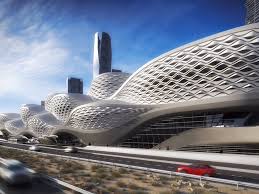
Number of stations: 85 (including 4 iconic main stations: KAFD, Qasr Al Hokm, Western, STC)
Total project cost: $22.5–25 billion
Groundbreaking: April 4, 2014
Inauguration: November 27, 2024 (King Salman); public opening: December 1, 2024 (Lines 1, 4, 6); December 15, 2024 (Lines 2, 5); January 5, 2025 (Line 3 — full network)
Design capacity: 3.6 million passengers/day at full capacity; currently up to 1.6 million/day
Year-one ridership: 162 million+ passengers; Line 1 carrying up to 215,000/day; Line 2 up to 67,000/day
First week ridership (Dec 1–7, 2024): 1.9 million passengers; total by end of February 2025: 18 million
Guinness World Record: World’s longest fully automated driverless metro network (January 2025)
Integration: DARB app (unified metro + bus fare/tracking); 840+ buses on 80 routes; taxi ranks and park-and-ride
Fares: SAR 4 (standard, 2 hours); SAR 10 (first class, 2 hours); daily/weekly/monthly pass options
Operating hours: 6:00am to midnight daily
Future expansion: Line 7 proposed (65km, 19 stations; Qiddiya City to King Khalid International Airport via NEOM MiSK City, New Murabba, Diriyah); Line 2 extension proposed westward; contractor prequalification underway
Sustainability: Reduces carbon emissions via vehicle displacement; LEED Silver minimum at iconic stations; urban shading and adaptive planting along corridor
Safety: 2,500+ days Lost-Time Injury-Free achieved by October 2024; 7 million+ hours LTI-free by August 2024
Project Team
Owner/Client: Royal Commission for Riyadh City (RCRC) / ArRiyadh Development Authority (ADA)
Programme Management (Lines 1, 2, 3): Riyadh Metro Transit Consultants (RMTC) — Parsons, Egis, Systra JV
Programme Management (Lines 4, 5, 6): RAMPED consortium — WSP and Hill International
Construction Package 1 (Lines 1 & 2 — Blue & Red): BACS consortium — Bechtel, Almabani General Contractors, Consolidated Contractors Company (CCC), Siemens
Construction Package 2 (Lines 3 & 4 — Orange & Yellow): ANM (Arriyadh New Mobility) — Webuild (then Salini-Impregilo), Bombardier, Ansaldo, Larsen & Toubro, Nesma & Partners, WorleyParsons
Construction Package 3 (Lines 5 & 6 — Green & Purple): FAST consortium — FCC, Alstom, Samsung C&T, Strukton, Typsa
O&M Contractor (Lines 1 & 2): Capital Metro Company (Camco) — RATP Dev (80%) + Saudi Public Transport Company/Saptco (20%); 12-year contract (SAR 8.5bn)
O&M Contractor (Lines 3, 4, 5, 6): Flow consortium — Alstom and Hitachi; 12-year contract (SAR 10.9bn / $2.91bn)
Architect (iconic stations): Zaha Hadid Architects (KAFD/King Abdullah Financial District Station); Gerber Architekten (Qasr Al Hokm); HOK (STC Station)
Bechtel Chairman & CEO: Brendan Bechtel
RATP Dev CEO: Laurence Nion; Line 1 Project Director: Seyadou; Lines 1 & 2 CEO: Farès
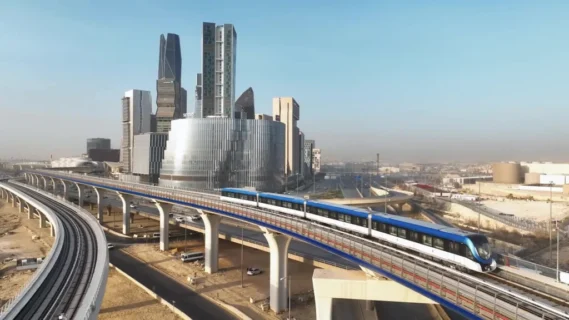
Published 25th August 2024: The Riyadh Metro has been inaugurated and will be open to the public from December. The metro features 183 trains serving 85 stations and spans a length of 176kilometres. The Public transport network is also augmented by a Bus Rapid Transit (BRT) system. The inauguration was conducted by King Salman
The new metro will be open to the public from the 1st of December and will operate from 6am to midnight daily. Only the blue, yellow and purple lines will be initially opened followed by the green line mid December and the Orange line at the beginniing of 2025.
The $25bn project was scheduled to open six years ago, in 2018, but construction activity on the project has slowed in recent years due to disputes over prolongation and the disruption caused by the Covid-19 pandemic.
Developers of the Riyadh Metro
Arriyadh Development Authority, now the Royal Commission for Riyadh City (RCRC), awarded the main construction packages for the scheme on 28 July 2013.
In November 2022, the three contracting consortiums working on the Riyadh Metro scheme had struck deals regarding the completion of the works for the project with the RCRC.
The completed Riyadh Metro will feature six lines, with a total of 84 stations.
The project aims to contribute to solving traffic congestion. Currently, 90% of trips within the Saudi capital rely on cars.
The development was divided into five major design-and-build packages, with lines one and two as a combined package, and the other lines as single packages. Each package also includes the supply of rolling stock.
Spanish firm FCC Construccion heads up the consortium known as Fast, while US firm Bechtel leads the BACS consortium. Italian firm Ansaldo STS is the leader of the Arriyadh New Mobility group.
The Fast consortium won lines four, five and six, which are reported to be valued at $7.82bn. The BACS consortium picked up lines one and two for $9.45bn, while Arriyadh New Mobility secured line three for $5.21bn.
Significance of the Project
The project will considerably reduce carbon emissions by providing a sustainable means of transportation to facilitate citizens’ and residents’ dependence on vehicles.
In one of its project highlights, RMTC said that the designs developed for the four stations will meet a minimum silver certification of Leadership in Energy and Environmental Design certification.
Overall, the project has taken the lifecycle design approach: plan, design, and construct the project using materials that are local, recyclable and nonpolluting.
Once launched, this monumental project will be a testament to the creativity and ingenuity of architects, artists and engineers, a celebration of the human mind.
It will demonstrate the country’s commitment to modernized structures that offer people top-tier facilities, making it a sought-after experience at the Riyadh Expo 2030.
Riyadh Metro Fact sheet
- The Riyadh Metro is the largest metro project in the world to be built in a single phase.
- It spans six lines (or routes) across 176 kilometres, with 84 stations connecting the city.
- The Blue Line will cover Al Olaya, Al Batha, and Al Hayer roads, while
- The Red Line will run along King Abdullah Road.
- The Orange Line will connect Al Madinah Al Munawarah Road to Prince Saad Bin Abdurrahman I Road.
- The Yellow Line will service the King Khalid International Airport,
- The Green Line will follow King Abdulaziz Road, and the Violet Line will link Abdurrahman Bin Awf Road to Sheikh Hassan Bin Hussain Bin Ali Road.
- The Purple Line will start at King Abdullah Financial District, passing Imam Mohamed Bin Saud University, and ending at Prince Saad Ibn Abdulrahman Al Awal Road
Also read: Multi Billion Dubai Metro Line Tender Issued
ACWA Power commissions 700MW AlRass1 Solar Photovoltaic Project in Saudi Arabia
Saudi Arabia’s $2 Billion Mixed-use District Development Contract Awarded
Saudi Arabia’s Vision 2030: On Track to Become the World’s Largest Construction Market

Leave a Reply