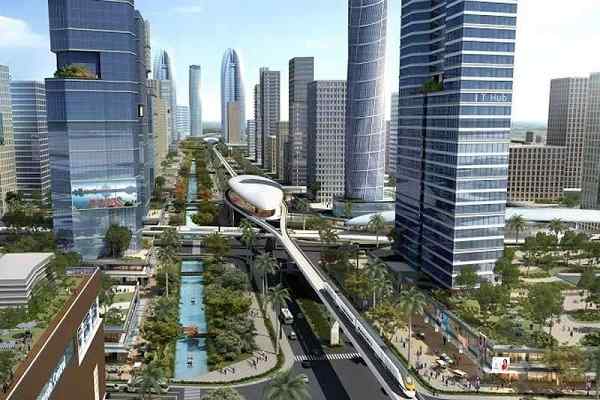
Saudi Arabia’s NEOM Spine rail project remains under strategic review as authorities reassess construction priorities, delivery timelines, and infrastructure spending across the wider NEOM development. The high-speed transport corridor still forms part of the kingdom’s long-term Vision 2030 agenda despite revised implementation targets and phased development adjustments.
The Spine was originally designed as the transport backbone for The Line, the futuristic linear city planned within NEOM. The rail system aimed to move passengers across the 170km development in roughly 20 minutes through ultra-high-speed transit technology. However, current activity now focuses on priority infrastructure zones and foundational works rather than the complete original rollout.
NEOM Spine rail project undergoes phased development review
Recent 2026 reports indicate that Saudi authorities scaled back some early expansion plans following cost reviews and engineering reassessments. Current construction efforts reportedly prioritize industrial infrastructure, logistics facilities, and energy developments instead of large-scale residential buildouts.
Officials nevertheless continue describing NEOM as a long-term strategic investment project. The kingdom still considers the mega-development central to economic diversification, clean energy expansion, advanced manufacturing, and technology-driven urban planning.
The revised approach reflects broader infrastructure optimization efforts taking place across several major Saudi projects. Analysts believe authorities are now concentrating on commercially viable phases capable of attracting long-term investment and operational stability.
Saudi Arabia continues expanding transport infrastructure projects
Despite NEOM’s revised timeline, Saudi Arabia continues advancing major mobility developments nationwide. Recently, Riyadh completed construction works on the final station along the Orange Line corridor under the Riyadh Metro programme. The milestone highlights the kingdom’s continued investment in large-scale transport systems aimed at reducing congestion and improving urban mobility.
Meanwhile, NEOM continues progressing selected infrastructure packages linked to Oxagon, renewable energy facilities, logistics corridors, and AI-focused developments. Several tourism and residential components, however, remain under ongoing review. Industry observers expect Saudi Arabia to continue delivering phased sections of NEOM over the coming decade rather than pursuing simultaneous full-scale construction across all planned districts.
The Significance of the World’s Fastest Train Line in NEOM’s The Line
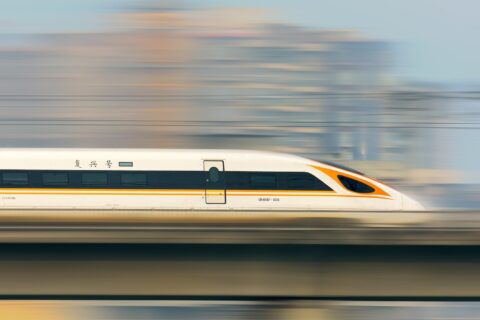
In comparison to some of the fastest trains across the world, the Spine will be the world’s fastest train. It literally races ahead of the rest when compared to Shanghai’s Maglev, which is currently the world’s first high-speed magnetic levitation line. It boasts a maximum operation speed of 450km/h and runs a 19-mile track. The Spine will be much faster and will be able to zoom residents and visitors alike across the linear mega city.
This proves that the Spine rail is indeed a spectacle and will be one of NEOM city’s most spectacular features. The aim of the project is to connect the high-speed railway called the Connector, running along the Red Sea Coast. Once completed, the two high-speed railway tracks will connect the port city of Oxagon and the Line. Oxagon is expected to become the world’s largest floating structure. The Kingdom of Saudi Arabia has allocated $1.5 billion to implement the Connector and link it with the Spine.
The Spine Takes Shape as Construction Commences Underground
Saudi Arabia’s NEOM is shifting gears from ideas and captivating graphics to actionable and tangible proof. The construction of the world’s fastest train is taking shape based on the latest revelation from NEOM’s X account. The images show the progress made by the contracted companies on the Spine. According to the information shared, the contracted firms have already commenced and completed 25% work on one of the tunnels. This is in anticipation that some of the 170 kilometers that the Spine will cover will be underground. Furthermore, the space will be utilized by other high-speed trains, freight trains, and even transport vehicles. It will also be immensely fundamental in linking the Line and the industrial port, Oxagon. Work is already ongoing in full swing inside the tunnel. It creates an otherworldly atmosphere complete with trucks, diggers, etc.
The State of the Region in Regards to Implementing The Spine.
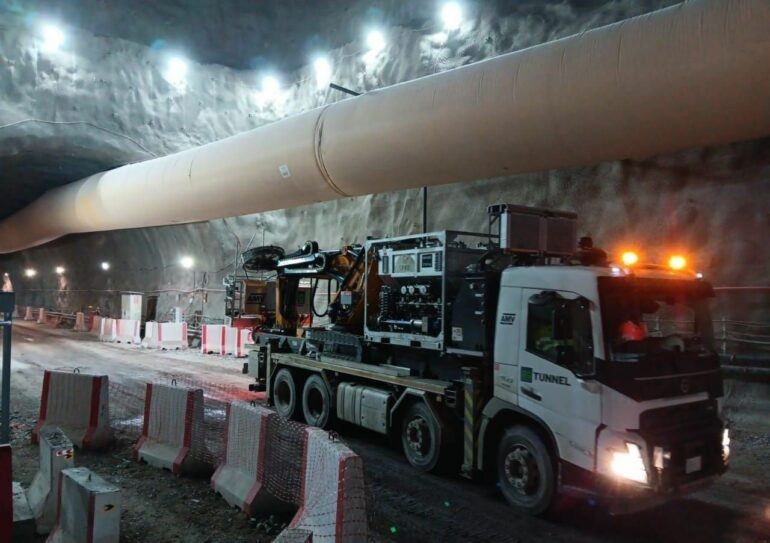 This sneak peek into the tunnel follows news of NEOM officials taking elite bankers in swish private jets so they can witness the Line firsthand. They were also able to view the scale and development pace of the world’s fastest train, the Spine. They even arranged for more than 100 construction companies to visit Neom City to understand firsthand the development. The Kingdom of Saudi Arabia is impressed with the progress so far and hopes that it will flourish. It has also set aside funds that will facilitate in its construction, including the world’s fastest train, the Spine.
Also read:
$500B NEOM Seeks Firms to Commence Construction of the Trojena Mirage Visitor Center
NEOM Unveils Raffles Trojena: A Mixed-use Destination Resort in the Mountains of Trojena
Project Fact Sheet
Project: NEOM Spine high-speed rail corridor
Location: NEOM, Tabuk Province, Saudi Arabia
Overall NEOM programme value: Approximately $500 billion
Rail corridor purpose: High-speed transport backbone for The Line
Planned route length: Approximately 170km
Planned travel time: Around 20 minutes end-to-end
Current status (2026): Strategic review and phased reassessment underway
Development priorities:
- Industrial infrastructure
- Logistics facilities
- Renewable energy projects
- Smart mobility systems
Strategic programme alignment: Saudi Vision 2030
Project Team
Project owner: NEOM
Government oversight: Public Investment Fund
National strategic framework: Saudi Vision 2030
Infrastructure and planning consultants:
- AECOM
- Bechtel
- Parsons Corporation
Construction and engineering participants:
- Webuild
- Larsen & Toubro
- China Railway Construction Corporation
Specialist scope areas:
- High-speed rail systems
- Urban mobility integration
- Smart city infrastructure
- Renewable-powered transport systems