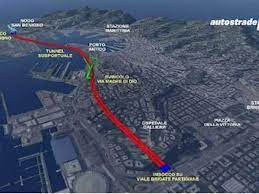
The Genoa Sub-Port Tunnel project involves the construction of an underwater transport infrastructure currently underway in Genoa, Italy as of 2024. When it is completed, the tunnel will be the longest of its kind in Italy and the largest diameter in Europe, and fourth largest in the world. Construction of the project has now begun in Italy’s north-western port city. This is Italy’s first underwater tunnel project of such magnitude. It has been approved by the Ministry of Transport headed by Deputy Prime Minister Matteo Salvini and designed by Italian architect Renzo Piano.
The groundbreaking ceremony marked the beginning of work on the 3.4-kilometre tunnel, which will be 45 metres below sea level. The project aims to contribute to regional mobility along the Ligurian Sea coast by providing passage for vehicles at up to 70 kilometres per hour, thereby reducing traffic congestion on the surface. According to officials, the tunnel represents a big infrastructure intervention for the town and introduces a large model of engineering into the European context.
Italy is committed to enhancing its transport projects. Other than planning for the world’s longest suspension bridge, the nation also has its eyes on the Europe’s largest underwater tunnel, the Genoa sub-portal tunnel. These projects are expected to be monumental in enhancing accessibility across the nation. However, the implementation of the bridge is facing major setbacks as the Court of Auditors reject the flagship project plan.
Prime Minister Giorgia Meloni issued an angry statement accusing the judges of exceeding their authority. The government in early August approved the project, one of the most ambitious and contested in the country’s history. However, the audit court’s rejected the plan in October due to technical fears. The court highlighted gaps in the paperwork and procedural shortcuts as well as possible non-compliance with European Union environmental and procurement rules.
Read also: Europe-Africa Rail Tunnel Project to Connect Two Continents
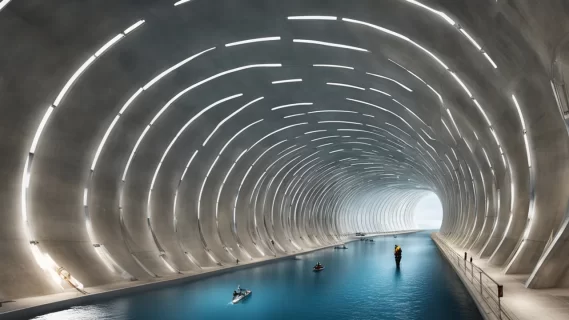
Construction timeline for the Genoa sub-port tunnel
The project, based on a masterplan by the celebrated Italian architect Renzo Piano, includes two main separate tunnels, one for each direction. The project is scheduled to open to traffic in the summer of 2029, according to the government and the developers.
“It fills me with pride to inaugurate today a construction site poised to redefine the landscape of Genoa in the coming years,” explains Genoa’s Mayor, Marco Bucci. “The sub-port tunnel signifies a pivotal project set to enhance traffic flow in our city while prioritizing safety and sustainability, particularly from an environmental standpoint. It heralds a genuine revolution for Genoa, an unparalleled infrastructure in Italy, and one of the most forward-thinking endeavors in Europe presently. From its conception, we’ve held steadfast belief in this project, recognizing it as an engineering feat of the highest caliber. Together with the new Waterfront, the Dam, and the Lanterna Park, it will utterly transform this section of the city. We stand prepared to tackle this new challenge head-on, as months of intensive labor lie ahead to realize the vision of the new sub-port tunnel, propelling Genoa boldly into the future.”
Read also: The top 5 longest underwater tunnels in the world
Genoa sub-port tunnel focus on environment
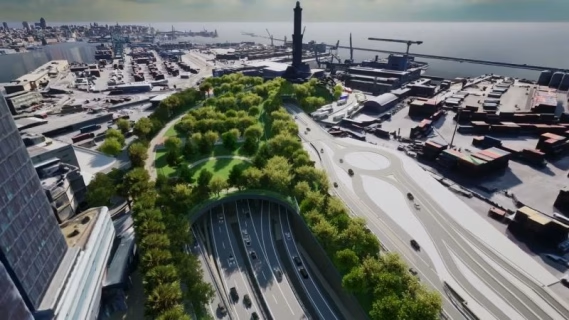
Thanks to Europe’s largest underwater tunnel, the Genoa sub-port tunnel it will be possible to save more than 1 million hours of travel each year, and it comes with positive repercussions also in environmental terms. The city will acquire 10 hectares of new park spaces, which will be complete with cycle and pedestrian paths, thereby enriching the city’s recreational and ecological assets. The new parks will thus become an integral part of the Genoese landscape system, recalling its characteristics and the history of its territory, its gardens, parks, squares, and seafront, in favor of a structural continuity of green systems to defend and support quality environment and biodiversity.
The Genoa sub-port tunnel project, thanks to the contribution of local institutions based on the Genoa master plan drawn up by Studio Renzo Piano and under the supervision of the Ministry of Infrastructure and Transport, is an expression of the synergy between the companies of the Aspi Group, starting with Tecne, engineering company that oversaw the design, up to Amplia, the first construction company for activities at a national level, which will take care of the first phase of work.
Read also: Italy to build world’s longest suspension bridge, design approved
Following the preparatory works already started in 2023, the works start with the demolition of the large CSM industrial warehouse, by two massive cranes with grapples, thus opening up to the city and an area of over 25,000 square meters which will be the western entrance to the tunnel, from which the excavations will start. With a 3.4 kilometers long route, made up of two separate main tunnels, one for each direction of travel, with an external excavation diameter of approximately 16 meters, which will run at a maximum depth of -45 meters under sea level, The Genoa sub-port tunnel project, thanks to an investment of approximately 1 billion euros, the project ranks as the longest in Italy and the largest in Europe in terms of diameter.
A milestone for Europe’s infrastructure
The Genoa sub-port underwater tunnel is poised to be the largest of its kind in Europe and the fourth largest Worldwide, it represents a significant stride in engineering and architectural excellence. With big names like Salvini and Piano at the helm, the project not only exemplifies Italy’s prowess in innovative infrastructure but also sets a precedent for sustainable urban development across Europe. As construction progresses, the tunnel will redefine transportation efficiency, environmental management, and quality of urban life.
Read also: T-50: India’s longest transportation tunnel is now open