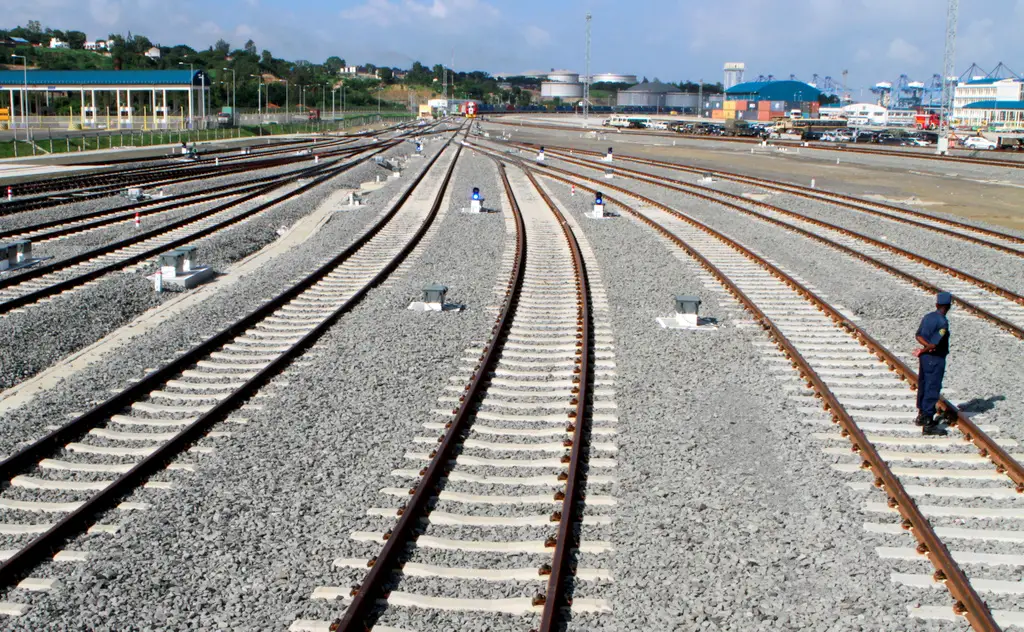
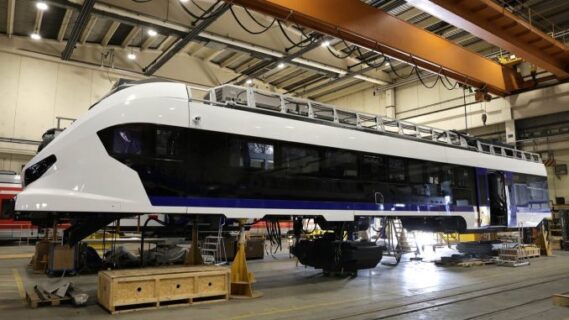
Since the original article was published in May 2023, Croatia’s rail investment programme has significantly scaled up in both ambition and committed spending. HZ Infrastruktura is now targeting nearly EUR 6 billion in railway reconstruction by 2035, up from the EUR 4 billion figure cited at the 2023 Zagreb conference. Active construction is underway across multiple corridors simultaneously, with more than EUR 1.5 billion in upgrades and reconstruction currently in progress nationwide. The passenger fleet modernisation target of 70 new trains, forecast for mid-2025, has been delivered on schedule, including Croatia’s first battery-powered and electro-battery trains now in operation.
Major Contracts Awarded as the Rijeka Corridor Takes Centre Stage
Two landmark construction contracts have been awarded since 2023, bringing the programme firmly into the execution phase. In April 2026, HZ Infrastruktura signed a EUR 279 million contract with Spanish firm Comsa for the double-tracking, reconstruction and electrification of the 44-kilometre Hrvatski Leskovac to Karlovac section of the Zagreb to Rijeka line, with construction due to start in summer 2026 and completion within three years. Separately, in May 2026, Indian contractor Afcons Infrastructure was selected for the EUR 677 million Dugo Selo to Novska upgrade, described as the largest single railway contract in Croatia’s history. This major award is detailed in the Croatia Dugo Selo–Novska railway line contract announcement. Meanwhile, the new lowland Zagreb to Rijeka railway, valued at an estimated EUR 2.5 billion to EUR 3 billion, has entered active design and procurement stages, with environmental clearances secured in 2025 and a tender for Alliance model delivery consultancy launched in February 2026.
Project Overview
- Project Name: Croatia National Railway Infrastructure Investment Programme
- Location: Nationwide, Croatia; key corridors include TEN-T Mediterranean and Rhine-Danube routes
- Developer/Owner: HZ Infrastruktura (Croatian Railway Infrastructure Manager); Ministry of the Sea, Transport and Infrastructure
- Total Cost/Value: Nearly EUR 6 billion planned through 2035 (up from EUR 4 billion announced in 2023)
- Scale/Capacity: 2,617 km network; 439 km renewal and 222 km modernisation planned for 2026 to 2027 alone; target speeds of 160 km/h on key corridors
- Construction Start: Ongoing; multiple projects active since 2023, with major new contracts entering construction from mid-2026
- Expected Completion: Rolling programme through 2035; individual project timelines vary (e.g. Dugo Selo to Novska completion approximately 2032; Hrvatski Leskovac to Karlovac completion approximately 2029)
- Funding/Financing: EU Connecting Europe Facility (CEF), Competitiveness and Cohesion Programme 2021 to 2027, National Recovery and Resilience Plan, European Investment Bank loans, Croatian state budget
- Current Status: Active construction and procurement across multiple corridors; EUR 318 million budgeted for 2026, rising to EUR 365 million in 2027
- Key Milestone: EUR 677 million Dugo Selo to Novska contract awarded to Afcons Infrastructure in May 2026, marking Croatia’s largest ever single railway contract
Project Team
- HZ Infrastruktura — Railway Infrastructure Manager and Client
- Ministry of the Sea, Transport and Infrastructure — Government Owner and Policy Authority
- Afcons Infrastructure Limited — Main Contractor (Dugo Selo to Novska, EUR 677 million)
- Comsa Corporacion (Spain) — Main Contractor (Hrvatski Leskovac to Karlovac, EUR 279 million)
- European Commission — Primary Financier via Connecting Europe Facility and Competitiveness and Cohesion Programme
- European Investment Bank — Loan Financier (Cakovec to Varazdin to Koprivnica regional line; rail mechanisation procurement)
- Plasser and Theurer (Austria) — Equipment Supplier (EUR 7.3 million heavy-duty rail maintenance vehicle contract, April 2026)
- DB Engineering and Consulting — Design Consortium Member (Dugo Selo to Novska Phase 1 design)
- Granova; Zeljeznicko projektno drustvo (ZPD) — Design Consortium Members (multiple sections)
- Tecnica y Proyectos (TYPSA); Egis Rail; INECO — Design Consortium (Dugo Selo to Novska Phases 2 and 3)
- BBD Bridge and Building Design; Mobilita Vision; Geotehnicki studio — Design Consortium (Karlovac to Skradnik and Skradnik to Krasica to Tijani sections)
- AZD Praha — Signalling and Interlocking Contractor (earlier Hrvatski Leskovac to Karlovac contract)
- IPMA Croatia (International Project Management Association) — Advisory and Knowledge-Transfer Body
Reported 3rd May 2023: More than €4 billion is set to be invested in Croatia’s rail infrastructure development in the course of the next ten years. The Agency for the Safety of Railway Transport, the Agency for the Investigation of Air, Maritime, and Railway Transport Accidents, and the Croatian Regulatory Agency for Network Activities (Hakom) held a conference in Zagreb, where the plans were unveiled.
Alen Gospoi, state secretary at the Ministry of Sea, Transport, and Infrastructure, claims that 25 significant infrastructure projects are now being carried out. Sixteen of them are co-financed with financing from the European Union (EU).
Croatia’s rail infrastructure renovation program
In 2024, a program for extensive local and regional railroad renovation and building will begin. Additionally, discussions with international financial institutions are still going on. This will assist in restoring 800 to 1000 kilometers of local and regional lines in the following ten years.
By the middle of 2025, the passenger fleet will have undergone modernization. The modernization will help add around 70 new trains. By 2032, Gospočić estimates that 120 and 130-passenger trains should receive a comprehensive overhaul.
Read Also: Plans in for a 15-storey women-only tower block in West London
Gospočić said in a statement about freight operator HŽ Cargo that the business is now stable and restructured. It is thus looking for a strategic partner for long-term stability. The minister added that by 2033, the government hopes to raise rail freight traffic from its current level of 16 million tonnes to more than 25 million tonnes.
Expectations for the program
As of 2023, around 17.5% of Croatia’s whole rail network allows for speeds above 100 km/h. Almost 50% allows for a top speed of 80 km/h, and the remainder allows for speeds of between 80 and 100 km/h.
Speeds on the entire network will increase. This will be after the modernization of a few major rail corridors and a few crucial regional corridors. The modernization will allow for speeds of over 100 km/h and the remaining 1200 km for speeds between a minimum of 70 km/h and up to 100 km/h.
Thus, it will help to completely eliminate slow routes. The most optimistic period for a complete renovation of Croatia’s rail infrastructure might extend into several decades. However, the modernization of the rail infrastructure is a continuous process reliant on government and EU financing.

Leave a Reply