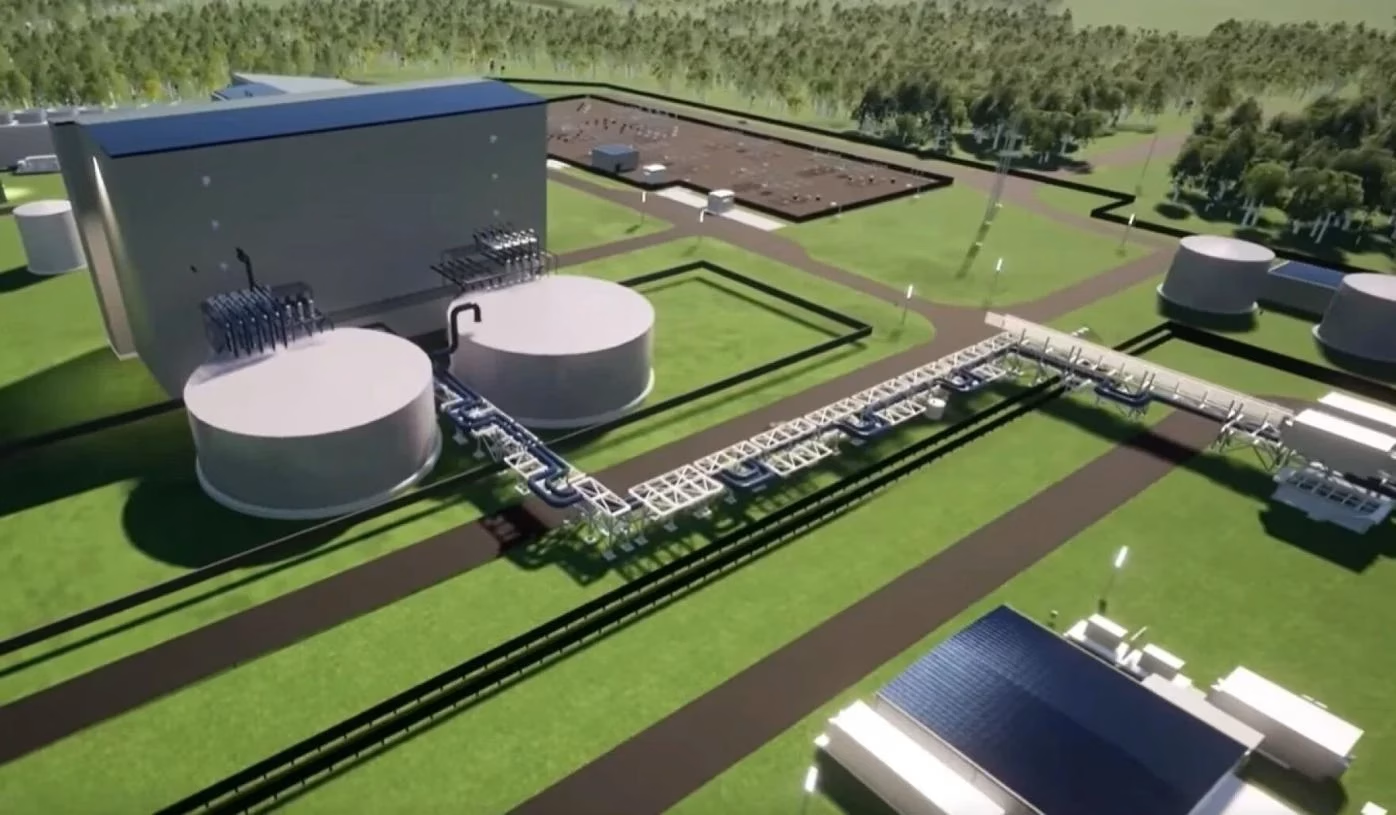
Deep Fission, a Berkeley-based nuclear technology startup, has officially selected the Great Plains Industrial Park in Parsons, Kansas, as the site for its groundbreaking pilot project which aims to demonstrate the viability of placing small modular nuclear reactors one mile beneath the earth’s surface. The company has scheduled a ceremonial groundbreaking for Tuesday, December 9, 2025, initiating an aggressive development timeline that targets operational criticality for the 15-megawatt micro-reactor by July 4, 2026, pending final authorization from the U.S. Department of Energy.
This pilot represents a radical departure from conventional nuclear infrastructure by utilizing a 30-inch wide borehole to house the reactor core deep within the geological strata, effectively eliminating the need for massive, expensive surface-level containment domes while leveraging the natural pressure of the depth to maintain reactor stability. The project has garnered significant attention from both state and federal officials, including Kansas Governor Laura Kelly and U.S. Senators, who view this initiative as a pivotal moment in re-establishing American leadership in advanced nuclear energy innovation while revitalizing a historic industrial site that formerly served as the Kansas Army Ammunition Plant.
Revolutionary “Gravity” Reactor Technology
The proprietary “Gravity Nuclear Reactor” design proposed by Deep Fission fundamentally reimagines the safety architecture of nuclear power by utilizing the earth itself as a primary containment vessel and radiation shield. By positioning the pressurized water reactor module a full mile underground, the system naturally achieves the necessary 160 atmospheres of operational pressure through the weight of the water column above it, removing the requirement for complex and costly mechanical pressurizers that are standard in surface plants.
This configuration ensures that all radioactive isotopes remain isolated deep within the bedrock, protected by billions of tons of passive geological shielding that renders the facility virtually impervious to surface-level threats such as tornadoes, aircraft impacts, or sabotage. The non-radioactive steam generated at depth is piped to the surface to drive standard turbines for electricity generation. This creates a closed-loop system that promises to deliver carbon-free baseload power with a significantly reduced physical footprint. In addition, it promises a projected levelized cost of electricity that could rival the affordability of natural gas.
Deep Fission Parsons Pilot Project: Factsheet
Location: Great Plains Industrial Park, Parsons, Kansas (Labette County)
Developer: Deep Fission (Berkeley, CA)
Technology: Gravity Nuclear Reactor (Underground SMR)
Depth: 1 mile (approx. 1.6 km)
Borehole Diameter: 30–50 inches
Capacity: 15 Megawatts (MW) per module
Key Dates:
Groundbreaking: Dec 9, 2025
Target Criticality: July 4, 2026
Primary Benefits:
Natural geological shielding (passive safety).
Elimination of surface containment structures.
High pressure achieved via water column (no pressurizer needed).
Regulatory Context: Part of U.S. DOE Reactor Pilot Program.
Local Partner: Great Plains Development Authority.
Revitalizing the Great Plains Industrial Park
Selecting Parsons for this high-stakes demonstration highlights the strategic value of the Great Plains Industrial Park. A sprawling 14,000-acre complex that is actively transitioning from its mid-20th-century origins as a munitions manufacturing hub into a modern center for heavy industry and energy production. Furthermore, the site offers Deep Fission an ideal combination of existing heavy infrastructure and favorable geological conditions for deep drilling. Additionally, a supportive local administration eager to attract long-term high-tech investment to Southeast Kansas.
Local county commissioners and the Great Plains Development Authority have rallied behind the project. They recognize that a successful pilot could pave the way for a full-scale commercial deployment where multiple reactor modules are installed across the park to power energy-intensive tenants such as data centers or manufacturing plants. This “energy-first” development strategy positions the region to capitalize on the surging demand for reliable industrial power grids. Further, it creates a unique economic ecosystem where abundant, clean energy serves as the primary magnet for future tenants and job creation in Labette County.
National Implications for Energy Independence
The Parsons project is advancing under the auspices of the Department of Energy’s Reactor Pilot Program, a federal initiative designed to fast-track the deployment of novel nuclear technologies that can be built faster and cheaper than traditional large-scale plants—an ambition recently underscored as the Clinch River nuclear site in Tennessee gets $400M funding from DOE to deploy GE Vernova’s BWRX-300 reactors. Deep Fission’s approach addresses two of the most persistent criticisms of the nuclear industry; exorbitant construction costs and lengthy permitting timelines. By utilizing standard oil and gas drilling techniques and off-the-shelf reactor components that do not require custom fabrication.
If the Kansas pilot successfully demonstrates that a reactor can be taken from groundbreaking to criticality in under a year, validating a scalable model for rapid decarbonization that could be replicated across the United States. The regulatory data gathered from this project will be instrumental for the Nuclear Regulatory Commission as it establishes frameworks for subsurface reactors, potentially unlocking a new era where nuclear power can be safely integrated into populated or industrial areas with minimal visual or environmental impact.

Leave a Reply