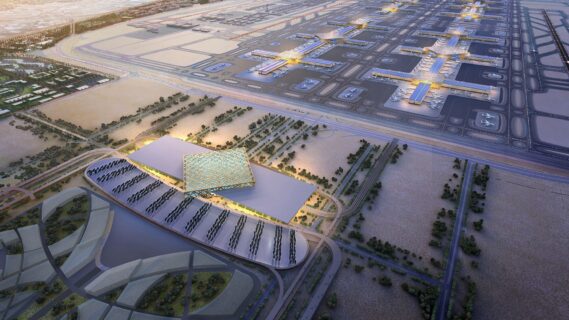
The expansion of Al Maktoum International Airport is the cornerstone of Dubai’s ambition to consolidate its position as the undisputed global epicenter of aviation. With a recently confirmed investment of AED 128 billion ($35 billion), the project aims to create the world’s largest airport, featuring five parallel runways and an ultimate capacity of 260 million passengers annually, five times the size of the current Dubai International (DXB). Dubai intends to utilize this “aerotropolis” to shift the city’s economic center of gravity southward, integrating advanced AI-driven logistics and biometric passenger processing to redefine the transit experience.
This aviation-led growth is inextricably linked to the city’s broader infrastructure evolution, most notably the Dubai Metro Blue Line, where primary tunneling works were officially inaugurated on May 3, 2026. Just as the Blue Line’s 15.5 km of underground tunnels are designed to seamlessly connect high-density hubs like Dubai Creek Harbour and Academic City to the existing rail network, they provide the technical blueprint for the massive subterranean connectivity required at DWC. The airport expansion itself features a 14-station automated people-mover (APM) system running beneath the apron, reflecting the same Dubai 2040 Urban Master Plan strategy: using deep-earth infrastructure to bypass surface congestion and ensuring that the world’s largest aviation hub is supported by a transit system capable of moving millions with pinpoint efficiency.
June 13, 2024
Dubai is expected to commence the construction works on the brand new passenger terminal as part of its $35bn expansion of Al Maktoum International airport which is also set to be the World’s Largest Airport, by the end of this month.
Media reports citing Emirates president Tim Clark stated, “the work is expected to commence in the coming two to three weeks”.
In the month of May, Dubai invited interested contractors to express interest in the airport project’s infrastructure works.
The project client, Dubai Aviation Engineering Projects, issued the expression of interest notice last month and the last date for submission was at 20th of May.
Dubai approved the updated designs and timelines for its largest construction project in the month of April.
Size of the World’s Largest Airport
Covering an area of 70 square kilometers in the south of Dubai, the upcoming airport project will have a total of five parallel runways and five terminal buildings with a total of 400 aircraft gates. It will be five times the size of the existing Dubai International airport and have the world’s largest passenger handling capacity of 260 million passengers a year. For cargo, it will have the capacity to handle up to 12 million tonnes a year.

The government of Dubai mentioned that the plan is for all operations from Dubai International airport to be transferred to Al Maktoum International airport within a period of 10 years. The first phase, capable of accommodating 150 million passengers per year, will also be completed within 10 years.
The government statement also revealed that the project will create housing demand for 1 million people living around the airport.
Project history
The expansion of Al Maktoum International airport is a long-standing project. Also dubbed as Dubai World Central (DWC), it was officially launched in the year 2014, with a different design to the one approved in April 2024. Back then, it involved the construction of the biggest airport in the world by 2050, with the capacity to handle 255 million passengers a year.
An initial phase, due to be completed in the year 2030, involved increasing the airport’s passenger capacity to 130 million passengers a year. The airport development project was to cover an overall area of 56 square kilometres.

Progress on the project slipped as the region grappled with the impact of lower oil prices and Dubai focused on developing the Expo 2020 site. Tendering for work on the project then stalled with the onset of the Covid-19 pandemic in early 2020. Upon completion, Al Maktoum International Airport, which opened in the year 2010, will be the new home of flagship carrier Emirates featuring a remarkable five parallel runways and 400 aircraft gates. The Al Maktoum International Airport project is not just about meeting current aviation needs; it anticipates future needs by integrating very advanced technologies, sustainable infrastructures, and improved connectivity. By aligning its objectives with the UAE’s vision for sustainability, the new airport aims to reduce environmental emissions and achieve LEED Gold certification in future.
Also read: World’s Largest Airport Project Kicked Off in Dubai
$2 Billion Rwanda’s Bugesera Airport Operations Commencement Set at 2028
UK’s Top 10 Largest and Busiest Airports: London Dominates the Top Three