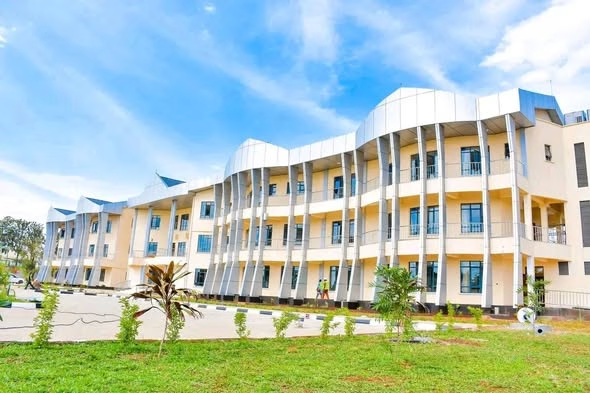
The East African Community (EAC) has launched the ksh440 million Lake Victoria basin headquarters in Kisumu. The complex marks one of the most significant joint regional investments undertaken by EAC member states in recent years. Furthermore, the state-of-the-art facility was built and financed jointly by taxpayers across the region. It is expected to enhance cooperation in management of Africa’s largest freshwater basin. Moreover, it will strengthen the commission’s role in research, policy coordination and environmental governance.
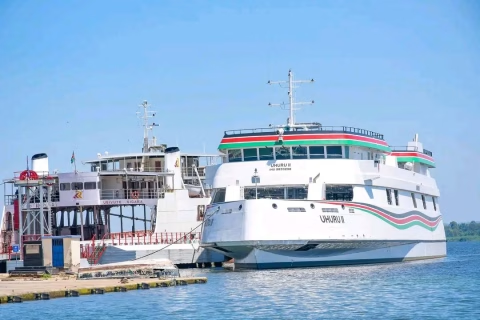
The launch was attended by regional leaders and diplomats. It was led by Kenya’s Cabinet Secretary for East African Community Affairs Beatrice Askul. She represented President William Ruto in his capacity as chair of the EAC Heads of State Summit. “This headquarters is more than a building; it is a commitment to the livelihoods and prosperity of millions who depend on Lake Victoria,” Askul said. Furthermore, she noted that more than 45 million people across Kenya, Uganda, Tanzania, Rwanda, Burundi and South Sudan rely on the lake. Other than the headquarters, projects such as the Lake Victoria Marina highlight infrastructure development along the Lake Victoria basin. Either for administrative or real estate purposes, the Lake Victoria basin is developing at an accelerating pace.
The State of Affairs Regarding the Lake Victoria Basin Headquarters
The commissioning of the Lake Victoria basin headquarters caps a process that began in 2008 when Kenya allocated 2.8 hectares along the Kisumu lakeshore. Construction commenced in 2020 after partner states jointly approved the project and agreed to split the financing equally. LVBC Executive Secretary Dr. Masinde Bwire said the building stands as a symbol of regional unity. He also noted it represents commitment to shared development goals. “This achievement is entirely funded by the people of East Africa through their governments,” he said.
“It shows our collective resolve to invest in our future.” Bwire also noted that the headquarters will serve as a hub for various aspects. These include climate resilience research, policy harmonization, transboundary resource management and regional operations. It is also expected to host high-level meetings, create local jobs and further cement Kisumu’s profile as a diplomatic, business and conference destination. Representatives from the World Bank, GIZ, UNEP, UNESCO, the African Development Bank and the European Union also attended the ceremony
Leave a Reply